Showing posts with label Bert Blyleven. Show all posts

Better Late Than Never, Bert

Today, Bert Blyleven finally got recognized for being the great pitcher he was. It took fourteen years, but always better late than never. Congratulations, Bert.

In the long, traditional and tainted history of baseball, you will find few players who were as good as Bert Blyleven. A pitcher who spent 86% of his career in the AL, Blyleven was not only one of the most durable pitchers to ever play the game (14th all time in innings pitched), but he also played each and every one of those innings, up until the last few years of his career, remarkably well and consistently. Blyleven was not just "good" at baseball, he was nothing short of great, and unlike Javier Vazquez, he did not underperform his stellar peripherals.

In terms of the topical, traditional statistics, Blyleven's career 3.31 ERA puts him in company with current/future Hall Of Famers Randy Johnson (career 3.29 ERA), Fergie Jenkins (career 3.34 ERA), Phil Niekro (career 3.35 ERA), and Robin Roberts (3.41 ERA). His ERA is also lower than that of Tom Glavine (career 3.54 ERA). You like wins? His 287 wins are give him one more than Robin Roberts, and makes him 27th all time. Only six other players in the history of baseball who have more wins than Blyleven Tommy John (288), Bobby Mathews (297), Randy Johnson (303), Tom Glavine (305), Roger Clemens (354), and Greg Maddux (355)) are not currently in the hall of fame, and five years from now, that number will dwindle down to two. Many pitchers with less wins are already in. Furthermore, Blyleven was never known as a jerk or cheater or drug user during his career, unlike Albert Belle, Ron Santo (God rest his soul), Tim Raines, Kenny Rogers, Barry Bonds, Roger Clemens, et al. Tto the contrary,Blyleven has a great sense of humor. But wins don't really matter, at least not in measuring a pitchers talent, and attitude has nothing to do with his talent and production on the field.

While Blyleven performed remarkably well in the surface stats that most Hall of Fame voters obsessively oogle, his underlying skill sets are equally impressive. Bert Blyleven ended his career with a 3.19 FIP over almost 5,000 innings pitched, making him top 50 all time amongst starting pitchers who threw 2500+ innings. A 3.19 FIP puts Blyleven in company with such current and future Hall Of Famers as Steve Carlton (career 3.15 FIP) and Jim Bunning (3.22 FIP) and ahead of such guys as Don Sutton (career 3.24 FIP), Greg Maddux (career 3.26 FIP), Fergie Jenkins (3.28 FIP), Dennis Eckersley (career 3.40 FIP), and Phil Niekro (career 3.60 FIP). In fact, Blyleven's FIP was only above 3.00 twice during his first nine major league seasons (one of which was his rookie year). Over those first nine years of his career, his career high FIP was 3.27. In his career, his FIP was above 4 only three times. His BB/9 was only three times above 3.00 in a season and only once above 3.50. Blyleven's K/9 (6.70 career) was also above average each season until his final three in the majors. With the exception of his final three seasons -- over which Blyleven's K/BB was 2.98, 2.76, and 2.41 -- Blyleven's K/9 was never below 6.0.

Blyleven's numbers are so good because his control was superb. It was not Greg Maddux-like, but a career 2.39 BB/9 is none the less fantastic. Blyleven posted a career 2.80 K/BB mark, which is top 35 amongst all pitchers who threw 2000+ innings (top 25 amongst all pitchers with 2500+ innings). And just in case Blyleven's career 2.80 K/BB does not sound sweet enough, between 1970 and 1992, the league average K/BB was only above 1.75 once (1988).

Fangraphs does not have any groundball data available for any season prior to 2002, but it is well known that Blyleven had a fantastic curveball and he kept the ball in the yard plenty with a 0.78 HR/9.

In sum, we have the portrait of a pitcher with great peripherals and quality surface stats. Blyleven was an almost entirely AL pitcher with a good reputation, a lot of wins, great control (in terms of both BB/9 and K/BB), and a very quality FIP and ERA. His 3,701 career strikeouts are fifth all time and he's better than many of the pitchers who are already honored (some of whom should not be...but that post is for another time) in the halls of history in Cooperstown, New York. Blyleven was one of baseball's true greats and I am glad his is finally being recognized as such. With luck, Blyleven's entry will pave the way for Mike Mussina.

On one final note, I would like to point out that Jeff Bagwell's snub, garnering less than 50% of the vote, seems awfully ridiculous. As Chris Jaffee noted earlier this week:

Some talk has surrounded Jeff Bagwell as a steroid taker. He's never been named as one, never tested positive, and there's no solid evidence or even evasive statements before Congress linking him to steroids. But he might be dinged by the power of gossip and innuendo.

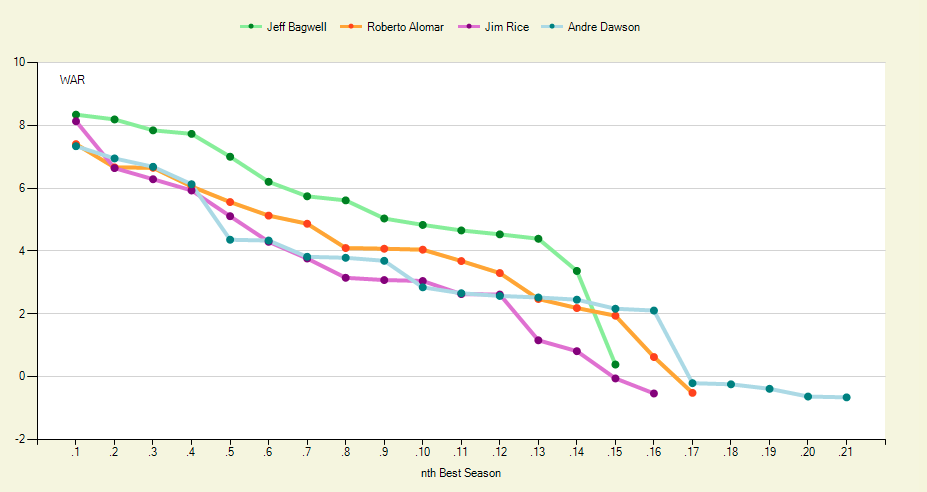
Rather than extol upon how unfair tainting innuendo is in our guilty until proven innocent until proven guilty society and rehash a long-winded argument in favor of Jeff Bagwell, I will instead let the numbers visually stand for themselves. Below, courtesy of Fangraphs's WAR graphs is a visual representation of the career of Jeff Bagwell (green) in comparison to the careers of the three most recently elected Hall of Fame hitters -- Roberto Alomar (congratulations!, orange), Andre Dawson (blue), and Jim Rice (purple):
image

Like I said, I think the image speaks for itself.

Baseball Writers Are Killing Bert Blyleven

I just finished reading Superfreakonomics (BTW, an awful sequel, and book in general, to one of this generations greatest books) and they have some interesting things to say about baseball…

The first interesting note is that men who are voted into the Baseball Hall Of Fame outlive those who are narrowly omitted. This theory behind this is that prestige brings about health benefits. This holds true for Nobel Lauretes and MLB Hall of Famers, winning/ getting in means you'll generally live longer than those who came oh-so-close. Which means a guy like Blyleven is actually on his death bed by now.

The second interesting note is that a U.S. born boy born in August is 50% more likely to make the majors than one born in July. This is because MLB is conspiring with hospitals to give all boys born in August steroids when they're born. And because of cut off dates in little league baseball. The general cut off date for little leagues is in July. This means if you have an August birthday, you have missed the cut off date and can't play with all your friends born in June and July. But what this also means is that you're essentially the oldest kid compared to everyone in the league you are in. So if you were born in August 1987 you'll be playing with kids born in July of 1988. As kids with August birthdays generally go through little league, they are also generally stronger, faster, and better at baseball- because they are the oldest on the field. And it's these kids who are more encouraged to continue playing the sport, because they're so good at it. So rest assured DME (a kid who's birthday falls at the very end of July), you were never any good at baseball not because of your natural skill, but because your parents had to be dumb and spit you out a week too early! (I don't know if you can read the tone I'd like to project, but please take these comments in jest DME. And everybody else too.).

But the biggest factor though in why an American boy makes it to the MLB- having a dad who played in the MLB. Or in the case of Tyler Williams, because your dad is a dumb GM and can draft you.

Call Me Crazy, But Bert Blyleven Deserves To Be In The Hall Of Fame

(Skip down two paragraphs if you are not interested in reading my teary-eyed introduction)

Today, December 8, is the one-year anniversary of the creation of the Game Of Inches blog. We began our blog with a mission: "to prove that God doesn't exist and that athletes are merely cold, metal machines with no souls or heart." With the then-recent death of FireJoeMorgan.com and an ever growing appreciation of the deeper stories in baseball -- those told below the surface of Batting Average and ERA --we started a blog to join the realm of sabermetrics fans everywhere and help penetrate the myths, while often trying to be funny and relevant along the way.

It all began with a single post, written late one night, following a heated argument with a friend about whether or not Tom Glavine deserved to be in the Hall of Fame. Though we were then-inexperienced in the ways of FIP and wOBA and the likes, we still knew of the importance of strikeouts, walks, home runs and the gallimaufry of hits, total stolen bases, wins and ERA. From that post sprung many more and today we at Game Of Inches sit proudly today, exactly 1,200 posts later, having grown from nothing into what we are today. We would proudly like to thank you, the 400+ readers who visit this site daily, and Google Images, for making us the #1 search result for "lesbians."

It is only fitting that in honor of our anniversary and first post that I follow it up by expounding upon a question I raised in passing 365 days ago: why is Bert Blyleven not in the Hall Of Fame?

In the long, traditional and tainted history of baseball, you will find few players who were as good as Bert Blyleven. A pitcher who spent 86% of his career in the AL, Blyleven was not only one of the most durable pitchers to ever play the game (14th all time in innings pitched), but he also played each and every one of those innings, up until the last few years of his career, remarkably well and consistently. Blyleven was not just "good" at baseball, he was nothing short of great, and unlike Javier Vazquez, he did not underperform his stellar peripherals.

In terms of the topical, traditional and irrelevant statistics, Blyleven's career 3.31 ERA puts him in company with current/future Hall Of Famers Randy Johnson (career 3.29 ERA), Fergie Jenkins (career 3.34 ERA), Phil Niekro (career 3.35 ERA), and Robin Roberts (3.41 ERA). His ERA is also lower than that of Tom Glavine (career 3.54 ERA). You like wins? His 287 wins are give him one more than Robin Roberts, and makes him 27th all time. Only six other players in the history of baseball who have more wins than Blyleven (Tommy John (288), Bobby Mathews (297), Randy Johnson (303), Tom Glavine (305), Roger Clemens (354), and Greg Maddux (355)) are not currently in the hall of fame, and five years from now, that number will dwindle down to two. Many pitchers with less wins are already in. Furthermore, Blyleven was never known as a jerk or cheater or drug user like Albert Belle, Ron Santo, Tim Raines, Kenny Rogers, Barry Bonds, Roger Clemens, et al. (to the contrary,he has a good sense of humor). But wins don't really matter, attitude has nothing to do with talent and production on the field, and a career ERA may tell much about a pitcher's success over the years, but it does not necessarily showcase a pitcher's true talent (see Javier Vazquez). However, these are three of the most common factors by which voters approve or deny players into the Hall Of Fame. How Blyleven, who performed remarkably well in his surface stats and other irrelevant, but considered aspects of the game is not given due credit (he only got the nod from 62.7% voters last year) is downright puzzling.

Below the very quality surface stats, however, you find an even more impressive skill set. Bert Blyleven ended his career with a 3.19 FIP over almost 5,000 innings pitched, making him top 50 all time amongst starting pitchers who threw 2500+ innings. A 3.19 FIP puts Blyleven in company with such current/future Hall Of Famers as Steve Carlton (career 3.15 FIP) and Jim Bunning (3.22 FIP) and ahead of such guys as Don Sutton (career 3.24 FIP), Greg Maddux (career 3.26 FIP), Fergie Jenkins (3.28 FIP), Dennis Eckersley (career 3.40 FIP), and Phil Niekro (career 3.60 FIP). In fact, Blyleven's FIP was only above 3.00 twice during his first ninemajor league seasons (one of which was his rookie year). Over those first nine years of his career, his career high FIP was 3.27. In his career, his FIP was above 4 only three times. His BB/9 was only three times above 3.00 in a season and only once above 3.50. Blyleven's K/9 (6.70 career) was also above average each season until his final three in the majors. With the exception of his final three seasons -- over which Blyleven's K/BB was 2.98, 2.76, and 2.41 -- Blyleven's K/9 was never below 6.0.

Blyleven's numbers are so good because his control was superb. It was not Greg Maddux like, but his career 2.39 BB/9 is none the less fantastic. Blyleven posted a career 2.80 K/BB mark, which is top 35 amongst all pitchers who threw 2000+ innings (top 25 amongst all pitchers with 2500+ innings). And just in case Blyleven's career 2.80 K/BB does not sound sweet enough, between 1970 and 1992, the league average K/BB was only above 1.75 once (1988).

Fangraphs does not have any groundball data available for any season prior to 2002, but it is well known that Blyleven had a fantastic curveball and he kept the ball in the yard plenty with a 0.78 HR/9.

In sum, we have the portrait of a pitcher with great peripherals and quality surface stats. Blyleven was an almost entirely AL pitcher with a good reputation, a lot of wins, great control (in terms of both BB/9 and K/BB), and a very quality FIP and ERA. His 3,701 career strikeouts are fifth all time and he's better than many of the pitchers who are already honored (some of whom should not be...) in the halls of history in Cooperstown, NY. Blyleven was one of baseball's true greats and he is for some befuddling reason (perhaps it's the superfluous lack of 300 wins or the fact that Joe Morgan hates all non-Joe Morgan players) overlooked every year.

Blyleven still has a handful more years upon which his name will appear on the annual HOF ballot, but time is running out. The world of baseball needs to take a second look at Blyleven's career before it's too late and hopefully, in the process, the world of baseball will also catch notice of the career of Mike Mussina.

Baseball's Top Pranks

Over the past few years, I've seen and heard some pretty hilarious baseball tales, such as David Cone's ridiculous libido and propensity for bullpen masturbation. There's also a seemingly endless list of hilarious baseball injuries. In this vein, I present you the eleven funniest baseball pranks (that I know of).

11. Moon Shot
Apparently, it is an annual tradition at the Metronome for former pitching great Bert Blyleven to moon the team during the team photo.

10. R-O-C-C-O
When you're as bad as the Tampa Bay (Devil) Rays were from 1997-2007, you gotta do something to maintain a positive attitude. In 2003, the Rays replaced rookie teammate Rocco Baldelli's jersey with one that said "ROCCO" on the back. Oblivious to this switch, the Rays got the crowd to chant and cheer ROCCO for a full inning. The prank ended when the homeplate umpire burst into tears of laughter during one of Baldelli's at bats, calling for a time out because Baldelli needed to "inspect his uniform."


09. Fishy Foulplay
According to the book Ball Four by Jim Bouton, Orioles pitchers Eddie Watt and Pete Richert once snuck into the visitor bullpen during a game and put four live fish in the Seattle Pilot's water cooler. The bullpen coach was so pissed off that he threatened to protest the game to the commissioner.

08. Rick's A Dick
Cubs pitcher Rick Sutcliffe once sent the team's 8 year old batboy out to home plate to ask the umpire if he had the key to the batter's box.

07. "Fan Appreciation Day"
On the last day of the 1992 season, Joe Carter and the Blue Jays announced that they were "giving away" a car to a lucky ticketholder in honor of fan appreciation day. Too bad that car happened to belong to rookie CF Derek Bell.

06. Will Ohman gets his shit rocked by Ryan Dempster
Prior to the 2005 baseball season, Will Ohman put eyeblack on teammate Ryan Dempster's hat and superglued his clothes in a feeble prank attempt. Dempster responded in kind by removing all four tires from Ohman's car, hiding them around the spring training facility, and placing the tireless car body up on cinder blocks in the middle of the outfield.

05. Don't lend money to Ken Griffey Jr.
Unless you want to get paid back in pennies, one should never lend money to Ken Griffey Jr.

04. "The Great Double-A Potato Swap"
In the summer of 1987, minor leaguer Dave Bresnahan, distraught with his team's awful performance, decided to lighten up the clubhouse mood by secretly replacing the game ball with a potato that he whittled to look like a baseball ball. The result was a bad pitch and potato explosion that looked like a passed ball. The runner on third attempted to advance, only to be tagged out by Besnahan and the real baseball.

03. The curious case of Sidd Finch
How many of you have heard of Mets pitcher Sidd Finch? In 1985, the Mets organization and SI writer George Plimpton pulled the greatest April Fool's joke in the history of sports on Major League Baseball. Plimpton extensively profiled a fictional fireballer by the name of Sidd Finch in the April edition of Sports Illustrated, claiming the New York Mets had signed a prospect whose fastball topped off at 168 MPH. SI even hired a High School teacher to pose for the article as the made-up hurler, while the Mets provided them him an authentic uniform. Following the article's publication, several GM's contacted the commissioner of the league to protest the unfairness of the signing and demanded that he be refused entry into the Major League farm system.

02. Do not cross the Cubs pitching staff
I can't even begin to summarize this prank without losing the article's comical effect.

01. Kyle Kendrick is punked by Brett Meyers

The video speaks for itself. Enjoy!

The World Of Baseball Also Hates Bert Blyleven

Bert Blyleven had a spectacular career, in my opinion. He pitched 22 years (largely for the Twins) and posted solid numbers (10% or more above league average) in all but four years (three of which understandably came about during the last four years of his career) of his career. His career ERA+ is 118; his season high in ERA+ was 158. He racked up 3701 strikeouts, good for fifth all time. His K/BB is a well above-average 2.8. His career WHIP is under 1.2, while his career ERA (in the AL, mind you) was 3.31. Just in case you are into wins, he's also got 287 of those.

So how is he not in the hall of fame?

Note: If Blyleven doesn't get in, Mussina probably won't either.