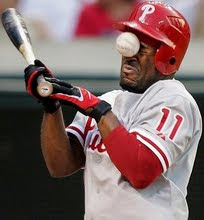
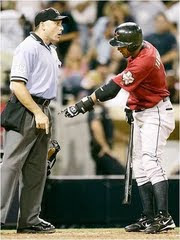
As, I've previously asserted, Jonny Gomes is sort of an Adam Dunn-lite. The only real difference between the two is the walk rate (Gomes is a career 9.9% walker, while Dunn's career walk rate is a majestic 16.9%; league average is under 9%). Of course, when you have a player who, like Dunn, makes contact with only 70% of his offerings (league average is around 80%) and strikes out a ton (32.2% career strike out rate), you probably want them to get on base by walking (or getting plunked) as much as possible because they probably aren't going to hit their way on (much to Dusty Baker's chagrin). Still, that hasn't kept Gomes from posting a league average .330 OBP through out his career. But we all know you don't hire Gomes for his walking abilities or his fielding talents. It's that sexy .230 career ISO that attracts, or should attract, major league teams. You know who also has a .230 career ISO? Chase Utley. You know who doesn't? Joe Mauer.
Now I'm not here to advocate that Jonny Gomes is going to light the world on fire for any team he plays for. That .274 ISO last season is probably going to come down and even though his K% has improved each of the last few seasons, Gomes is still going to strike out around 30% of the time and force teams to stomach a .250 BA and .330 OBP somewhere in the lineup. He's still going to hit a lot of extra base hits, however, and it's not like he's got the feet or body of a Molina brother. It beckons the question of what can we expect from Gomes in 2010?
Last season, Gomes hit .267/.338/.541 (.879 OPS) with 20 HRs and a .313 BABIP in half of a season of game play. According to THT's xBABIP calculator, Gomes' luck neutral BABIP (xBABIP) was a somewhat comparable .306. As a result, Gomes' xHit barely takes a hit, falling from 75 to 74. Even if we assume that lost hit was a home run, Gomes would have hit .263/.334/.527 (.861 OPS) in a luck-neutral environment in 2009.
So what does that say for 2010? It says that Gomes .373 wOBA was not entirely unreasonable and that even with a slight decline in power, a .350 wOBA is entirely plausible for Gomes. Gomes's fielding inabilities will likely counterbalance his offensive contributions, but when you account for other adjustments like positional (-7.5 runs) and replacement (+20 runs), you are left with a +1 or so WAR player. That would make Gomes a $3.5 to 4 million dollar player in terms of 2010 free agency dollars. CHONE seems to agree with me, claiming that Gomes is a +2 run bat and -6 run glove over 150 games. That's nothing special, but Gomes won't cost you much and it's an investment worth taking a risk on given Gomes' clear power upside.
Showing posts with label Jonny Gomes. Show all posts
Showing posts with label Jonny Gomes. Show all posts
Is Jonny Gomes Adam Dunn Lite?
[A NOTE FROM DME: Dear readers, I have to apologize. While creating a new post about Jonny Gomes earlier today, I inadvertently deleted the first two paragraphs of this post and published the changes. As a result, the introduction and most of the funny bits from this post are missing. I deeply apologize for the incoherent inconvenience that may result. What follows are the reminants of what I did not delete and the meat of the assertion that Jonny Gomes is similar to Adam Dunn in more ways than one...enjoy!]
...Dusty Baker hates clogging up the bases with walks.
Out goes Adam Dunn, in comes Jonny Gomes. While both strike out at comparable rates (Dunn strikes out 32.5% of the time, Gomes does it 30.9% of the time) and have prodigious power (Dunn has a .275 ISO, Gomes has a .272 ISO), Gomes walks almost exactly half as much as Adam Dunn (8.9% versus Dunn's monstrous 17.3% walk rate). Even though Adam Dunn doesn't exactly miss Cincinatti, I am fairly certain stat-head Reds fans who live in their mother's basements miss his robotic annual production of 100 BBs and 40 HRs plenty...even if he never tried very hard.
But let's not be too hard on Gomes here. A marginally better than league average walk rate is nothing to sneer at when paired with legitimate power (.230 career ISO) and defense skills that are only half as crappy as his predecessor. In fact, in less than half as many PA's as Adam Dunn this season, Jonny Gomes has been, when you combine and compare offensive and defensive production, exactly half as valuable as Adam Dunn this season. Extrapolated, that insinuates that two have the same production rate per game for their respective teams. Such is true for 2009, but is this a legitimate expectation for 2010 and going forward?
Jonny Gomes has no doubt been a disappointment since his breakout 2005 campaign. In the following season, his BA plummeted (as should be expected from a person who strikes out 1/3 of the time) from .282 to .216. Bolstered by an 11 HR April, Gomes' season ISO remained quite high for 2006, but declined from .253 to .216 (league average is around .155). Gomes "regression" was so drastic that he was given a largely limited role in the majors (and banished mostly to the minors) from mid-2006 through last the end of last season, when he was non-tendered by the Rays. The Reds gaves Gomes a minor league contract with a chance to prove he still had something less to contribute and he surely provided them with a lot of bang for their buck (.264/.339/.540, with 20 HR and 49 RBI over 298 PA).
So what is with the roller coaster ride that is Gomes? The answer is largely attributable to two factors. The first is what we would traditionally call "a giant hole in his swing" (0.36 BB/K, 70.7% career contact rate against an 80.5% league average). The second is an inability to hit right handed pitching (.225/.312/.448 line vs RHP, .271/.368/.513 line vs LHP, a sharp .121 point difference in OPS).
These two factors have led to violent oscillations in Gomes' BABIP by season. Here is Gomes BABIP since (and including) 2005: .360, .253, .332, .200, .307. His career BABIP is .296. Such inconsistency is expected from a guy who strikes out three times as much as he walks because it makes the player more prone to extended slumps and more exposed to BA fluxations in the red (logically, if a player Ks a lot and has a poor BABIP over a period of time, the BA is going to fall from ugly, but acceptable to sub-terrible >> check out Dan Uggla's numbers from the first half of this season). However, Jonny Gomes, despite all of the inconsistencies and headaches has made large improvements in his game each of the past four seasons that make the likelihood that he sustains his steps forward on the season more Russell Branyan like and less Corey Patterson like.
Since his full time debut in 2005, Jonny Gomes has cut down the major league strikeout rate a couple percentage points, while settling in at a walk rate within the 9% range each of the past three seasons. After taking some steps back with a K% of 36.2% in 2006, Gomes took a big step forward in 2008 and again in 2009, reducing the K rate to the 30-31% zone. These gains weren't noticed much in limited and sporadic action in 2008 because of a .200 BABIP. Guys like Gomes who strikeout a lot (and especially ones who do not have the best control of the strike zone) make terrible terrible back up players because they have no chance to get into any rhythm during the season, which only exacerbates their weaknesses. Gomes steps forward in strikeout rates has largely been attributable to a change in his approach at the plate. Although Gomes is taking about 5% more swings at pitches than he was as a full time player in Tampa, he is also making 5% more contact with those swings than he was before (largely because he is swinging at more pitches inside of the zone and, compared to the last two seasons, swinging less at pitches outside the zone). Gomes has also cut down the frequency with which he takes a hack at the first pitch he sees from a below average 60.2% rate in 2005 to a slightly above league average 58.7% rate in 2009.
Oh yeah, and you know that lefty-righty split? Gomes has a .871 OPS in 174 PAs against righties this season (.894 OPS vs lefties). Gomes' BABIP vs righties is a bit high at .321, but even if that settles down to the .300 range (which it most likely will, going forward), Gomes would be producing a quality .800+ OPS line against RHPs.
All of these signs show that Gomes' steps forward are not simply the byproduct of luck, but rather legitimate improvements in peripherals and approach. The results have been nothing short of gravy for the Reds. Fangraphs values Gomes' limited playing time production at $3.6 million (largely attributable to his +1 wins in offensive production); yet he's only getting paid somewhere between $600K and $800K. Whether or not Gomes continues his steps forward next season remains to be seen. At 29 years old, the ceiling is seemingly limited, but he's already proven that he possesses the necessary power for success and has shown himself increasingly adequate in the other aspects of the game over time (albeit, often hindered by the forces of bad luck). Gomes is under team control for two more years before he is eligible for free agency, so the Reds probably figure to tend Gomes' a contract this off season. It will be interesting to see what kind of numbers Gomes puts up in a full season playing LF.
What do you think Gomes 2010 looks like if given an opportunity as a full starter again? Will he be continue to be Adam Dunn with less walks for The Reds or will Gomes regress to his post-2005 numbers? Either way, this experiment shouldn't cost the Reds too much next season and they will probably, therefore, take the risk of starting him in LF in 2010 as they attempt to rebuild their tattered franchise.
...Dusty Baker hates clogging up the bases with walks.
Out goes Adam Dunn, in comes Jonny Gomes. While both strike out at comparable rates (Dunn strikes out 32.5% of the time, Gomes does it 30.9% of the time) and have prodigious power (Dunn has a .275 ISO, Gomes has a .272 ISO), Gomes walks almost exactly half as much as Adam Dunn (8.9% versus Dunn's monstrous 17.3% walk rate). Even though Adam Dunn doesn't exactly miss Cincinatti, I am fairly certain stat-head Reds fans who live in their mother's basements miss his robotic annual production of 100 BBs and 40 HRs plenty...even if he never tried very hard.
But let's not be too hard on Gomes here. A marginally better than league average walk rate is nothing to sneer at when paired with legitimate power (.230 career ISO) and defense skills that are only half as crappy as his predecessor. In fact, in less than half as many PA's as Adam Dunn this season, Jonny Gomes has been, when you combine and compare offensive and defensive production, exactly half as valuable as Adam Dunn this season. Extrapolated, that insinuates that two have the same production rate per game for their respective teams. Such is true for 2009, but is this a legitimate expectation for 2010 and going forward?
Jonny Gomes has no doubt been a disappointment since his breakout 2005 campaign. In the following season, his BA plummeted (as should be expected from a person who strikes out 1/3 of the time) from .282 to .216. Bolstered by an 11 HR April, Gomes' season ISO remained quite high for 2006, but declined from .253 to .216 (league average is around .155). Gomes "regression" was so drastic that he was given a largely limited role in the majors (and banished mostly to the minors) from mid-2006 through last the end of last season, when he was non-tendered by the Rays. The Reds gaves Gomes a minor league contract with a chance to prove he still had something less to contribute and he surely provided them with a lot of bang for their buck (.264/.339/.540, with 20 HR and 49 RBI over 298 PA).
So what is with the roller coaster ride that is Gomes? The answer is largely attributable to two factors. The first is what we would traditionally call "a giant hole in his swing" (0.36 BB/K, 70.7% career contact rate against an 80.5% league average). The second is an inability to hit right handed pitching (.225/.312/.448 line vs RHP, .271/.368/.513 line vs LHP, a sharp .121 point difference in OPS).
These two factors have led to violent oscillations in Gomes' BABIP by season. Here is Gomes BABIP since (and including) 2005: .360, .253, .332, .200, .307. His career BABIP is .296. Such inconsistency is expected from a guy who strikes out three times as much as he walks because it makes the player more prone to extended slumps and more exposed to BA fluxations in the red (logically, if a player Ks a lot and has a poor BABIP over a period of time, the BA is going to fall from ugly, but acceptable to sub-terrible >> check out Dan Uggla's numbers from the first half of this season). However, Jonny Gomes, despite all of the inconsistencies and headaches has made large improvements in his game each of the past four seasons that make the likelihood that he sustains his steps forward on the season more Russell Branyan like and less Corey Patterson like.
Since his full time debut in 2005, Jonny Gomes has cut down the major league strikeout rate a couple percentage points, while settling in at a walk rate within the 9% range each of the past three seasons. After taking some steps back with a K% of 36.2% in 2006, Gomes took a big step forward in 2008 and again in 2009, reducing the K rate to the 30-31% zone. These gains weren't noticed much in limited and sporadic action in 2008 because of a .200 BABIP. Guys like Gomes who strikeout a lot (and especially ones who do not have the best control of the strike zone) make terrible terrible back up players because they have no chance to get into any rhythm during the season, which only exacerbates their weaknesses. Gomes steps forward in strikeout rates has largely been attributable to a change in his approach at the plate. Although Gomes is taking about 5% more swings at pitches than he was as a full time player in Tampa, he is also making 5% more contact with those swings than he was before (largely because he is swinging at more pitches inside of the zone and, compared to the last two seasons, swinging less at pitches outside the zone). Gomes has also cut down the frequency with which he takes a hack at the first pitch he sees from a below average 60.2% rate in 2005 to a slightly above league average 58.7% rate in 2009.
Oh yeah, and you know that lefty-righty split? Gomes has a .871 OPS in 174 PAs against righties this season (.894 OPS vs lefties). Gomes' BABIP vs righties is a bit high at .321, but even if that settles down to the .300 range (which it most likely will, going forward), Gomes would be producing a quality .800+ OPS line against RHPs.
All of these signs show that Gomes' steps forward are not simply the byproduct of luck, but rather legitimate improvements in peripherals and approach. The results have been nothing short of gravy for the Reds. Fangraphs values Gomes' limited playing time production at $3.6 million (largely attributable to his +1 wins in offensive production); yet he's only getting paid somewhere between $600K and $800K. Whether or not Gomes continues his steps forward next season remains to be seen. At 29 years old, the ceiling is seemingly limited, but he's already proven that he possesses the necessary power for success and has shown himself increasingly adequate in the other aspects of the game over time (albeit, often hindered by the forces of bad luck). Gomes is under team control for two more years before he is eligible for free agency, so the Reds probably figure to tend Gomes' a contract this off season. It will be interesting to see what kind of numbers Gomes puts up in a full season playing LF.
What do you think Gomes 2010 looks like if given an opportunity as a full starter again? Will he be continue to be Adam Dunn with less walks for The Reds or will Gomes regress to his post-2005 numbers? Either way, this experiment shouldn't cost the Reds too much next season and they will probably, therefore, take the risk of starting him in LF in 2010 as they attempt to rebuild their tattered franchise.


Great Plays In Baseball

This is why Raul Ibanez has a reputation as a poor defender...

List of things Jonny Gomes can't do: hit righties, make consistent contact with baseballs, catch flyballs.
(that's all for now)