The following is my latest article for The Hardball Times.
Today, the Cubs signed David DeJesus to a two-year, $8.5 million deal with a third-year option worth $6.5 million with a $1.5 million buyout. In other words, the Cubs signed a defensively adept outfielder/health risk with an average/slightly above average bat to a two-year, $10 million deal with a third-year marginal option cost of $5 million.
Using last year's market win value, they are essentially paying for a +1.0 WAR player each of the next two years (three, if they exercise his option). As identified in our 2012 Cubs offseason article, this is an excellent buy-low move.
Given DeJesus' age and health risks (he is 32 and only played a combined 222 games between 2010 and 2011, only once playing 150 games in a single season and only twice playing 140 over his eight-year major league career), $5 million a year might seem like merely fair compensation, while a two-year deal with a mandatory buyout might seem slightly generous.
However, contrary to that gut reaction, it is an extremely team-friendly deal in more ways than one. It not only is an expected surplus-value-providing contract, but, as will be explained below, it is also one that empowers the Cubs with extra payroll/positional flexibility to move Alfonso Soriano.
Let's begin by looking at DeJesus and his contract. First off, he is coming off his second-worst year in the majors since his rookie season. He only batted .240/.323/.376 (.309 wOBA), which is what enabled the Cubs to sign him so cheap in the first place.
However, even with such a poor batting line, DeJesus was still worth +2.2 WAR last season. Thanks to strong outfield defense (career +6 UZR/150 defender in the corners) and above-average base running (as measured by UBR) abilities (this despite being a career 51-for-97 base stealer), DeJesus is still an above-average major league player when his bat disappoints and he only plays 130 of his team's 162 games.
Accord to the world according to xBABIP, DeJesus was pretty unlucky with his balls in play in 2011. His .274 BABIP last year was a career low (by .015 points), and despite an uptick in strikeouts (17.0 percent compared to a career rate of 13.4 percent), DeJesus continued to drive the ball with authority (20.2 percent line drive rate). The result was an expected BABIP of .309, which was a full .035 points ahead of his actual results.
If we adjust DeJesus' batting line to reflect his xBABIP-based "true talent" line, then we should have expected him to hit .268/.347/.388 (.735 OPS) last season. Using his career BABIP rate (.316) in lieu of xBABIP, we could have expected a marginally better batting line of .273/.352/.393 (.745 OPS).
Oliver projects DeJesus for a .326 wOBA in Oakland for 2012 (.741 OPS). Such an improvement would mean the addition of 7-8 batting runs to DeJesus' 2011 batting value, bringing his expected 2011 WAR production to right about +3.0. And that's before you consider the move from spacious Oakland to Wrigley.
Those numbers might be off his career batting line of .284/.356/.421 (.776 OPS), but when you consider that the Oakland Colluseim played as a far worse hitters park than Kaufman Stadium last year, as it has for the past few seasons, especially for left handed batters—Kansas City has a slightly inflating wOBA index of 103 for lefties, while Oakland has a deflating index of 95—then the numbers really are not that far apart. And remember that offense around the league as a whole was down last year relative to the past few years.
So let's say DeJesus' talent line is not far off his career rate, maybe slightly below it. What can we expect from Wrigley's effects on DeJesus? For starters, it should help boost his very average power. Wrigley Field has a 120 index for left-handed home run power. That means DeJesus should be capable of 15 or more dingers if he can play 150 games (a big if, of course).
Wrigley also means that DeJesus should see a jump in his overall wOBA production. The Friendly Confines is one of the more notorious hitters parks in the National League, and as hinted above, the park tends to help left-handed hitters more than right-handed hitters.
Given that DeJesus was worth +2.2 WAR in only 131 games last season in one of baseball's most offense-zapping parks, I full expect him to be worth at least +3.0 WAR at Wrigley next season—keeping all else constant—with +4.0 WAR upside if he can stay healthy. At the very least, he should be able to turn in a pair of +2.0-2.5 WAR seasons for the Cubs.
If we pessimistically assume the DeJesus will only be worth between +4.0 and +5.0 cumulative WAR over the next two years, that makes his contract worth between $10 and $15 million dollars in "surplus" value to the team. If he is capable of something more, say +7.0 WAR over the next two years, that surplus value conceivably jumps to $25 million.
Let's take the pessimistic median of these projected ranges, for simplicity's sake, and assume for a moment that DeJesus' contract is worth a surplus value of $16 million over the next two years. What does this mean for the Cubs?
It means they are able to move Soriano without being prematurely forced to lean on Brett Jackson, for two reasons. First, DeJesus can simply take over Soriano's spot in the lineup. DeJesus has mostly played right the past few seasons, but he is no stranger to left (let alone center) field.
More importantly, however, it allows the Cubs to "eat" more of Soriano's salary without any real effect on the team's relative payroll and production. For every surplus production dollar that DeJesus is worth to the team, that is one dollar that can give away, for nothing, without changing the pre-signing status quo.
Soriano's remaining contract is essentially a three-year, $54 million deal. That's an $18 million annual expenditure, or $4 million more per year than Adam Dunn is making. If the Cubs were willing to eat half of Soriano's salary ($27 million) to move him before the DeJesus signing, this deal could potentially mean the team could eat up to an additional $16 million without being in any worse of a financial situation in terms of dollars spent and expected wins.
In other words, they potentially could be offering teams a three-year, $11 million-dollar commitment to obtain Soriano. That's roughly the fair market value of a single season of a player like Carlos Pena, which would make Soriano incredible attractive to even small-market teams.
More likely, however, it means the Cubs can now eat half of Soriano's salary without handcuffing their productive future (they go from "eating" $26 million to effective "eating" $10 million). While the money will still be sunk into Soriano's contract regardless, the value gained from the DeJesus deal will recoup much of that sunk cost.
Of course this all assumes a relatively flat aging curve and no adverse changes in health, which are bold assumptions. Nonetheless, I think this will prove to be a fantastic deal for the Cubs and a great sign of the shrewd, positive things to come during the Epstein/Hoyer era.
Showing posts with label baseball. Show all posts
Showing posts with label baseball. Show all posts
2012 Offseason Outlook: The Chicago White Sox
My latest article for The Hardball Times.
One of a series on dilemmas facing major league teams this winter.
There are three ways to build a baseball team, though the three methods are the ends and the middle of a continuum. The White Sox seem stuck at one end, and it's not clear how they can change that this offseason.
The first way to build a contender is organically, relying heavily on successful scouting and development of players in the farm system. This is the method the Tampa Bays Rays have followed so successfully, and though not the easiest way to build a team—it requires good projection by scouts—it is most appealing method for small market teams.
Of course, not even the Rays' deep farm system can churn out a full 25-man roster, so organic growth must be supplemented by shrewd trades and free agent signings. This means exploiting market inefficiencies and avoiding brand names, like signing Kyle Farnsworth ("washed up") and letting Rafael Soriano ("the next Jonathan Papelbon") walk. Because young talent is cost-controlled, and because shrewd free agent signings tend to be some combination of short-term commitment and relatively low-cost, "misses" in current years tend to have a lower impact on future years. At the same time, more players are required to contend because the young talent tends to be more raw. The need for more good decisions is especially true when the organizational philosophy is to build a stable of young 3 WAR players with upside, rather than around a perennial 8 WAR player.
At the other extreme of team building is signing players who are already good to fill out your roster through free agency pool and big trades. This approach is somewhat attractive because players between ages 27 and 30 tend to "be what they are" and are more projectable in the years immediately following. These players also are more established, meaning they can sell jerseys. On the other hand, these players cost more money and more contract years, or cost big prospects who are young, cost-controlled and potentially the source of many future years of value. The back end of most large free agent contracts, where money is often backloaded, can turn once-stars into untradable albatrosses. And overvaluing a free agent or acquired player—think Barry Zito or Vernon Wells—can make even the early years of the contract ugly.
In this category, misses not only hurt now, but they can cripple a team's future. It can have big results, but it requires the franchise using it to be able to eat massive contracts, or otherwise be so bloated with inefficient contracts for several seasons that it is unable to contend. This approach is best embodied by the Yankees, and teams that are trying to "win now" by mortgaging some or all of their future (the 2008-2011 Brewers, for example). Teams that employ this strategy tend not to get high draft picks (surrendered to Type A signings), and any drafting successes they do have are often used as leverage to bring in "younger" talent through trades.
The middle ground between these two strategies blends signings and drafting to form the nucleus of the team. This could be done by signing a young free agent stud like Prince Fielder and using the farm system to build around him with young. above-average major league talent. It could alternatively mean developing a superstar stud (think Albert Pujols, Evan Longoria or Troy Tulowitzki), signing him for a very long time, and then using the free agent market and swapping young talent to fill team holes. The middle ground can take many creative forms, the best of which are embodied by the Cardinals and Rockies. "Misses" are can be stomached and "hits" do not need to be as dramatic because moves tend to be one at a time as needed and built around some long-term nucleus. Provided the middle ground is done right, rebuilding and reloading should be the "simplest" under this method because the right young players will steadily trickle in, contracts won't cripple, and free agency can be used to fill the needs the farm system cannot provide.
The White Sox are the small market team of big markets. Compared to the Cubs, Yankees, Red Sox and even Dodgers, the White Sox are the Pirates. They are just barely a top 10 revenue franchise, according to Forbes estimates. Yet, they've tried to build a team like the Yankees. Their 2011 payroll was seventh overall, just a few million behind the Cubs. Depending on what the Cubs, Yankees and Angels do this offseason, the Sox could have the fourth highest payroll in baseball next year, behind only the Yankees, Red Sox and Phillies.
General manager Kenny Williams uses his farm system as a trade block. Sometimes this approach has worked, as with the team's trades for Jim Thome, Gavin Floyd and John Danks. More often, however, these trades have not worked out, and when they didn't, the Sox either sold low or cut bait (e.g., Nick Swisher). Being trade-focused, the White Sox have not been nearly as heavy-handed in the free agent market as the Yankees, which is why unjustified moves like using Mark Kotsay at DH did not cripple the team's future. Alas, given their lack of player development, heavy reliance on building through trades and recent spending binge spending, the result has been practically the same. Only the White Sox do not have the same resources as the Yankees to eat bad contracts—or, ironically, as good a farm system to reload through. (Who expected the Yankees to have a borderline top five farm system?)
What does this mean for the Sox?
In theory, the Sox have the short-term pieces in place to compete. They were just a few games under .500 in a relatively weak division last year, and BABIP luck did not fall their way. Then again, the Indians have upgraded their weak pitching with groundball specialists Ubaldo Jimenez and Derek Lowe, the Twins can't be any worse next year than they were this year, and the Tigers are still in a very good competitive position.
Who knows if Paul Konerko can keep up his late-career resurgence, though there is no reason he cannot be a +3 WAR first baseman if healthy in 2012. (Oliver forecasts a .289/.359/.497 triple-slash line). Alexei Ramirez, athletic and just 30, has turned into an All-Star shortstop.
You have to imagine that Alex Rios and Gordon Beckham have nowhere to go but up from last year, right? Rios' xBABIP says he should have hit .275 or so last season, but except for April and May of 2010, he has been a negative asset for the Sox in every other month. Rios does not have much room to improve at 31, and he may just be an overpaid league average player at this point. Still, league average is not awful.
And then there is Adam Dunn. Even though he fell off horribly, Dunn's true talent line lies somewhere in between his 2008 and 2011 numbers. In the world according to xBABIP, Dunn's expected BABIP was .060 points higher than his actual, meaning his "luck neutral" slash line last year should have been a still pathetic .191/.319/.317. Dunn's appendectomy may have had some impact on his swing and ability to turn on the ball last season. Expect a lot of rebound.
But rebound means a .235/.350/.450 slash line—or about what Carlos Pena did for the Cubs this past year. That would be productive, and add a relative offensive boost to the 2012 White Sox, but it is not the impact bat they quite expected when they handed Dunn $56 million. They might as well have just re-signed Jim Thome who, despite playing in only 201 games over the past two years, has produced 4.5 wins above replacement for under $5 million. Compare that to the -4.3 WAR of combined DH production of, and the $17.3 million the Sox paid to, Kotsay, Manny Ramirez, and Dunn over the past two seasons. A +2 WAR season for Dunn next year is entirely in the cards, but the Sox will be overpaying for that production by about 35 to 50 percent, depending on the price of a win this offseason. Given Carlos Quentin's defense, it is a wonder that the Sox needed to bring in a DH at all (although when you look at defense through Jermaine Dye-tinted, rose colored glasses, everyone looks like Franklin Gutierrez).
Mark Buehrle may or may not re-sign, but the 2012 roster is looking a lot like the 2011 roster with a healthier Jake Peavy and an emerged Sergio Santos. They should be very competitive in the short run. The long run is a much uglier story.
The White Sox will have two major players hitting free agency after 2012 in Quentin and Danks. Peavy, who has a $22 million team option for 2013, will almost unquestionably be let go for the price of the $4 million buyout, but he'll save the team a net $13 million. Floyd might also reach free agency, though I expect the White Sox to exercise his $9.5 million team option. Meanwhile, the Sox' payroll will experience a mild offsetting payroll jump from the back-loaded contracts of Dunn, Rios and Ramirez—this before any possible arbitration raises. The White Sox already have a payroll just under $130 million, and it is a serious question whether they can maintain or extend their payroll beyond that amount. Anyone who thinks that young players Dayan Viciedo (projected .748 OPS), Alejandro De Aza (projected .752 OPS), Zach Stewart (projected 5.30 ERA), and Phil Humber (projected 4.30 ERA) are the answers to the Sox' future holes might be strongly mistaken. That's not to mention the current hole at third base (Brent Morel projects for a .703 OPS).
Through a decade-plus of trading, Williams has decimated the White Sox farm system. At least that much is certain. Heading into 2011, the White Sox were universally regarded as having a bottom five farm system. Marc Hulet went so far as to rank the Sox farm system as the worst in baseball last year, behind even the Brewers. Especially with the graduation of Chris Sale from prospect status, the Sox do not have anyone who would qualify as a prospect, let alone a top 10 prospect on most other teams.
The Sox only have two viable choices: Go all in for 2012, or hold a 50-75 percent off Macy's Spring Day Sale, hope to save some money and start the rebuilding process sooner than later by targeting very young prospects in low levels in the minors. I doubt Williams will opt for the latter strategy, especially not after all the White Sox have tried to do to rebuild the fan base over the past decade. As a result, we may see Williams try to spin a few trades and short-term-risk signings to shore up the 2012 roster. If the Sox are in contention by the All-Star break, I would not be surprised to see Viciedo on the move. An underperforming team would likely see Danks and Quentin depart early.
At some point, the White Sox are going to have to start reloading for the future, and they'll have to start from square one. At the moment, they do not have a nucleus core of players who are relatively young and figure to be productive for a long time. Ramirez, Rios and Dunn will be around the longest, and they're all in their 30s. Beckham's fallen off the map since 2009—those second-half flashes of hope in 2010 seem lost in a putrid 2011 campaign. Tyler Flowers projects as potentially a slightly above average major leaguer, but he's no core-nucleus to build around.
The future is ugly for the White Sox. But hey, at least Ozzie Guillen is gone and 2012 should be fun to watch. The White Sox are approximately in the same boat as the Cubs were heading into 2009, only with a lot fewer projected wins.
One of a series on dilemmas facing major league teams this winter.
There are three ways to build a baseball team, though the three methods are the ends and the middle of a continuum. The White Sox seem stuck at one end, and it's not clear how they can change that this offseason.
The first way to build a contender is organically, relying heavily on successful scouting and development of players in the farm system. This is the method the Tampa Bays Rays have followed so successfully, and though not the easiest way to build a team—it requires good projection by scouts—it is most appealing method for small market teams.
Of course, not even the Rays' deep farm system can churn out a full 25-man roster, so organic growth must be supplemented by shrewd trades and free agent signings. This means exploiting market inefficiencies and avoiding brand names, like signing Kyle Farnsworth ("washed up") and letting Rafael Soriano ("the next Jonathan Papelbon") walk. Because young talent is cost-controlled, and because shrewd free agent signings tend to be some combination of short-term commitment and relatively low-cost, "misses" in current years tend to have a lower impact on future years. At the same time, more players are required to contend because the young talent tends to be more raw. The need for more good decisions is especially true when the organizational philosophy is to build a stable of young 3 WAR players with upside, rather than around a perennial 8 WAR player.
At the other extreme of team building is signing players who are already good to fill out your roster through free agency pool and big trades. This approach is somewhat attractive because players between ages 27 and 30 tend to "be what they are" and are more projectable in the years immediately following. These players also are more established, meaning they can sell jerseys. On the other hand, these players cost more money and more contract years, or cost big prospects who are young, cost-controlled and potentially the source of many future years of value. The back end of most large free agent contracts, where money is often backloaded, can turn once-stars into untradable albatrosses. And overvaluing a free agent or acquired player—think Barry Zito or Vernon Wells—can make even the early years of the contract ugly.
In this category, misses not only hurt now, but they can cripple a team's future. It can have big results, but it requires the franchise using it to be able to eat massive contracts, or otherwise be so bloated with inefficient contracts for several seasons that it is unable to contend. This approach is best embodied by the Yankees, and teams that are trying to "win now" by mortgaging some or all of their future (the 2008-2011 Brewers, for example). Teams that employ this strategy tend not to get high draft picks (surrendered to Type A signings), and any drafting successes they do have are often used as leverage to bring in "younger" talent through trades.
The middle ground between these two strategies blends signings and drafting to form the nucleus of the team. This could be done by signing a young free agent stud like Prince Fielder and using the farm system to build around him with young. above-average major league talent. It could alternatively mean developing a superstar stud (think Albert Pujols, Evan Longoria or Troy Tulowitzki), signing him for a very long time, and then using the free agent market and swapping young talent to fill team holes. The middle ground can take many creative forms, the best of which are embodied by the Cardinals and Rockies. "Misses" are can be stomached and "hits" do not need to be as dramatic because moves tend to be one at a time as needed and built around some long-term nucleus. Provided the middle ground is done right, rebuilding and reloading should be the "simplest" under this method because the right young players will steadily trickle in, contracts won't cripple, and free agency can be used to fill the needs the farm system cannot provide.
The White Sox are the small market team of big markets. Compared to the Cubs, Yankees, Red Sox and even Dodgers, the White Sox are the Pirates. They are just barely a top 10 revenue franchise, according to Forbes estimates. Yet, they've tried to build a team like the Yankees. Their 2011 payroll was seventh overall, just a few million behind the Cubs. Depending on what the Cubs, Yankees and Angels do this offseason, the Sox could have the fourth highest payroll in baseball next year, behind only the Yankees, Red Sox and Phillies.
General manager Kenny Williams uses his farm system as a trade block. Sometimes this approach has worked, as with the team's trades for Jim Thome, Gavin Floyd and John Danks. More often, however, these trades have not worked out, and when they didn't, the Sox either sold low or cut bait (e.g., Nick Swisher). Being trade-focused, the White Sox have not been nearly as heavy-handed in the free agent market as the Yankees, which is why unjustified moves like using Mark Kotsay at DH did not cripple the team's future. Alas, given their lack of player development, heavy reliance on building through trades and recent spending binge spending, the result has been practically the same. Only the White Sox do not have the same resources as the Yankees to eat bad contracts—or, ironically, as good a farm system to reload through. (Who expected the Yankees to have a borderline top five farm system?)
What does this mean for the Sox?
In theory, the Sox have the short-term pieces in place to compete. They were just a few games under .500 in a relatively weak division last year, and BABIP luck did not fall their way. Then again, the Indians have upgraded their weak pitching with groundball specialists Ubaldo Jimenez and Derek Lowe, the Twins can't be any worse next year than they were this year, and the Tigers are still in a very good competitive position.
Who knows if Paul Konerko can keep up his late-career resurgence, though there is no reason he cannot be a +3 WAR first baseman if healthy in 2012. (Oliver forecasts a .289/.359/.497 triple-slash line). Alexei Ramirez, athletic and just 30, has turned into an All-Star shortstop.
You have to imagine that Alex Rios and Gordon Beckham have nowhere to go but up from last year, right? Rios' xBABIP says he should have hit .275 or so last season, but except for April and May of 2010, he has been a negative asset for the Sox in every other month. Rios does not have much room to improve at 31, and he may just be an overpaid league average player at this point. Still, league average is not awful.
And then there is Adam Dunn. Even though he fell off horribly, Dunn's true talent line lies somewhere in between his 2008 and 2011 numbers. In the world according to xBABIP, Dunn's expected BABIP was .060 points higher than his actual, meaning his "luck neutral" slash line last year should have been a still pathetic .191/.319/.317. Dunn's appendectomy may have had some impact on his swing and ability to turn on the ball last season. Expect a lot of rebound.
But rebound means a .235/.350/.450 slash line—or about what Carlos Pena did for the Cubs this past year. That would be productive, and add a relative offensive boost to the 2012 White Sox, but it is not the impact bat they quite expected when they handed Dunn $56 million. They might as well have just re-signed Jim Thome who, despite playing in only 201 games over the past two years, has produced 4.5 wins above replacement for under $5 million. Compare that to the -4.3 WAR of combined DH production of, and the $17.3 million the Sox paid to, Kotsay, Manny Ramirez, and Dunn over the past two seasons. A +2 WAR season for Dunn next year is entirely in the cards, but the Sox will be overpaying for that production by about 35 to 50 percent, depending on the price of a win this offseason. Given Carlos Quentin's defense, it is a wonder that the Sox needed to bring in a DH at all (although when you look at defense through Jermaine Dye-tinted, rose colored glasses, everyone looks like Franklin Gutierrez).
Mark Buehrle may or may not re-sign, but the 2012 roster is looking a lot like the 2011 roster with a healthier Jake Peavy and an emerged Sergio Santos. They should be very competitive in the short run. The long run is a much uglier story.
The White Sox will have two major players hitting free agency after 2012 in Quentin and Danks. Peavy, who has a $22 million team option for 2013, will almost unquestionably be let go for the price of the $4 million buyout, but he'll save the team a net $13 million. Floyd might also reach free agency, though I expect the White Sox to exercise his $9.5 million team option. Meanwhile, the Sox' payroll will experience a mild offsetting payroll jump from the back-loaded contracts of Dunn, Rios and Ramirez—this before any possible arbitration raises. The White Sox already have a payroll just under $130 million, and it is a serious question whether they can maintain or extend their payroll beyond that amount. Anyone who thinks that young players Dayan Viciedo (projected .748 OPS), Alejandro De Aza (projected .752 OPS), Zach Stewart (projected 5.30 ERA), and Phil Humber (projected 4.30 ERA) are the answers to the Sox' future holes might be strongly mistaken. That's not to mention the current hole at third base (Brent Morel projects for a .703 OPS).
Through a decade-plus of trading, Williams has decimated the White Sox farm system. At least that much is certain. Heading into 2011, the White Sox were universally regarded as having a bottom five farm system. Marc Hulet went so far as to rank the Sox farm system as the worst in baseball last year, behind even the Brewers. Especially with the graduation of Chris Sale from prospect status, the Sox do not have anyone who would qualify as a prospect, let alone a top 10 prospect on most other teams.
The Sox only have two viable choices: Go all in for 2012, or hold a 50-75 percent off Macy's Spring Day Sale, hope to save some money and start the rebuilding process sooner than later by targeting very young prospects in low levels in the minors. I doubt Williams will opt for the latter strategy, especially not after all the White Sox have tried to do to rebuild the fan base over the past decade. As a result, we may see Williams try to spin a few trades and short-term-risk signings to shore up the 2012 roster. If the Sox are in contention by the All-Star break, I would not be surprised to see Viciedo on the move. An underperforming team would likely see Danks and Quentin depart early.
At some point, the White Sox are going to have to start reloading for the future, and they'll have to start from square one. At the moment, they do not have a nucleus core of players who are relatively young and figure to be productive for a long time. Ramirez, Rios and Dunn will be around the longest, and they're all in their 30s. Beckham's fallen off the map since 2009—those second-half flashes of hope in 2010 seem lost in a putrid 2011 campaign. Tyler Flowers projects as potentially a slightly above average major leaguer, but he's no core-nucleus to build around.
The future is ugly for the White Sox. But hey, at least Ozzie Guillen is gone and 2012 should be fun to watch. The White Sox are approximately in the same boat as the Cubs were heading into 2009, only with a lot fewer projected wins.


2012 Offseason Outlook: The Chicago Cubs
The following is a sneak peak of my upcoming article for The Hardball Times. The management section will be different, but I thought this draft would make an interesting read.
Hiring Theo Epstein and Jed Hoyer was a great step forward for the Cubs organization, whose last World Series appearance was 1945.
For the past 30 years, since the team passed from the Wrigley family, Cubs' ownership has rarely seen the team as anything more than a cash cow. Cubs games are a unique social experience that blend booze and brotherhood with more than 100 years of bad luck. Wrigleyville is a one-of-a-kind sports neighborhood that surrounds the field with good eats and plenty of bars. The atmosphere is safe and always welcoming (unless you are a Cardinals fan, in which case you get an in-all-good fun jostling). The slightly intoxicated Cubs fan -- second only to Wisconsin in inebriation per capita -- tends to be a complete 180 from the associated personality of a Philadelphia [choose your sport] fan*. This is why the Cubs are the lovable losers, who live at what has been dubbed the friendly confines. Heck, we're world famous for our bleacher bums.
*To be fair to those Phillies fans who threw batteries at J.D. Drew, some Cubs fan once threw a battery at former Cub Jacque Jones. Still, no stadium full of Cubs fans has ever booed Santa Claus."
Even though the Cubs are only sporadically good due to a history of poor management, unfortunate drafting and bad trades, their games have historically sold. People come for the environment more than the product on the field, to experience and take part in the fun. Over the past 30 years, the social aspect of Cubs games has grown from the bleacher bums, who are being phased out for overpriced corporate outings—the "white collar social." Wrigley Field has become the epitome of the casual—not to be confused with fair-weather—fan. It has evolved into more of a place to go than a place to truly care about the result.
Now, with more than a hundred years since the Cubs' last World Series win and with the losing teams of the past two seasons, fans are proving they are finally fed up with the way the organization has been run. This year, tickets to Cubs games could be purchased on StubHub for as low as $1. Even the "guaranteed to sell out" games, such as those against the Cardinals, did not sell out toward the end of the season. And even when the tickets sold—many purchased on speculation with the intent to resell—seats remained empty, poking holes in vending sales.
Firing general manager Jim Hendry in favor of guy who "embraces the numbers" was a big step forward for an organization that has not played "smart baseball." By all accounts, Hendry is one of the nicest guys in the business, and a real class act. Alas, Hendry's tenure as the Cubs' GM was marred by bad drafting, albatross contracts that featured no-trade clauses and player options, and disappointing failure despite three playoff runs. Hendry went all-in from 2007-2009. Had it paid off with a World Series berth, Cubs fans could probably stomach the team's current state of affairs as the cost of glorious success. But that success did not occur. Some great trades early in his role as the Cubs' G.M. (e.g., stealing Aramis Ramirez and Derek Lee), were countered by equally bad losses (the Juan Pierre deal and the Alfonso Soriano contract).
Even though the Cubs are one of the top five organizations in terms of revenue and payroll, throwing money around on players rarely solves one's problems unless you are New York. Even Boston, in a great position at the moment, has its issues due to a few big, bad salaries. If you are going to spend big, you need to hit. A big organization like the Cubs can afford to miss every now and then, but not consistently, and with the magnitude of commitment they did from 2007-2009.
New owner Tom Ricketts, in dropping Hendry in favor of Hoyer, and hiring Epstein as the president of baseball operations, indicated to Cubs fans that he cares about, and is committed to, winning. With Hoyer and Epstein aboard, and with the Cubs' payroll demons slowly but steadily shedding over the next two or three seasons (Soriano is signed through 2014), an era of sustainable success akin to Boston's past decade could be upon us. Drafting and prospect loading will be key over the next couple of years, as will be finding good low-risk, high-reward contracts that could return dividends.
The Cubs have a long way to go toward competing, but putting the right people in charge is a major first step. The Cubs have lacked a philosophy and direction, and this is one of the (many) things that has kept the Cubs from sustainable success. Since the mid-'90s, Cubs management has always talked about a youth movement when things got their roughest, only to catch lightning in a bottle a few years later and try to capitalize on that flash by sacrificing the future for the now. Toggling between rebuilding and going all-in over the past 15 years is just one reason the Cubs are in the position they are today, but it is a big one.
With the foundation laid, there is much work left ahead. Let's look at the state of the team, starting with the Cubs' strengths.
The Cubs' clearest strengths come at the hardest-to-fill positions. Between the young shortstop/second baseman Starlin Castro (depending on how his defense continues to develop) and the underrated power and patience of catcher Geovany Soto (new manager, less Koyie Hill?), the Cubs have mainstays at two of the most important spots on the field.
Provided the Cubs new manager gives Soto the playing time he deserves (despite being healthy over the past two seasons, he was in only a combined 230 games), they should see a modest offensive boost from 2011. Soto took a step back in terms of his walk rate and strikeout rate, which had progressed over the past few seasons, but still managed to turn in a respectable +2.1 WAR despite a .280 BABIP and limited playing time. The power that people were worried had disappeared stuck around, more or less. Power was down across the major leagues this year, and I expect Soto's ISO to be back over the .200 plateau in 2012. His defense, to the extent you trust the plus/minus system for catchers, has progressed from horrible to bad to average over the years, which is encouraging.
At second base, the Cubs have rookie Darwin Barney. Despite a hot-then-cold first/second half split, Barney was worth +2.2 WAR over 143 games. In other words, he is a slightly above average player making the league minimum for another two seasons. The Cubs could do worse, and keeping Barney frees up resources for the Cubs to spend elsewhere. If the Cubs want to take a low-risk, high-reward approach to the shallow free agent pool, however, Kelly Johnson could be a fit. That would slide Barney over to third base, where the Cubs have no one to play at the moment.
Johnson is a very attractive free agent because he possesses +4 WAR potential, as evidenced by 2007-08 and 2010, though 2010 was bookmarked by by two pretty disappointing seasons. If the Cubs do not sign a second baseman like Johnson and slide Barney over, they will need to bring in some outside help at third base, potentially in the form of Michael Cuddyer, but more on that below.
Meanwhile, in the upper minors, Brett Jackson continues to develop as the Cubs' center-fielder of the future. Jackson does not have an MVP or superstar ceiling, but he should be a consistent All-Star in his prime. Jackson has issues with strikeouts, but has a modest (20+ home run) power upside, speed and athleticism. Those should combine for a handful of 3-4+ WAR seasons if he can just cut down the whiff rate. That may be a big if, but Jackson is the most exciting Cubs hitting prospect to reach the upper minors in the past 10 years. He should arrive around the All-Star break.
Though the Cubs have strong enough starters, they lack depth up the middle. Their utility guy this year was a combination of Blake DeWitt, DJ LeMahieu and Jeff Baker, none of whom are anything but replacement level. LeMahieu probably has the most value of that group, given his age (23), but he is a light-hitting, no-walking, no-running middle infielder who is just a DL stopgap with a decent glove. If anyone up the middle for the Cubs gets injured for an ex tended time, there's not an even "average" replacement. Perhaps the Cubs will target a low-cost Jamey Carroll type in free agency; more likely, LeMahieu will have a graduated role in 2012 doing what he did down the stretch in 2011.
The Cubs are not just weak at the corners. They do not even have players reasonably scheduled to play third base, right field, or first base.
With Aramis Ramirez declining his player option (saving the Cubs $2 million in the process), the closest thing the Cubs have to a third baseman at the moment is Barney, who is playing second. Josh Vitters is the team's only prospect at the position, and he's been a massive disappointment to date, with neither walks nor power over the past three years. Vitters is only 22, so perhaps he has time, but it is hard to teach players with no patience at the plate how to walk. Vitters is playing pretty decently in the hitter-friendly Arizona Fall League, but those stats have to be taken with a grain of salt. A realistic outcome of the third base situation would be Johnson or Michael Cuddyer. He's 32, but third base is a vacuum for the Cubs and the third base free agency pool is shallower than the girls of the Jersey Shore. A three-year, $30-35 million deal may be in the cards for Cuddyer. Ramirez, to the extent he wants a four-year deal, is going to end up as an Oriole—where Cubs go to retire.
Right field is just as open as third base. Bryan LaHair could get first dibs on the gig in spring training, but, like many a Cubs hitting prospect over the past five years, he's approaching 30 has minimal major league experience. If the Cubs are going to give LaHair a chance at a full time gig, they might as well let him play first base. They would be better off letting the younger Jackson try out for right to get some major league experience for when he slides over to center field in 2013. That is not to say that LaHair isn't a promising power bat, but he is a first baseman in outfielder's clothing in right.
If the Cubs want to go outside the organization, Grady Sizemore on a one-year incentive-laden deal could make a lot of sense, as could a low-cost one- or two-year deal for David DeJesus as a stopgap until Jackson arrives. Either could get full-time outfield duties in 2012, and likely 2013, assuming Marlon Byrd gets traded to a contender in need of an outfielder upon Jackson's arrival. Josh Willingham could also fit as an interesting power bat if he is willing to take a two-, rather than three-, year deal.
In left field, Soriano is going nowhere. The Cubs could bring back Reed Johnson on another one-year deal as a fourth outfielder, but they also have Tony Campana and former first-round pick Luis Montanez trolling around as outfield defensive replacements at the league minimum.
The Cubs also need a first baseman, and lucky for them, not only is a lot of money coming off the books, but two of the four best guys are currently on the market. The Cubs, along with the Mariners and Nationals, are probably among the favorites to sign Prince Fielder. With the Cardinals having won the 2011 World Series in Disney-magic fashion, Albert Pujols leaving St. Louis seems a longshot at this point, but the Cubs are one of two teams, the other being Toronto, that could feasibly offer the slugger $300 million if they really wanted to.
Though both Fielder and Pujols are great players who would make great additions, the Cubs should save their money. Pujols, to the extent he would sign with someone other than the Cardinals, is more of a "win now" player. He will be 32 next season, and though his career-low WAR total is 5.1, that low figure came this year. Pujols should keep being great over the next few years, but aging curves are never gracious to athletes in their mid-30s who aren't on the juice. Pujols has been relatively healthy over the past few years, which is encouraging, but can he maintain health and production four, five, and even six years into a multi-year contract? Cubs fans know what happened to Soriano by 2009, and though Pujols is an infinitely better player than Soriano, there is no reason to expect him to maintain a +6-9 WAR pace into his age 35 season, which is what he would have to do to be worth his contract. Just ask the Yankees how that monstrous Alex Rodriguez deal is working out for them.
That said, Pujols has the type of plate discipline skills that age well, even with a power decline. But the Cubs are not in a position to win now. They are not even in a position to likely win in 2013. They need to rebuild. By the time the Cubs realistically can compete again, Pujols will be into his mid-30s, and by then, he will be eating up resources relative to his production that the Cubs could better allocate elsewhere.
Then what of Fielder, who is four years Pujols' junior? Fielder is probably the better player to sign for several reasons. The first is that he will cost less money than Pujols. Of course Fielder is also a lesser player than Pujols, but a lot of Pujols' superior present value would be lost on a non-contending team like the Cubs. Fielder is also younger, by four years, and he would still be in his prime, albeit the tail end of his prime, by the time the Cubs are competing again. Age and cost would make more sense as a long-term contract for a team that is not trying to "win now."
However, Fielder is not much of an "athlete" in the traditional sense of the word. We all know the real reason that the Brewers couldn't resign CC Sabathia after 2008 was that there was not enough food in Milwaukee to feed the two of them. Fangraphs had an excellent article about Fielder's expected aging curve a few weeks ago, noting that fat baseball players tend to age substantially less gracefully than other players:
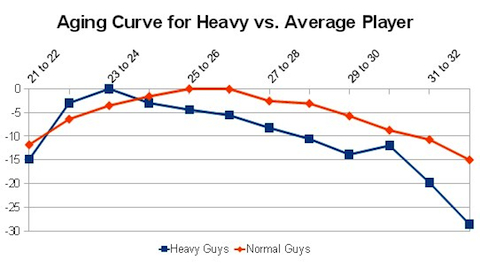
Do you remember what happened to Dmitri Young after he turned 31? Or Pat Burrell at 32? Or what happened to Adam Dunn this season? Nonathletic power hitters seem to fall rapidly when they hit their 30s, and even if their offense rebounds some, their defense remains atrocious. Fielder should be a fine player the next three or four seasons, but no better than Soriano by the time he is 33, and the Cubs would be paying him more than Soriano money for several years after that point.
So what should the Cubs do? In the short run, they'll certainly need a stopgap. This is where LaHair comes in. He has flashed really good power and patience for the Cubs (and before them, the Mariners) in the upper minors over the past few seasons. He also held his own for 20 games in the majors last season. Oliver projects LaHair as a .350-wOBA capable major league hitter (.800+ OPS) with a respectable on-base percentage and .200+ ISO power over the next two-plus years. His 2010 and 2009 major league equivalencies (MLEs) essentially agree. If nothing more, then, LaHair should be your very average first baseman, with some upside.
LaHair won't be a long term option, but he can certainly hold the place until 2014, when Joey Votto is a 30-year-old free agent. Votto is substantially more athletic than Fielder, and he'll be a couple of years younger than Pujols, and he is one of the most talented hitters in baseball. The Cubs would save money over the next two seasons, which could be allocated to Votto in the future, while being a better position to know what they'll need when they're in a position to compete, rather than guessing now and tossing around a lot of money to players who may or may not be worth it by 2014/2015.
Or the Cubs could turn back to Carlos Pena on another one-year deal, though the Pirates may offer two or three years out of desperation.
That is at least what I would do. However, the Cubs are probably going to sign Fielder for Carl Crawford money, in which case I hope I am dead wrong about how he'll age.
A major strength of the Cubs over the past decade, the rotation is currently in shambles and lacks an ace.
Matt Garza is the closest thing to an ace the Cubs have, but he's more an elite No. 2 type. Garza saw a huge jump in his strikeout rate when he moved to the National League this past season, though much of his whiff gain seemed to fizzle away in the second half. Garza's peripherals indicate he's capable of much better than his 2011 results in 2012. However, the Cubs gave up more in prospects to get Garza than the Brewers gave up to get Zack Greinke, and the value of a cost-controlled pitcher of Garza's talent is essentially lost on a team like the Cubs.
Ryan Dempster exercised his player option, and will return in 2012. Dempster was never an ace, but he's been a solid No. 2 starter for the past four years. Though 2011 was a disappointment by ERA/WHIP standards, Dempster's peripherals were essentially in line with his 2007-2009 performance heading into September, when he seemed to wear out down the stretch.
Beyond Dempster and Garza, the Cubs rotation has a lot of question marks. Will Carlos Zambrano be back? Probably not, and he most certainly will not return in 2013. Can Randy Wells and Andrew Cashner stay healthy for the Cubs? If each can, which Randy Wells—the one from the first or second half—will show up? Will Cashner's third pitch ever develop so that he can take the leap from questionable mid-rotation starter to a solid No. 2 type? Trey McNutt is the Cubs' top pitching prospect, but he took a major step back in Double-A last year—his strikeout rate fell and his walk rate spiked. McNutt looks to repeat Double-A next year, and could arrive in mid-2013 if all goes well, but he is no sure thing and is no ace even if he does pan out.
The Cubs gave a lot of starts to terrible pitchers in 2011. Among Casey Coleman, Doug Davis, Ramon Ortiz, Rodrigo Lopez, and James Russell, the Cubs gave 49 starts to substantially below-average pitchers. Of that group, only Lopez's 4.40 xFIP was within even 15 percent of league average. For 2012, the Cubs are going to need to bring in someone to shore up the back of the rotation. Joel Pinero is the most attractive and reasonably attainable free agent pitcher on the market for cheap. What Pinero lacks in strikeouts he makes up for in ground balls and a very limited walk rate. Pinero was kind of a disaster last year, so he should not cost too much on an incentive-laden one-year deal.
Javier Vazquez is another attractive name, worthy of a multi-year deal now that his velocity is back, but all signs currently point to him either retiring or returning to the Marlins. Likewise, Mark Buehrle would be a great innings eater, but would likely cost too much for what he does, and is more likely to stick with the White Sox or go to the Marlins, who probably will make a more attractive offer to fill out their team before the opening of their new stadium. The Cubs aren't likely to go after any of the "big" free agent pitchers, though a run at Yu Darvish could prove fruitful. Perhaps the Cubs can convince Roy Oswalt to come aboard at the right price, or woo Chris Capuano with a one-year deal.
In the bullpen, Carlos Marmol is still the Cubs closer, and Sean Marshall, who was a decent lefty starter a few years back, will remain an elite setup man. Kerry Wood could return on another one-year deal.
Jeff Samardzija will almost certainly be back; he has a $3 million option for 2012, which the Cubs probably will decline and work out a more team-friendly deal in light of how he's performed the past few years. Samardzija was serviceable in 2011, but he has to slash the walk rate. People not named Carlos Marmol have no excuse for walking 13.2 percent of the batters they face.
Chris Carpenter should be an interesting bullpen addition, assuming he is not converted back into a starter. Carpenter has control issues, but he also routinely hits triple digits on the radar gun and punches out a respectable number of batters with a strong groundball rate. If Carpenter cuts down the free passes, he could develop into an elite reliever for the Cubs. As a starter, he has a very limited ceiling because he really has only two pitches (and no control). Marco Mateo could also be good reliever, but like many before him, he is a high-strikeout, high-walk guy who cannot be relied upon in high-leverage situations. And if If Mateo is questionable, the rest of the bullpen is a double question mark. Between Chris Archer (in the Garza deal) and Jose Ceda (in the Kevin Gregg deal), the Cubs have traded away most of their electric relief arms in recent years. Jay Jackson has plateaued in talent as he reached the upper minors as a starter, so perhaps as a converted reliever he could develop into a reliable reliever for the Cubs given his good control and respectable strikeout rates as a starter. Rafael Dolis, a converted position player, could develop into a Sergio Santos type given his 96 mph fastball and supposedly electric slider/changeup combo, but his control needs a lot of work before he becomes a high-leverage reliever.
These question marks mean that the Cubs bullpen, outside its top three names (four, if Wood returns), is going to be a mess of young, rough, and still-developing pitchers unless Hoyer and Epstein find someone better (and relatively cheap) on the free agent market. On the brigh tside, the Cubs bullpen is entirely cost-controlled, so at least it won't be an expensive disaster when a starter gets knocked out early.
Tim Dierkes did a great job covering the Cubs' projected 2012 payroll situation last month.
Though the Cubs have had one of the highest payrolls in baseball in recent years, most of those contracts are finally starting to come off the books. Between Ramirez and Kosuke Fukudome, the Cubs are going to save $30 million in payroll. Another $5 million, half of Pena's salary, will be gone as well, though all of that and then some will go toward salary boosts for Soto, Garza and Byrd. John Grabow is off the books as well, which saves the Cubs roughly $5 million. If the Cubs can get some team to eat $5 million or so of Zambrano's salary (the Marlins?), they could free up between $30 and $40 million for 2012 when other players who will not be returning are considered.
In addition to that money, the Cubs will have Zambrano's $18 million, Dempster's $14 million, $6.5 million from Byrd, and another $5 million from Pena coming off the books for 2013, giving the Cubs between $50 and $60 million to work with over the next two seasons. Unfortunately, Soriano's $18 million per year will be around another three seasons, though the Cubs could move him to an AL team in need of a DH if they are willing to eat a lot of the salary. Even with Soriano on the books, Epstein andHoyer should be able to afford the necessary pieces, though one hopes a lot of the money is spent on the 2012 and 2013 drafts.
The Cubs' farm system is a disaster. Though they lacked a true star heading into 2011, the Cubs had enough depth to make them a borderline top 10 farm system. The Matt Garza deal eliminated almost all that depth, and what the Cubs are left with is a questionable No. 2 starterm in McNutt, a flawed but promising center field prospect in Jackson, and a prototypical Cubs prospect in Matt Szczur: a speedy "tools" guy who does not walk and has almost no power, like Montanez. The Cubs' top draft pick in 2012, Javier Baez, is a promising third base prospect (his shortstop defense is probably not good enough to stick), who could leapfrog Vitters with a good 2012 season in the minors. Hayden Simpson was a questionable pick in 2011, and his first year in the minors was a disaster.
Mike Quade is out, and it looks like Mike Maddux is the favorite to replace him. That could create an interesting dynamic because he could bring in his brother Greg to join the coaching staff. The Maddux brothers know quite a lot about pitching, and they could teach the Cubs young pitchers a lot of valuable game theory in addition to polishing their pitching mechanics. If Mike Maddux does not join the Cubs, Greg Maddux, who worked as a special consultant to Hendry, probably will not return in 2012 due to family issues.
The Cubs are a disaster at the moment, but Tom Ricketts is laying the foundation necessary to rebuild not only the team, but the franchise. Epstein and Hoyer have a long, uphill battle, but they are the right guys for the challenge. The Cubs have a foundation to build on with good up-the-middle starters. Corner positions are much easier to fill and the Cubs will have the payroll to make the necessary moves. The future of the Cubs rotation looks to be somewhat of a mess, with lots of question marks surrounding their prospects. They will need to bring in some outside help or make some very good draft picks and-or trades in the next couple of years.
What do you think about the Cubs' 2012 and future outlook? What moves would you like to see the Cubs make and why? Who is excited for the Epstein-Hoyer era to begin?
Hiring Theo Epstein and Jed Hoyer was a great step forward for the Cubs organization, whose last World Series appearance was 1945.
For the past 30 years, since the team passed from the Wrigley family, Cubs' ownership has rarely seen the team as anything more than a cash cow. Cubs games are a unique social experience that blend booze and brotherhood with more than 100 years of bad luck. Wrigleyville is a one-of-a-kind sports neighborhood that surrounds the field with good eats and plenty of bars. The atmosphere is safe and always welcoming (unless you are a Cardinals fan, in which case you get an in-all-good fun jostling). The slightly intoxicated Cubs fan -- second only to Wisconsin in inebriation per capita -- tends to be a complete 180 from the associated personality of a Philadelphia [choose your sport] fan*. This is why the Cubs are the lovable losers, who live at what has been dubbed the friendly confines. Heck, we're world famous for our bleacher bums.
*To be fair to those Phillies fans who threw batteries at J.D. Drew, some Cubs fan once threw a battery at former Cub Jacque Jones. Still, no stadium full of Cubs fans has ever booed Santa Claus."
Even though the Cubs are only sporadically good due to a history of poor management, unfortunate drafting and bad trades, their games have historically sold. People come for the environment more than the product on the field, to experience and take part in the fun. Over the past 30 years, the social aspect of Cubs games has grown from the bleacher bums, who are being phased out for overpriced corporate outings—the "white collar social." Wrigley Field has become the epitome of the casual—not to be confused with fair-weather—fan. It has evolved into more of a place to go than a place to truly care about the result.
Now, with more than a hundred years since the Cubs' last World Series win and with the losing teams of the past two seasons, fans are proving they are finally fed up with the way the organization has been run. This year, tickets to Cubs games could be purchased on StubHub for as low as $1. Even the "guaranteed to sell out" games, such as those against the Cardinals, did not sell out toward the end of the season. And even when the tickets sold—many purchased on speculation with the intent to resell—seats remained empty, poking holes in vending sales.
Firing general manager Jim Hendry in favor of guy who "embraces the numbers" was a big step forward for an organization that has not played "smart baseball." By all accounts, Hendry is one of the nicest guys in the business, and a real class act. Alas, Hendry's tenure as the Cubs' GM was marred by bad drafting, albatross contracts that featured no-trade clauses and player options, and disappointing failure despite three playoff runs. Hendry went all-in from 2007-2009. Had it paid off with a World Series berth, Cubs fans could probably stomach the team's current state of affairs as the cost of glorious success. But that success did not occur. Some great trades early in his role as the Cubs' G.M. (e.g., stealing Aramis Ramirez and Derek Lee), were countered by equally bad losses (the Juan Pierre deal and the Alfonso Soriano contract).
Even though the Cubs are one of the top five organizations in terms of revenue and payroll, throwing money around on players rarely solves one's problems unless you are New York. Even Boston, in a great position at the moment, has its issues due to a few big, bad salaries. If you are going to spend big, you need to hit. A big organization like the Cubs can afford to miss every now and then, but not consistently, and with the magnitude of commitment they did from 2007-2009.
New owner Tom Ricketts, in dropping Hendry in favor of Hoyer, and hiring Epstein as the president of baseball operations, indicated to Cubs fans that he cares about, and is committed to, winning. With Hoyer and Epstein aboard, and with the Cubs' payroll demons slowly but steadily shedding over the next two or three seasons (Soriano is signed through 2014), an era of sustainable success akin to Boston's past decade could be upon us. Drafting and prospect loading will be key over the next couple of years, as will be finding good low-risk, high-reward contracts that could return dividends.
The Cubs have a long way to go toward competing, but putting the right people in charge is a major first step. The Cubs have lacked a philosophy and direction, and this is one of the (many) things that has kept the Cubs from sustainable success. Since the mid-'90s, Cubs management has always talked about a youth movement when things got their roughest, only to catch lightning in a bottle a few years later and try to capitalize on that flash by sacrificing the future for the now. Toggling between rebuilding and going all-in over the past 15 years is just one reason the Cubs are in the position they are today, but it is a big one.
With the foundation laid, there is much work left ahead. Let's look at the state of the team, starting with the Cubs' strengths.
Up the middle
The Cubs' clearest strengths come at the hardest-to-fill positions. Between the young shortstop/second baseman Starlin Castro (depending on how his defense continues to develop) and the underrated power and patience of catcher Geovany Soto (new manager, less Koyie Hill?), the Cubs have mainstays at two of the most important spots on the field.
Provided the Cubs new manager gives Soto the playing time he deserves (despite being healthy over the past two seasons, he was in only a combined 230 games), they should see a modest offensive boost from 2011. Soto took a step back in terms of his walk rate and strikeout rate, which had progressed over the past few seasons, but still managed to turn in a respectable +2.1 WAR despite a .280 BABIP and limited playing time. The power that people were worried had disappeared stuck around, more or less. Power was down across the major leagues this year, and I expect Soto's ISO to be back over the .200 plateau in 2012. His defense, to the extent you trust the plus/minus system for catchers, has progressed from horrible to bad to average over the years, which is encouraging.
At second base, the Cubs have rookie Darwin Barney. Despite a hot-then-cold first/second half split, Barney was worth +2.2 WAR over 143 games. In other words, he is a slightly above average player making the league minimum for another two seasons. The Cubs could do worse, and keeping Barney frees up resources for the Cubs to spend elsewhere. If the Cubs want to take a low-risk, high-reward approach to the shallow free agent pool, however, Kelly Johnson could be a fit. That would slide Barney over to third base, where the Cubs have no one to play at the moment.
Johnson is a very attractive free agent because he possesses +4 WAR potential, as evidenced by 2007-08 and 2010, though 2010 was bookmarked by by two pretty disappointing seasons. If the Cubs do not sign a second baseman like Johnson and slide Barney over, they will need to bring in some outside help at third base, potentially in the form of Michael Cuddyer, but more on that below.
Meanwhile, in the upper minors, Brett Jackson continues to develop as the Cubs' center-fielder of the future. Jackson does not have an MVP or superstar ceiling, but he should be a consistent All-Star in his prime. Jackson has issues with strikeouts, but has a modest (20+ home run) power upside, speed and athleticism. Those should combine for a handful of 3-4+ WAR seasons if he can just cut down the whiff rate. That may be a big if, but Jackson is the most exciting Cubs hitting prospect to reach the upper minors in the past 10 years. He should arrive around the All-Star break.
Though the Cubs have strong enough starters, they lack depth up the middle. Their utility guy this year was a combination of Blake DeWitt, DJ LeMahieu and Jeff Baker, none of whom are anything but replacement level. LeMahieu probably has the most value of that group, given his age (23), but he is a light-hitting, no-walking, no-running middle infielder who is just a DL stopgap with a decent glove. If anyone up the middle for the Cubs gets injured for an ex tended time, there's not an even "average" replacement. Perhaps the Cubs will target a low-cost Jamey Carroll type in free agency; more likely, LeMahieu will have a graduated role in 2012 doing what he did down the stretch in 2011.
Corner infield
The Cubs are not just weak at the corners. They do not even have players reasonably scheduled to play third base, right field, or first base.
With Aramis Ramirez declining his player option (saving the Cubs $2 million in the process), the closest thing the Cubs have to a third baseman at the moment is Barney, who is playing second. Josh Vitters is the team's only prospect at the position, and he's been a massive disappointment to date, with neither walks nor power over the past three years. Vitters is only 22, so perhaps he has time, but it is hard to teach players with no patience at the plate how to walk. Vitters is playing pretty decently in the hitter-friendly Arizona Fall League, but those stats have to be taken with a grain of salt. A realistic outcome of the third base situation would be Johnson or Michael Cuddyer. He's 32, but third base is a vacuum for the Cubs and the third base free agency pool is shallower than the girls of the Jersey Shore. A three-year, $30-35 million deal may be in the cards for Cuddyer. Ramirez, to the extent he wants a four-year deal, is going to end up as an Oriole—where Cubs go to retire.
Right field is just as open as third base. Bryan LaHair could get first dibs on the gig in spring training, but, like many a Cubs hitting prospect over the past five years, he's approaching 30 has minimal major league experience. If the Cubs are going to give LaHair a chance at a full time gig, they might as well let him play first base. They would be better off letting the younger Jackson try out for right to get some major league experience for when he slides over to center field in 2013. That is not to say that LaHair isn't a promising power bat, but he is a first baseman in outfielder's clothing in right.
If the Cubs want to go outside the organization, Grady Sizemore on a one-year incentive-laden deal could make a lot of sense, as could a low-cost one- or two-year deal for David DeJesus as a stopgap until Jackson arrives. Either could get full-time outfield duties in 2012, and likely 2013, assuming Marlon Byrd gets traded to a contender in need of an outfielder upon Jackson's arrival. Josh Willingham could also fit as an interesting power bat if he is willing to take a two-, rather than three-, year deal.
In left field, Soriano is going nowhere. The Cubs could bring back Reed Johnson on another one-year deal as a fourth outfielder, but they also have Tony Campana and former first-round pick Luis Montanez trolling around as outfield defensive replacements at the league minimum.
The Cubs also need a first baseman, and lucky for them, not only is a lot of money coming off the books, but two of the four best guys are currently on the market. The Cubs, along with the Mariners and Nationals, are probably among the favorites to sign Prince Fielder. With the Cardinals having won the 2011 World Series in Disney-magic fashion, Albert Pujols leaving St. Louis seems a longshot at this point, but the Cubs are one of two teams, the other being Toronto, that could feasibly offer the slugger $300 million if they really wanted to.
Though both Fielder and Pujols are great players who would make great additions, the Cubs should save their money. Pujols, to the extent he would sign with someone other than the Cardinals, is more of a "win now" player. He will be 32 next season, and though his career-low WAR total is 5.1, that low figure came this year. Pujols should keep being great over the next few years, but aging curves are never gracious to athletes in their mid-30s who aren't on the juice. Pujols has been relatively healthy over the past few years, which is encouraging, but can he maintain health and production four, five, and even six years into a multi-year contract? Cubs fans know what happened to Soriano by 2009, and though Pujols is an infinitely better player than Soriano, there is no reason to expect him to maintain a +6-9 WAR pace into his age 35 season, which is what he would have to do to be worth his contract. Just ask the Yankees how that monstrous Alex Rodriguez deal is working out for them.
That said, Pujols has the type of plate discipline skills that age well, even with a power decline. But the Cubs are not in a position to win now. They are not even in a position to likely win in 2013. They need to rebuild. By the time the Cubs realistically can compete again, Pujols will be into his mid-30s, and by then, he will be eating up resources relative to his production that the Cubs could better allocate elsewhere.
Then what of Fielder, who is four years Pujols' junior? Fielder is probably the better player to sign for several reasons. The first is that he will cost less money than Pujols. Of course Fielder is also a lesser player than Pujols, but a lot of Pujols' superior present value would be lost on a non-contending team like the Cubs. Fielder is also younger, by four years, and he would still be in his prime, albeit the tail end of his prime, by the time the Cubs are competing again. Age and cost would make more sense as a long-term contract for a team that is not trying to "win now."
However, Fielder is not much of an "athlete" in the traditional sense of the word. We all know the real reason that the Brewers couldn't resign CC Sabathia after 2008 was that there was not enough food in Milwaukee to feed the two of them. Fangraphs had an excellent article about Fielder's expected aging curve a few weeks ago, noting that fat baseball players tend to age substantially less gracefully than other players:
Do you remember what happened to Dmitri Young after he turned 31? Or Pat Burrell at 32? Or what happened to Adam Dunn this season? Nonathletic power hitters seem to fall rapidly when they hit their 30s, and even if their offense rebounds some, their defense remains atrocious. Fielder should be a fine player the next three or four seasons, but no better than Soriano by the time he is 33, and the Cubs would be paying him more than Soriano money for several years after that point.
So what should the Cubs do? In the short run, they'll certainly need a stopgap. This is where LaHair comes in. He has flashed really good power and patience for the Cubs (and before them, the Mariners) in the upper minors over the past few seasons. He also held his own for 20 games in the majors last season. Oliver projects LaHair as a .350-wOBA capable major league hitter (.800+ OPS) with a respectable on-base percentage and .200+ ISO power over the next two-plus years. His 2010 and 2009 major league equivalencies (MLEs) essentially agree. If nothing more, then, LaHair should be your very average first baseman, with some upside.
LaHair won't be a long term option, but he can certainly hold the place until 2014, when Joey Votto is a 30-year-old free agent. Votto is substantially more athletic than Fielder, and he'll be a couple of years younger than Pujols, and he is one of the most talented hitters in baseball. The Cubs would save money over the next two seasons, which could be allocated to Votto in the future, while being a better position to know what they'll need when they're in a position to compete, rather than guessing now and tossing around a lot of money to players who may or may not be worth it by 2014/2015.
Or the Cubs could turn back to Carlos Pena on another one-year deal, though the Pirates may offer two or three years out of desperation.
That is at least what I would do. However, the Cubs are probably going to sign Fielder for Carl Crawford money, in which case I hope I am dead wrong about how he'll age.
Pitching
A major strength of the Cubs over the past decade, the rotation is currently in shambles and lacks an ace.
Matt Garza is the closest thing to an ace the Cubs have, but he's more an elite No. 2 type. Garza saw a huge jump in his strikeout rate when he moved to the National League this past season, though much of his whiff gain seemed to fizzle away in the second half. Garza's peripherals indicate he's capable of much better than his 2011 results in 2012. However, the Cubs gave up more in prospects to get Garza than the Brewers gave up to get Zack Greinke, and the value of a cost-controlled pitcher of Garza's talent is essentially lost on a team like the Cubs.
Ryan Dempster exercised his player option, and will return in 2012. Dempster was never an ace, but he's been a solid No. 2 starter for the past four years. Though 2011 was a disappointment by ERA/WHIP standards, Dempster's peripherals were essentially in line with his 2007-2009 performance heading into September, when he seemed to wear out down the stretch.
Beyond Dempster and Garza, the Cubs rotation has a lot of question marks. Will Carlos Zambrano be back? Probably not, and he most certainly will not return in 2013. Can Randy Wells and Andrew Cashner stay healthy for the Cubs? If each can, which Randy Wells—the one from the first or second half—will show up? Will Cashner's third pitch ever develop so that he can take the leap from questionable mid-rotation starter to a solid No. 2 type? Trey McNutt is the Cubs' top pitching prospect, but he took a major step back in Double-A last year—his strikeout rate fell and his walk rate spiked. McNutt looks to repeat Double-A next year, and could arrive in mid-2013 if all goes well, but he is no sure thing and is no ace even if he does pan out.
The Cubs gave a lot of starts to terrible pitchers in 2011. Among Casey Coleman, Doug Davis, Ramon Ortiz, Rodrigo Lopez, and James Russell, the Cubs gave 49 starts to substantially below-average pitchers. Of that group, only Lopez's 4.40 xFIP was within even 15 percent of league average. For 2012, the Cubs are going to need to bring in someone to shore up the back of the rotation. Joel Pinero is the most attractive and reasonably attainable free agent pitcher on the market for cheap. What Pinero lacks in strikeouts he makes up for in ground balls and a very limited walk rate. Pinero was kind of a disaster last year, so he should not cost too much on an incentive-laden one-year deal.
Javier Vazquez is another attractive name, worthy of a multi-year deal now that his velocity is back, but all signs currently point to him either retiring or returning to the Marlins. Likewise, Mark Buehrle would be a great innings eater, but would likely cost too much for what he does, and is more likely to stick with the White Sox or go to the Marlins, who probably will make a more attractive offer to fill out their team before the opening of their new stadium. The Cubs aren't likely to go after any of the "big" free agent pitchers, though a run at Yu Darvish could prove fruitful. Perhaps the Cubs can convince Roy Oswalt to come aboard at the right price, or woo Chris Capuano with a one-year deal.
In the bullpen, Carlos Marmol is still the Cubs closer, and Sean Marshall, who was a decent lefty starter a few years back, will remain an elite setup man. Kerry Wood could return on another one-year deal.
Jeff Samardzija will almost certainly be back; he has a $3 million option for 2012, which the Cubs probably will decline and work out a more team-friendly deal in light of how he's performed the past few years. Samardzija was serviceable in 2011, but he has to slash the walk rate. People not named Carlos Marmol have no excuse for walking 13.2 percent of the batters they face.
Chris Carpenter should be an interesting bullpen addition, assuming he is not converted back into a starter. Carpenter has control issues, but he also routinely hits triple digits on the radar gun and punches out a respectable number of batters with a strong groundball rate. If Carpenter cuts down the free passes, he could develop into an elite reliever for the Cubs. As a starter, he has a very limited ceiling because he really has only two pitches (and no control). Marco Mateo could also be good reliever, but like many before him, he is a high-strikeout, high-walk guy who cannot be relied upon in high-leverage situations. And if If Mateo is questionable, the rest of the bullpen is a double question mark. Between Chris Archer (in the Garza deal) and Jose Ceda (in the Kevin Gregg deal), the Cubs have traded away most of their electric relief arms in recent years. Jay Jackson has plateaued in talent as he reached the upper minors as a starter, so perhaps as a converted reliever he could develop into a reliable reliever for the Cubs given his good control and respectable strikeout rates as a starter. Rafael Dolis, a converted position player, could develop into a Sergio Santos type given his 96 mph fastball and supposedly electric slider/changeup combo, but his control needs a lot of work before he becomes a high-leverage reliever.
These question marks mean that the Cubs bullpen, outside its top three names (four, if Wood returns), is going to be a mess of young, rough, and still-developing pitchers unless Hoyer and Epstein find someone better (and relatively cheap) on the free agent market. On the brigh tside, the Cubs bullpen is entirely cost-controlled, so at least it won't be an expensive disaster when a starter gets knocked out early.
Payroll
Tim Dierkes did a great job covering the Cubs' projected 2012 payroll situation last month.
Though the Cubs have had one of the highest payrolls in baseball in recent years, most of those contracts are finally starting to come off the books. Between Ramirez and Kosuke Fukudome, the Cubs are going to save $30 million in payroll. Another $5 million, half of Pena's salary, will be gone as well, though all of that and then some will go toward salary boosts for Soto, Garza and Byrd. John Grabow is off the books as well, which saves the Cubs roughly $5 million. If the Cubs can get some team to eat $5 million or so of Zambrano's salary (the Marlins?), they could free up between $30 and $40 million for 2012 when other players who will not be returning are considered.
In addition to that money, the Cubs will have Zambrano's $18 million, Dempster's $14 million, $6.5 million from Byrd, and another $5 million from Pena coming off the books for 2013, giving the Cubs between $50 and $60 million to work with over the next two seasons. Unfortunately, Soriano's $18 million per year will be around another three seasons, though the Cubs could move him to an AL team in need of a DH if they are willing to eat a lot of the salary. Even with Soriano on the books, Epstein andHoyer should be able to afford the necessary pieces, though one hopes a lot of the money is spent on the 2012 and 2013 drafts.
Pipeline
The Cubs' farm system is a disaster. Though they lacked a true star heading into 2011, the Cubs had enough depth to make them a borderline top 10 farm system. The Matt Garza deal eliminated almost all that depth, and what the Cubs are left with is a questionable No. 2 starterm in McNutt, a flawed but promising center field prospect in Jackson, and a prototypical Cubs prospect in Matt Szczur: a speedy "tools" guy who does not walk and has almost no power, like Montanez. The Cubs' top draft pick in 2012, Javier Baez, is a promising third base prospect (his shortstop defense is probably not good enough to stick), who could leapfrog Vitters with a good 2012 season in the minors. Hayden Simpson was a questionable pick in 2011, and his first year in the minors was a disaster.
Management
Mike Quade is out, and it looks like Mike Maddux is the favorite to replace him. That could create an interesting dynamic because he could bring in his brother Greg to join the coaching staff. The Maddux brothers know quite a lot about pitching, and they could teach the Cubs young pitchers a lot of valuable game theory in addition to polishing their pitching mechanics. If Mike Maddux does not join the Cubs, Greg Maddux, who worked as a special consultant to Hendry, probably will not return in 2012 due to family issues.
Conclusion
The Cubs are a disaster at the moment, but Tom Ricketts is laying the foundation necessary to rebuild not only the team, but the franchise. Epstein and Hoyer have a long, uphill battle, but they are the right guys for the challenge. The Cubs have a foundation to build on with good up-the-middle starters. Corner positions are much easier to fill and the Cubs will have the payroll to make the necessary moves. The future of the Cubs rotation looks to be somewhat of a mess, with lots of question marks surrounding their prospects. They will need to bring in some outside help or make some very good draft picks and-or trades in the next couple of years.
What do you think about the Cubs' 2012 and future outlook? What moves would you like to see the Cubs make and why? Who is excited for the Epstein-Hoyer era to begin?
The Jim Joyce All-Stars: 2011

- 3/31 - Mark Kotsay makes a diving catch in the outfield, called a hit
- 3/31 - Botched ground ball hit directly at Derek Jeter called a hit
- 4/1 - Roy Halladay beats out a ground ball, called out at first
GOI's Mega Baseball Predictions Post
We've said it over and over again. Predictions are worthless. In a recent e-mail The 'Bright' One stated to me
I've asked the other three Game of Inches authors to send me their predictions on who will win the major end of the season awards as well as their predictions for how the standings will turn out. The four of us did not convene to talk about these predictions in any way and all individual predictions were done without the knowledge of what the other three had predicted.
END OF THE SEASON AWARDS
AL MVP
Sexy Rexy
Winner: Miguel Cabrera
Runner Up: Adrian Gonzalez
David "MVP" Eckstein
Winner: Nelson Cruz
Runner Up: Evan Longoria
The 'Bright' One
Winner: Josh Hamilton
Runner Up: Adrian Gonzalez
Cubsfan4evr1
Winner: Evan Longoria
Runner Up: Adrian Gonzalez
NL MVP
Sexy Rexy
Winner: Troy Tulowitzki
Runner Up: Albert Pujols
David "MVP" Eckstein
Winner: Troy Tulowitzki
Runner Up: Joey Votto
The 'Bright' One
Winner: Troy Tulowitzki
Runner Up: Albert Pujols
Cubsfan4evr1
Winner: Albert Pujols
Runner Up: Andre Ethier
AL Cy Young
Sexy Rexy
Winner: Jon Lester
Runner Up: Felix Hernandez
David "MVP" Eckstein
Winner: Justin Verlander
Runner Up: Jered Weaver
The 'Bright' One
Winner: Jon Lester
Runner Up: Felix Hernandez
Cubsfan4evr1
Winner: Jon Lester
Runner Up: Jered Weaver
NL Cy Young
Sexy Rexy
Winner: Tim Lincecum
Runner Up: Javier Vazquez
My #2 pitcher and the guy who will actually be the runner up is obviously Roy Halladay but I'm big on Javy this year and just wanted to give him some love
David "MVP" Eckstein
Winner: Tim Lincecum
Runner Up: Clayton Kershaw
The 'Bright' One
Winner: Roy Halladay
Runner Up: Tim Lincecum
Cubsfan4evr1
Winner: Tim Lincecum
Runner Up: Tommy Hanson
AL Rookie of the Year
Sexy Rexy
Winner: Desmond Jennings
Runner Up: Mike Moustakas
David "MVP" Eckstein
Winner: Michael Pineda
Runner Up: Jeremy Hellickson
The 'Bright' One
Winner: Michael Pineda
Runner Up: Michael Moustakas
Cubsfan4evr1
Winner: Jeremy Hellickson
Runner Up: Michael Pineda
NL Rookie of the Year
Sexy Rexy
Winner: Freddy Freeman
Runner Up: Brandon Beachy
David "MVP" Eckstein
Winner: Brandon Beachy
Runner Up: Aldoris Chapman
The 'Bright' One
Winner: Brandon Belt
Runner Up: Dominic Brown
Cubsfan4evr1
Winner: Brandon Beachy
Runner Up: Freddy Freeman
AL Sophomore of the Year
Sexy Rexy
Winner: Wade Davis
Runner Up: Carlos Santana
David "MVP" Eckstein
Winner: Carlos Santana
Runner Up: Brian Matusz
The 'Bright' One
Winner: Neftali Feliz
Runner Up: Carlos Santana
Cubsfan4evr1
Winner: Carlos Santana
Runner Up: Wade Davis
NL Sophomore of the Year
Sexy Rexy
Winner: Mike Stanton
Runner Up: Jason Heyward
David "MVP" Eckstein
Winner: Mike Stanton
Runner Up: Mat Latos
I personally don't think Latos is a sophomore in 2011 considering he pitched 50+ innings in 2009
The 'Bright' One
Winner: Starlin Castro
Runner Up: Jason Heyward
Cubsfan4evr1
Winner: Jason Heyward
Runner Up: Mike Stanton
DIVISION STANDINGS
* Denotes Wild Card
AL West
Sexy Rexy
1) Texas Rangers
2) Oakland A's
3) Los Angeles Angels
4) Seattle Mariners
David "MVP" Eckstein
1) Oakland A's
2) Texas Rangers
3) Los Angeles Angels
4) Seattle Mariners
The 'Bright' One
1) Texas Rangers
2) Oakland A's
3) Los Angeles Angels
4) Seattle Mariners
Cubsfan4evr1
1) Texas Rangers
2) Los Angeles Angels
3) Oakland A's
4) Seattle Mariners
AL Central
Sexy Rexy
1) Minnesota Twins
2) Chicago White Sox
3) Detroit Tigers
4) Kansas City Royals
5) Cleveland Indians
David "MVP" Eckstein
1) Chicago White Sox
2) Detroit Tigers
3) Minnesota Twins
4) Kansas City Royals
5) Cleveland Indians
The 'Bright' One
1) Minnesota Twins
2) Detroit Tigers
3) Chicago White Sox
4) Kansas City Royals
5) Cleveland Indians
Cubsfan4evr1
1) Chicago White Sox
2) Minnesota Twins
3) Detroit Tigers
4) Kansas City Royals
5) Cleveland Indians
AL East
Sexy Rexy
1) Boston Red Sox
2) Tampa Bay Rays*
3) New York Yankees
4) Toronto Blue Jays
5) Baltimore Orioles
David "MVP" Eckstein
1) Boston Red Sox
2) Tampa Bay Rays*
3) Toronto Blue Jays
4) New York Yankees
5) Baltimore Orioles
The 'Bright' One
1) Boston Red Sox
2) Tampa Bay Rays*
3) New York Yankees
4) Toronto Blue Jays
5) Baltimore Orioles
Cubsfan4evr1
1) Boston Red Sox
2) Tampa Bay Rays*
3) New York Yankees
4) Toronto Blue Jays
5) Baltimore Orioles
NL West
Sexy Rexy
1) Colorado Rockies
2) San Francisco Giants
3) Los Angeles Dodgers
4) Arizona Diamondbacks
5) San Diego Padres
David "MVP" Eckstein
1) Colorado Rockies
2) San Francisco Giants
3) San Diego Padres
4) Los Angeles Dodgers
5) Arizona Diamondbacks
The 'Bright' One
1) Colorado Rockies
2) San Francisco Giants
3) Los Angeles Dodgers
4) San Diego Padres
5) Arizona Diamondbacks
Cubsfan4evr1
1) San Francisco Giants
2) Los Angeles Dodgers
3) Colorado Rockies
4) San Diego Padres
5) Arizona Diamondbacks
NL Central
Sexy Rexy
1) Milwaukee Brewers
2) Cincinatti Reds
3) St. Louis Cardinals
4) Chicago Cubs
5) Houston Astros
6) Pittsburgh Pirates
David "MVP" Eckstein
1) Milwaukee Brewers
2) Cincinatti Reds
3) Chicago Cubs
4) St. Louis Cardinals
5) Houston Astros
6) Pittsburgh Pirates
The 'Bright' One
1) Chicago Cubs
2) Milwaukee Brewers*
3) Cincinnati Reds
4) St. Louis Cardinals
5) Houston Astros
6) Pittsburgh Pirates
Quote from TBO: I am biased as shit
Cubsfan4evr1
1) Milwaukee Brewers
2) Cincinatti Reds
3) Chicago Cubs
4) St. Louis Cardinals
5) Houston Astros
6) Pittsburgh Pirates
NL East
Sexy Rexy
1) Philadelphia Phillies
2) Florida Marlins*
3) Atlanta Braves
4) Washington Nationals
5) New York Mets
David "MVP" Eckstein
1) Philadelphia Phillies
2) Atlanta Braves*
3) Florida Marlins
4) Washington Nationals
5) New York Mets
The 'Bright' One
1) Philadelphia Phillies
2) 2) Atlanta Braves
3) Washington Nationals
4) Florida Marlins
5) New York Mets
Cubsfan4evr1
1) Philadelphia Phillies
2) Atlanta Braves*
3) Florida Marlins
4) New York Mets
5) Washington Nationals
WORLD SERIES PREDICTION
Sexy Rexy
Milwaukee Brewers def. Tampa Bay Rays
David "MVP" Eckstein
Atlanta Braves def. Tampa Bay Rays
The 'Bright' One
Chicago Cubs def. Boston Red Sox
Cubsfan4evr1
Philadelphia Phillies def. Boston Red Sox
I hate predicting standings. Player stats maybe, but predicting standings just makes the actual season seem inconsequential. As a former psych of happiness prof once told us, "enjoyment comes from embracing the process, not just the final resultAnd he's right. We here at GOI know how worthless predictions are so just take them for what they're worth. Baseball season is right around the corner and let's just enjoy the season. But at the same time, it sure feels good to say "I told you so" and this post will be proof to say that.
I've asked the other three Game of Inches authors to send me their predictions on who will win the major end of the season awards as well as their predictions for how the standings will turn out. The four of us did not convene to talk about these predictions in any way and all individual predictions were done without the knowledge of what the other three had predicted.
END OF THE SEASON AWARDS
AL MVP
Sexy Rexy
Winner: Miguel Cabrera
Runner Up: Adrian Gonzalez
David "MVP" Eckstein
Winner: Nelson Cruz
Runner Up: Evan Longoria
The 'Bright' One
Winner: Josh Hamilton
Runner Up: Adrian Gonzalez
Cubsfan4evr1
Winner: Evan Longoria
Runner Up: Adrian Gonzalez
NL MVP
Sexy Rexy
Winner: Troy Tulowitzki
Runner Up: Albert Pujols
David "MVP" Eckstein
Winner: Troy Tulowitzki
Runner Up: Joey Votto
The 'Bright' One
Winner: Troy Tulowitzki
Runner Up: Albert Pujols
Cubsfan4evr1
Winner: Albert Pujols
Runner Up: Andre Ethier
AL Cy Young
Sexy Rexy
Winner: Jon Lester
Runner Up: Felix Hernandez
David "MVP" Eckstein
Winner: Justin Verlander
Runner Up: Jered Weaver
The 'Bright' One
Winner: Jon Lester
Runner Up: Felix Hernandez
Cubsfan4evr1
Winner: Jon Lester
Runner Up: Jered Weaver
NL Cy Young
Sexy Rexy
Winner: Tim Lincecum
Runner Up: Javier Vazquez
My #2 pitcher and the guy who will actually be the runner up is obviously Roy Halladay but I'm big on Javy this year and just wanted to give him some love
David "MVP" Eckstein
Winner: Tim Lincecum
Runner Up: Clayton Kershaw
The 'Bright' One
Winner: Roy Halladay
Runner Up: Tim Lincecum
Cubsfan4evr1
Winner: Tim Lincecum
Runner Up: Tommy Hanson
AL Rookie of the Year
Sexy Rexy
Winner: Desmond Jennings
Runner Up: Mike Moustakas
David "MVP" Eckstein
Winner: Michael Pineda
Runner Up: Jeremy Hellickson
The 'Bright' One
Winner: Michael Pineda
Runner Up: Michael Moustakas
Cubsfan4evr1
Winner: Jeremy Hellickson
Runner Up: Michael Pineda
NL Rookie of the Year
Sexy Rexy
Winner: Freddy Freeman
Runner Up: Brandon Beachy
David "MVP" Eckstein
Winner: Brandon Beachy
Runner Up: Aldoris Chapman
The 'Bright' One
Winner: Brandon Belt
Runner Up: Dominic Brown
Cubsfan4evr1
Winner: Brandon Beachy
Runner Up: Freddy Freeman
AL Sophomore of the Year
Sexy Rexy
Winner: Wade Davis
Runner Up: Carlos Santana
David "MVP" Eckstein
Winner: Carlos Santana
Runner Up: Brian Matusz
The 'Bright' One
Winner: Neftali Feliz
Runner Up: Carlos Santana
Cubsfan4evr1
Winner: Carlos Santana
Runner Up: Wade Davis
NL Sophomore of the Year
Sexy Rexy
Winner: Mike Stanton
Runner Up: Jason Heyward
David "MVP" Eckstein
Winner: Mike Stanton
Runner Up: Mat Latos
I personally don't think Latos is a sophomore in 2011 considering he pitched 50+ innings in 2009
The 'Bright' One
Winner: Starlin Castro
Runner Up: Jason Heyward
Cubsfan4evr1
Winner: Jason Heyward
Runner Up: Mike Stanton
DIVISION STANDINGS
* Denotes Wild Card
AL West
Sexy Rexy
1) Texas Rangers
2) Oakland A's
3) Los Angeles Angels
4) Seattle Mariners
David "MVP" Eckstein
1) Oakland A's
2) Texas Rangers
3) Los Angeles Angels
4) Seattle Mariners
The 'Bright' One
1) Texas Rangers
2) Oakland A's
3) Los Angeles Angels
4) Seattle Mariners
Cubsfan4evr1
1) Texas Rangers
2) Los Angeles Angels
3) Oakland A's
4) Seattle Mariners
AL Central
Sexy Rexy
1) Minnesota Twins
2) Chicago White Sox
3) Detroit Tigers
4) Kansas City Royals
5) Cleveland Indians
David "MVP" Eckstein
1) Chicago White Sox
2) Detroit Tigers
3) Minnesota Twins
4) Kansas City Royals
5) Cleveland Indians
The 'Bright' One
1) Minnesota Twins
2) Detroit Tigers
3) Chicago White Sox
4) Kansas City Royals
5) Cleveland Indians
Cubsfan4evr1
1) Chicago White Sox
2) Minnesota Twins
3) Detroit Tigers
4) Kansas City Royals
5) Cleveland Indians
AL East
Sexy Rexy
1) Boston Red Sox
2) Tampa Bay Rays*
3) New York Yankees
4) Toronto Blue Jays
5) Baltimore Orioles
David "MVP" Eckstein
1) Boston Red Sox
2) Tampa Bay Rays*
3) Toronto Blue Jays
4) New York Yankees
5) Baltimore Orioles
The 'Bright' One
1) Boston Red Sox
2) Tampa Bay Rays*
3) New York Yankees
4) Toronto Blue Jays
5) Baltimore Orioles
Cubsfan4evr1
1) Boston Red Sox
2) Tampa Bay Rays*
3) New York Yankees
4) Toronto Blue Jays
5) Baltimore Orioles
NL West
Sexy Rexy
1) Colorado Rockies
2) San Francisco Giants
3) Los Angeles Dodgers
4) Arizona Diamondbacks
5) San Diego Padres
David "MVP" Eckstein
1) Colorado Rockies
2) San Francisco Giants
3) San Diego Padres
4) Los Angeles Dodgers
5) Arizona Diamondbacks
The 'Bright' One
1) Colorado Rockies
2) San Francisco Giants
3) Los Angeles Dodgers
4) San Diego Padres
5) Arizona Diamondbacks
Cubsfan4evr1
1) San Francisco Giants
2) Los Angeles Dodgers
3) Colorado Rockies
4) San Diego Padres
5) Arizona Diamondbacks
NL Central
Sexy Rexy
1) Milwaukee Brewers
2) Cincinatti Reds
3) St. Louis Cardinals
4) Chicago Cubs
5) Houston Astros
6) Pittsburgh Pirates
David "MVP" Eckstein
1) Milwaukee Brewers
2) Cincinatti Reds
3) Chicago Cubs
4) St. Louis Cardinals
5) Houston Astros
6) Pittsburgh Pirates
The 'Bright' One
1) Chicago Cubs
2) Milwaukee Brewers*
3) Cincinnati Reds
4) St. Louis Cardinals
5) Houston Astros
6) Pittsburgh Pirates
Quote from TBO: I am biased as shit
Cubsfan4evr1
1) Milwaukee Brewers
2) Cincinatti Reds
3) Chicago Cubs
4) St. Louis Cardinals
5) Houston Astros
6) Pittsburgh Pirates
NL East
Sexy Rexy
1) Philadelphia Phillies
2) Florida Marlins*
3) Atlanta Braves
4) Washington Nationals
5) New York Mets
David "MVP" Eckstein
1) Philadelphia Phillies
2) Atlanta Braves*
3) Florida Marlins
4) Washington Nationals
5) New York Mets
The 'Bright' One
1) Philadelphia Phillies
2) 2) Atlanta Braves
3) Washington Nationals
4) Florida Marlins
5) New York Mets
Cubsfan4evr1
1) Philadelphia Phillies
2) Atlanta Braves*
3) Florida Marlins
4) New York Mets
5) Washington Nationals
WORLD SERIES PREDICTION
Sexy Rexy
Milwaukee Brewers def. Tampa Bay Rays
David "MVP" Eckstein
Atlanta Braves def. Tampa Bay Rays
The 'Bright' One
Chicago Cubs def. Boston Red Sox
Cubsfan4evr1
Philadelphia Phillies def. Boston Red Sox
Pujols: The Free Agent
According to Ken Rosenthal's sources talks between Albert Pujols and the Cardinals are trending in the wrong direction. Pujols, deserving so, is looking for Alex Rodriguez money, and the Cardinals are reportedly balking at an asking price modeled after a 10-year, $275 million dollar deal. While the overwhelming sentiment around baseball is that Pujols will probably end up signing a deal with the Cardinals, Pujols has nonetheless set an deadline regarding contract extension negotiations with the Cardinals for the start of spring training. Pujols' agent was vocal early this offseason that if a deal could not be reached by then, Pujols would test the free agency market. With this in mind, the question beckens: if not St. Louis, where?
Before looking at Pujols' best possible suitors, let's first analyze whether Alex Rodriguez is a good contracts negotiation point comparable. Last season, per Fangraphs, Pujols was "only" worth +7.3 WAR, the second worst single-season performance of his career. His "puny" WAR total qualified as third best amongst all major league hitters last year, behind only Josh Hamilton (+8.0 WAR) and Joey Votto (+7.4 WAR). In fact, the only other players in baseball last season to even crack the +7.0 WAR mark last season were Ryan Zimmerman (+7.2 WAR) and Adrian Beltre (+7.1 WAR). Exclusive company, to say the least. Alex Rodriguez (+3.9 WAR) didn't even crack the +4.0 WAR plateau last season.
In the four seasons prior to 2010, each of which was marred by some medley of limiting injuries which frequently required offseason surgey, Pujols posted WAR total of +8.3 or higher. From 2008-2009, Pujols accumulated +18.0 WAR. The dollar value of a win over the past three seasons has been approximately $4.5 million. Applying this total to Pujols' past three year WAR value of +25.3 WAR, Pujols produced at a clip worth approximately $113.85 million. Let's be pessimistically conservative and round that total down to a flat $100 million. Considering that Pujols made less than half of that total over the past three seasons ($48 million), you can understand why the best right handed hitter in baseball, wants to share in the profits. Pujols will make $16 million in 2011 and estimates of this offseason's dollar value per win peg a single win-above-replacement at $5 million. Hence Pujols would only have to produce a +3.2 WAR clip to be worth his salary. His career low in single season WAR is +5.7, from his sophomore season. Yeah, this guy is worth some money.
By comparison, let's look at Alex Rodriguez's value heading into his record-setting $275 million dollar contract. No one doubts that Alex Rodriguez was one of the best shortstops of all time (sorry, Derek Jeter, but it was you who should have slid over to third base) and, even as a third basemen, he has been one of the best players in baseball. However, when we compare Arod's WAR to Pujols' WAR, keep in mind that the positional adjustment differential is about 1.5 wins per season in favor of Arod.
In the three seasons prior to signing his massive contract with the Yankees (opting out of his current deal), Alex Rodriguez was worth a cumulative +22.9 WAR, despite playing the better position. While Pujols had the better three-year WAR total, Arod had the better two-of-three seasons, being worth +9.2 WAR in 2007 and +9.4 WAR in 2005. Arod had a real stinker of a season in 2006 by Arod standard, posting a "meager" +4.3 WAR campaign (still all-star caliber season, no matter what the New York media proclaimed at the time). In the three years prior to signing his record-setting contract, Alex Rodriguez accrued +172.3 batting runs over the three seasons prior, while playing below-average defense at third base (-15.7 2005-07 UZR, -2.9 career UZR/150 at third). Alex Rodriguez was 32 years old at the time he signed his behemoth deal. In the three years since, Arod has had a squeaky hip and accumulated a cumulative +14.4 WAR for the Yankees.
Albert Pujols, likewise, will be 31 when he hits free agency. He has out hit (+200.8 batting runs) and outfielded (+5.9 three-year UZR, albeit at first base) Alex Rodriguez in the three-year sample preceding his massive contract. Granted, Albert Pujols still has 2011 to "show what he's worth," but it's unlikely that Pujols, barring some unforeseen injury, will post a WAR below +7.0 next season, let alone one below +8.0. Keep in mind that Albert Pujols used to play outfield and third base (and was a capable fielder at both), but was moved to first base because of lingering elbow issues and a (wise) desire by the Cardinals' to preserve Pujols health.
For a better look at Pujols' value, check out his comparative value against Alex Rodriguez, Mark Teixeira, and Ryan Howard (who signed a 5-year, $125 million deal last season) courtesy of Fangraphs' WAR charts. First, let's look at single-season WAR by age (click to embiggen):

A look at this chart indicates just how talented Arod, who broke into the majors a few seasons earlier than Pujols, and Pujols truly are. Ryan Howard has not been better at the same age than either of Arod or Pujols, and Teixeira's best season (age 28) was the only season he was able to (barely) out-edge either, being a half WAR better than Arod, but a full 2 WAR behind Pujols. While Arod has a better WAR, by a count of 5-4-1, than Pujols in the age-overlapping seasons of play, Pujols has been the more consistent player, which has lead to him producing a better WAR total in their age-overlapping seasons despite playing the inferior position (first base, to Arod's third and short). From age 21 to 30, Alex Rodriguez was worth a whopping +74.5 WAR. Pujols, on the other hand, has been worth a cumulative +80.6 WAR in his age 21-30 seasons.
Pujols' consistency can also be reflected in his WAR chart by nth best season (click to embiggen):

Again, we find Alex Rodriguez has the better single-season WAR campaigns, but, on top of being more consistent, Pujols gets a -12.5 runs per season adjustment to his WAR bottom line due to being a first basemen. Pujols also blows Mark Teixeira (8-year/$180 million contract) and Ryan Howard (5-years/$125 million) out of the water.
Have no doubt, Albert Pujols has been a better hitter and at least a comparable player to Alex Rodriguez. Inflation dictates a $275-300 million contract is not a poor starting point for Pujols' agent to negotiate, and as David Gassko pointed out the other day, Pujols' expected dollar value on a ten-year contract comes out to roughly $275 million dollars (assuming a 0.6 WAR/season regression towards mediocrity on Pujols' part).
This noted, what can be said of Albert Pujols' prospective 2012 and beyond value. If Albert Pujols does indeed test the free agency market following the 2011 season, who might be his best suitors? let's break it down by team.
American League
National League*
*with no DH spot in the NL, Pujols' potential landing spots will be substantially more limited than in the AL
In light of the above, I would expect the most likely "Pujols the free agent" suitors to be (in order): the Cardinals, Cubs, Diamondbacks, Red Sox, Blue Jays, Pirates, and Rangers. Of course, given that this is Albert Pujols we are talking about, many more teams might also get creative to make a run at baseball's best baseball player. You can read more of my thoughts on the subject here.
As always, leave the love/hate in the comments.
Before looking at Pujols' best possible suitors, let's first analyze whether Alex Rodriguez is a good contracts negotiation point comparable. Last season, per Fangraphs, Pujols was "only" worth +7.3 WAR, the second worst single-season performance of his career. His "puny" WAR total qualified as third best amongst all major league hitters last year, behind only Josh Hamilton (+8.0 WAR) and Joey Votto (+7.4 WAR). In fact, the only other players in baseball last season to even crack the +7.0 WAR mark last season were Ryan Zimmerman (+7.2 WAR) and Adrian Beltre (+7.1 WAR). Exclusive company, to say the least. Alex Rodriguez (+3.9 WAR) didn't even crack the +4.0 WAR plateau last season.
In the four seasons prior to 2010, each of which was marred by some medley of limiting injuries which frequently required offseason surgey, Pujols posted WAR total of +8.3 or higher. From 2008-2009, Pujols accumulated +18.0 WAR. The dollar value of a win over the past three seasons has been approximately $4.5 million. Applying this total to Pujols' past three year WAR value of +25.3 WAR, Pujols produced at a clip worth approximately $113.85 million. Let's be pessimistically conservative and round that total down to a flat $100 million. Considering that Pujols made less than half of that total over the past three seasons ($48 million), you can understand why the best right handed hitter in baseball, wants to share in the profits. Pujols will make $16 million in 2011 and estimates of this offseason's dollar value per win peg a single win-above-replacement at $5 million. Hence Pujols would only have to produce a +3.2 WAR clip to be worth his salary. His career low in single season WAR is +5.7, from his sophomore season. Yeah, this guy is worth some money.
By comparison, let's look at Alex Rodriguez's value heading into his record-setting $275 million dollar contract. No one doubts that Alex Rodriguez was one of the best shortstops of all time (sorry, Derek Jeter, but it was you who should have slid over to third base) and, even as a third basemen, he has been one of the best players in baseball. However, when we compare Arod's WAR to Pujols' WAR, keep in mind that the positional adjustment differential is about 1.5 wins per season in favor of Arod.
In the three seasons prior to signing his massive contract with the Yankees (opting out of his current deal), Alex Rodriguez was worth a cumulative +22.9 WAR, despite playing the better position. While Pujols had the better three-year WAR total, Arod had the better two-of-three seasons, being worth +9.2 WAR in 2007 and +9.4 WAR in 2005. Arod had a real stinker of a season in 2006 by Arod standard, posting a "meager" +4.3 WAR campaign (still all-star caliber season, no matter what the New York media proclaimed at the time). In the three years prior to signing his record-setting contract, Alex Rodriguez accrued +172.3 batting runs over the three seasons prior, while playing below-average defense at third base (-15.7 2005-07 UZR, -2.9 career UZR/150 at third). Alex Rodriguez was 32 years old at the time he signed his behemoth deal. In the three years since, Arod has had a squeaky hip and accumulated a cumulative +14.4 WAR for the Yankees.
Albert Pujols, likewise, will be 31 when he hits free agency. He has out hit (+200.8 batting runs) and outfielded (+5.9 three-year UZR, albeit at first base) Alex Rodriguez in the three-year sample preceding his massive contract. Granted, Albert Pujols still has 2011 to "show what he's worth," but it's unlikely that Pujols, barring some unforeseen injury, will post a WAR below +7.0 next season, let alone one below +8.0. Keep in mind that Albert Pujols used to play outfield and third base (and was a capable fielder at both), but was moved to first base because of lingering elbow issues and a (wise) desire by the Cardinals' to preserve Pujols health.
For a better look at Pujols' value, check out his comparative value against Alex Rodriguez, Mark Teixeira, and Ryan Howard (who signed a 5-year, $125 million deal last season) courtesy of Fangraphs' WAR charts. First, let's look at single-season WAR by age (click to embiggen):

A look at this chart indicates just how talented Arod, who broke into the majors a few seasons earlier than Pujols, and Pujols truly are. Ryan Howard has not been better at the same age than either of Arod or Pujols, and Teixeira's best season (age 28) was the only season he was able to (barely) out-edge either, being a half WAR better than Arod, but a full 2 WAR behind Pujols. While Arod has a better WAR, by a count of 5-4-1, than Pujols in the age-overlapping seasons of play, Pujols has been the more consistent player, which has lead to him producing a better WAR total in their age-overlapping seasons despite playing the inferior position (first base, to Arod's third and short). From age 21 to 30, Alex Rodriguez was worth a whopping +74.5 WAR. Pujols, on the other hand, has been worth a cumulative +80.6 WAR in his age 21-30 seasons.
Pujols' consistency can also be reflected in his WAR chart by nth best season (click to embiggen):

Again, we find Alex Rodriguez has the better single-season WAR campaigns, but, on top of being more consistent, Pujols gets a -12.5 runs per season adjustment to his WAR bottom line due to being a first basemen. Pujols also blows Mark Teixeira (8-year/$180 million contract) and Ryan Howard (5-years/$125 million) out of the water.
Have no doubt, Albert Pujols has been a better hitter and at least a comparable player to Alex Rodriguez. Inflation dictates a $275-300 million contract is not a poor starting point for Pujols' agent to negotiate, and as David Gassko pointed out the other day, Pujols' expected dollar value on a ten-year contract comes out to roughly $275 million dollars (assuming a 0.6 WAR/season regression towards mediocrity on Pujols' part).
This noted, what can be said of Albert Pujols' prospective 2012 and beyond value. If Albert Pujols does indeed test the free agency market following the 2011 season, who might be his best suitors? let's break it down by team.
American League
- Yankees. Because they are the biggest market in baseball, you can never count the Yankees out. However, with the presence of Mark Teixeira for five more seasons past 2011 and the declining range of and extended commitment to aging players like Jorge Posada, Alex Rodriguez and Derek Jeter, the Yankees seemingly have their first base/DH slot locked up for the near and extended future. That's not even to mention the possible need of the DH spot for the defensively inept, but potent bat of Jesus Montero (assuming he is not traded for a quality pitcher before the end of the season).
- Red Sox. While the Red Sox have seemingly set their eyes on extending newly acquired first baseman Adrian Gonzalez long term, David Ortiz's contract expires after 2011. While Big Papi has sold his share of jerseys and seats since coming to the Red Sox, helping lead them to two World Series titles, the aging slugger has shown signs of wear and decreasing bat speed. While you obviously would love to trot a guy like Albert Pujols out on the field given his average/above average defensive value, his elbow has been a concern in recent seasons. A move to DH to preserve the super-slugger's health would not be crazy. Unlike Jermaine Dye, Pujols probably would make the move away from playing defense if he is going to get paid the biggest bucks. The Red Sox do have a lot of long term money tied up already, however...
- Blue Jays. If the cost-controlled Adam Lind experiment fails, the Blue Jays might be in the market for a big slugging first basemen next season. The question is whether the Toronto market, not known for ticket sales of late, could afford the contract Pujols is looking for. With both Alex Rios and Vernon Wells gone, it's a distinct possibility.
- Orioles. Derrek Lee is around for only one more year, but Baltimore, like Toronto, is probably too small a market to realistically make a run at Pujols. The Orioles could barely afford to make an offer to Teixeira a few years back and their youngsters have not produced at a high enough clip to warrant taking on the long-term cost risk Pujols would bring.
- Rays. The Rays could barely afford Manny Ramirez at $2 million for 2012. Expect Andrew Friedman to continue to exploit the inefficiencies of the free agency market, rather than tie his entire team's payroll up upon one player.
- White Sox. Kenny Williams loves to mingle in the free agency market, but with three DHs on the team&mdaash;Carlos Quentin, Adam Dunn and Paul Konerko—the White Sox's ability to add Pujols is very slim. Of course, never count out Williams making some radical move like selling Carlos Quentin and sliding Adam Dunn back to right field. Usually, you'd say "wow, that's not good for your team's defense," but Quentin is Brad Hawpe-bad in the outfield...
- Twins. If they can barely afford Jim Thome, they can't afford Albert Pujols. Especially not with Justin Morneau lingering.
- Royals. The Royals probably have the biggest glut at first base/DH, including their stacked minor league hitters. Heck, Mike Moustakas might stick at third base simply because the Royals have nowhere else to put him!
- Tigers. Miguel Cabrera+Victor Martinez+payroll already well above $100 million = incredibly unlikely.
- Indians. Are the Indians even trying to trout out a major-league quality baseball team anymore? Travis Hafner still lingers at DH and while the team has a potential opening at first base, assuming Matt LaPorta can play left field, I doubt Mark Shapiro has the financial resources to make a run at Pujols.
- Athletics. This is Billy Beane we're talking about here. Even without the presence of Daric Barton and/Chris Carter, we'd probably see Beane sign Russell Branyan (and probably even Barry Bonds) before making a legitimate run at Pujols.
- Angels. If it wasn't for the "we are desperate, so we traded for Vernon Wells" bit that went down this offseason, the Angels might have been a legitimate suitor for Pujols.
- Rangers. As the Rangers missed out on Cliff Lee, they might have the cash lying around (though most of it was likely spent on Adrian Beltre). If the Chris Davis/Mitch Moreland experiment continues to fail, they might be in the running, assuming they move Michael Young, for an elite first basemen. I would guess the Rangers would target Prince Fielder first, however...
- Mariners. Pujols' defense is not good enough for Jack Zduriencik. In all seriousness, though, the team is going to give a long look at Justin Smoak and the DH market is always over-saturated with bargain buys.
National League*
*with no DH spot in the NL, Pujols' potential landing spots will be substantially more limited than in the AL
- Nationals. Not that the Nationals have been good at attracting marquis free market talent as of late (Jayson Werth excepted), but Adam LaRoche's multi-year contract will probably keep the Nationals out of the bidding. Even if the Nationals were to cut LaRoche to make room, I doubt they could sustain the payroll required to bring Pujols aboard.
- Mets. The Mets still have some big contracts handcuffing their financial flexibility. And with more pressing team needs (pitching) and the presence of young first baseman Ike Davis, Sandy Alderson almost certainly will sit on his hands when it comes to Pujols.
- Marlins. You're talking about the team that was too cheap to keep Dan Uggla and an owner recently accused of embezzling money. A team whose entire payroll just a few seasons ago was less than half the amount of money that Pujols is asking for annually. Count Jeff Loria and the Marlins out, if for no other reason than prospect Logan Morrison.
- Phillies. The Phillies were all too eager to overpay aging slugger Ryan Howard last season and with what it's paying Cliff Lee, Roy Halladay, and Roy Oswalt (to some extent), among others, the team can afford few of its residual needs, let alone luxuries, at this point.
- Braves. Two words: Freddie Freeman. The Braves are one of those rare teams that does not need the free agency market (or that Pujols guy).
- Cubs. Beyond just being a Cubs fan, I think that Albert Pujols would make a great fit for the Cubs for three reasons. First, payroll coming off the books: 2011 will be Kosuke Fukudome's last season in Cubbie Blue, while Carlos Pena's $10 million salary will most likely be gone as well. Carlos Zambrano will only have one season left with the Cubs (who are almost guaranteed to turn down his option), and Aramis Ramirez will likely also be a free agent after 2011. If the Cubs want, given only the lingering presence and lesson of Alfonso Soriano, they can probably afford Pujols. Second, the Cubs have long wanted to rekindle the elite power vacuum they've had since Sammy Sosa left long ago. The Cubs would likely prefer the power to come from a lefty, which is why they signed Pena this offseason and also why Prince Fielder makes a lot of sense for the Cubs. Still, Pujols is baseball's best hitter, who plays a position that will be open next season.
This brings us to the third reason the Cubs might sign Pujols: Doing so means he is not a Cardinal. With Ryan Theriot now "on the right side of the rivalry," nothing would give Cubs fans more pleasure than to steal the Cardinals slugger. It would hardly make up for the scores of Cubs players who went to the Cardinals to experience prosperous careers or win a World Series ring (from Lou Brock to Bruce Sutter and everyone in between), but it would be a great start. - Cardinals They currently "own" the rights to the super slugger and he's their player to lose. There's a million reasons why and how (and also why not) the team can and should (and should not) extend Pujols; those have been written ad nauseum elsewhere.
- Pirates. While signing Pujols would go a long way toward bringing respectability to a team that has been sub-.500 since Barry Bonds walked almost two decades ago, Neil Huntington's claim of the team's financial position probably means they cannot afford Pujols. The New York Times would probably disagree, however. Pujols would be a slight upgrade over Lyle Overbay.
- Reds. The Reds are currently within their "competing" window and have a good young core, but with the presence of their own elite first baseman, Joey Votto, for at least two seasons after 2011 at "below-market" prices (though $17 million for 2013 is definitely not "cheap"), the Reds are better suited to spend "Pujols money" elsewhere and on other needs. Especially if you believe in that Yonder Alonso fella.
- Astros. After years of unwise free agency moves that have deteriorated their minor league system, the Astros have finally committed themselves to rebuilding. Pujols would shatter those plans and could possibly ruin the franchise,. Do not count Ed Wade in here, at least not with cheap first baseman Brett Wallace around.
- Brewers. If the Brew Crew fails to retain Fielder, it is conceivable, given their somewhat comparable salary demands, that the Brewers might make a run at Pujols. The question will be whether the Brewers have the necessary cash. If they do, you'd imagine they'd just keep Fielder, a market-favorite, right?
- Giants. If the Giants truly want to retain Tim Lincecum long term, they are probably going to have to forgo Pujols. Besides, they are enamored with Aubrey Huff for the time being.
- Padres. The Padres recently shipped away their franchise slugger (Adrian Gonzalez) and are in rebuilding mode, hoping recently signed Brad Hawpe, and perhaps a healthy Kyle Blanks, might fill the hold that A-Gon left. I doubt that that Jed Hoyer has the financial flexibility to bring Pujols aboard, but given that PetCo park is substantially more home run-friendly to right-handed hitters than Busch Stadium and comparable in runs suppression for right-handed hitters overall, the Padres would take some solace in not having to worry about the Brian Giles effect settling in.
- Diamondbacks. Kevin Towers has always been a pitching-first GM, but in managing a team in hitter-friend Chase Field, perhaps he'll change his tune. While Busch Stadium has a home run park factor index of 77 for right-handed hitters (the worst in the NL and fourth worst in baseball), Chase Field has a home run park factor index of 121 for right-handed batters (tied for fifth-highest in baseball). That could add as many as 10 home runs to Pujols' season total and Towers has been on the lookout for some low-strikeout, high power output since taking over as the Diamondbacks' general manager.
- Rockies. With Carlos Gonzalez, and Troy Tulowitzki and Jorge de la Rosa, among others, around for the long-term, the Rockies probably can't afford to kill their residual payroll "flexibility" with Pujols. Plus, has Todd Helton's contract even expired yet?
- Dodgers. Divorce can really handcuff your finances. Frank McCourt will not control sole ownership rights to the team anymore and I doubt he is going to let ex-wife Jaime take half of Pujols along with half his money. In all seriousness, the Dodgers can't afford Pujols and have James Loney lingering anyway.
In light of the above, I would expect the most likely "Pujols the free agent" suitors to be (in order): the Cardinals, Cubs, Diamondbacks, Red Sox, Blue Jays, Pirates, and Rangers. Of course, given that this is Albert Pujols we are talking about, many more teams might also get creative to make a run at baseball's best baseball player. You can read more of my thoughts on the subject here.
As always, leave the love/hate in the comments.