Showing posts with label Randy Johnson. Show all posts
Showing posts with label Randy Johnson. Show all posts
Why is Randy Johnson retiring?
Earlier today, it was reported that Big Unit is retiring. My question is why.
Johnson reached the superfluous 300 win benchmark last season with the Giants, all but solidifying his resume for the Hall of Fame. Johnson achieved this feat while posting a gruesome 4.88 ERA (96 IP) and spending half the season on the DL. Perhaps, at age 46, it makes some sense for Johnson to retire. He is all but guaranteed a Hall of Fame spot; he is comfortably rich ($100.2 million in salary from 2002-2008); he has a family; he is aging and injury prone.
However, there are two great reasons for Randy Johnson to keep playing. First and foremost, Johnson has 4,875 career strikeouts and is a stone's throw away from the 5,000 K plateau (a feat so far only accomplished by Nolan Ryan). Secondly, and most importantly, Randy Johnson is still very good at pitching.
Put the 4.88 ERA and 1.33 WHIP out of your mind. Look below the surface. Sure, Johnson's strikeout rate slipped to 8.04 per nine, his lowest mark since 1990, and sure, Johnson HR/9 spiked to 1.78, despite the move from Chase Field to AT&T Park. However, Big Unit's peripherals remain strong, even if he has not been effective as he was a decade ago. Big Unit's 8.04 K/9 rate ranks well above the MLB average of 6.59 per nine, Johnson's walk rate (2.91 BB/9 last season) is solid (MLB average is 3.46), and his GB% spiked by five points last season (45.4% GB%, 1.28 GB/FB ratio).
So why the poor season? It was not the BABIP (.297 last season, .303 career) or the LOB% (72.5% last season, 71.9% MLB average). Rather, Johnson's bad luck came in the form of long balls. Despite the fact that Johnson moved to a home run suppressing park this season and that Johnson burned the most worms he had since 2002, Big Unit's HR/9 rate soared. His 19.2% HR/FB mark was the second highest the majors amongst all pitchers who tossed 90+ innings in 2009. Randy Johnson's 3.79 xFIP* (a metric that analyzes a pitcher's defense-neutral pitching ability based on strikeouts, walks and xHR's [adjusted to a league average HR/FB ratio based on a pitcher's FB%) last season paints a much more optimistic picture of what Randy Johnson is still capable of than his ERA.
*xFIP clearly has its limitations, as a league average HR/FB rate does not account for park dimensions. However, it is a better predictor of future success for a pitcher than FIP or, god forbid, ERA. The theory behind xFIP is that pitchers have some control over how the batter will make contact with the ball (thereby inducing GBs and FBs), but that once the ball is out of the pitcher's hand, he has no control over where the ball lands, the defensive positioning or ability of the fielders, or even how strong of contact the hitter will make with his offering (and thereby how far the ball will travel).
Plain and simple, Randy Johnson is still very good. He is not the 1993-2004 Big Unit we will all remember, but he is still a quality #2/#3 guy. It is quite surprising to me that Johnson is not at all interested in reaching the mythical 5,000 K plateau. Whereas many pitchers (relatively speaking) before him have reached the 300 win mark, only one other has even touched the plane of 5,000 strikeouts. At 8 K/9, Johnson would only have to toss 141 innings to reach the 5,000 strikeout mark in 2010. If his innings were to be managed properly (a la Rich Harden), Johnson could surely stay health enough to attain this achievement.
After 22 seasons of effective pitching, Johnson retires atop his game. He's not the best of the best anymore (that reign has been passed on to teammate Tim Lincecum), but his career did not fizzle out. Randy Johnson will go down as not only one of the best pitchers of his generation, but as one of the best pitchers of all time. He has achieved more than almost everyone else and is guaranted as a first round Hall of Famer. Still, it's a shame he just won't get this one last achievement.
Johnson reached the superfluous 300 win benchmark last season with the Giants, all but solidifying his resume for the Hall of Fame. Johnson achieved this feat while posting a gruesome 4.88 ERA (96 IP) and spending half the season on the DL. Perhaps, at age 46, it makes some sense for Johnson to retire. He is all but guaranteed a Hall of Fame spot; he is comfortably rich ($100.2 million in salary from 2002-2008); he has a family; he is aging and injury prone.
However, there are two great reasons for Randy Johnson to keep playing. First and foremost, Johnson has 4,875 career strikeouts and is a stone's throw away from the 5,000 K plateau (a feat so far only accomplished by Nolan Ryan). Secondly, and most importantly, Randy Johnson is still very good at pitching.
Put the 4.88 ERA and 1.33 WHIP out of your mind. Look below the surface. Sure, Johnson's strikeout rate slipped to 8.04 per nine, his lowest mark since 1990, and sure, Johnson HR/9 spiked to 1.78, despite the move from Chase Field to AT&T Park. However, Big Unit's peripherals remain strong, even if he has not been effective as he was a decade ago. Big Unit's 8.04 K/9 rate ranks well above the MLB average of 6.59 per nine, Johnson's walk rate (2.91 BB/9 last season) is solid (MLB average is 3.46), and his GB% spiked by five points last season (45.4% GB%, 1.28 GB/FB ratio).
So why the poor season? It was not the BABIP (.297 last season, .303 career) or the LOB% (72.5% last season, 71.9% MLB average). Rather, Johnson's bad luck came in the form of long balls. Despite the fact that Johnson moved to a home run suppressing park this season and that Johnson burned the most worms he had since 2002, Big Unit's HR/9 rate soared. His 19.2% HR/FB mark was the second highest the majors amongst all pitchers who tossed 90+ innings in 2009. Randy Johnson's 3.79 xFIP* (a metric that analyzes a pitcher's defense-neutral pitching ability based on strikeouts, walks and xHR's [adjusted to a league average HR/FB ratio based on a pitcher's FB%) last season paints a much more optimistic picture of what Randy Johnson is still capable of than his ERA.
*xFIP clearly has its limitations, as a league average HR/FB rate does not account for park dimensions. However, it is a better predictor of future success for a pitcher than FIP or, god forbid, ERA. The theory behind xFIP is that pitchers have some control over how the batter will make contact with the ball (thereby inducing GBs and FBs), but that once the ball is out of the pitcher's hand, he has no control over where the ball lands, the defensive positioning or ability of the fielders, or even how strong of contact the hitter will make with his offering (and thereby how far the ball will travel).
Plain and simple, Randy Johnson is still very good. He is not the 1993-2004 Big Unit we will all remember, but he is still a quality #2/#3 guy. It is quite surprising to me that Johnson is not at all interested in reaching the mythical 5,000 K plateau. Whereas many pitchers (relatively speaking) before him have reached the 300 win mark, only one other has even touched the plane of 5,000 strikeouts. At 8 K/9, Johnson would only have to toss 141 innings to reach the 5,000 strikeout mark in 2010. If his innings were to be managed properly (a la Rich Harden), Johnson could surely stay health enough to attain this achievement.
After 22 seasons of effective pitching, Johnson retires atop his game. He's not the best of the best anymore (that reign has been passed on to teammate Tim Lincecum), but his career did not fizzle out. Randy Johnson will go down as not only one of the best pitchers of his generation, but as one of the best pitchers of all time. He has achieved more than almost everyone else and is guaranted as a first round Hall of Famer. Still, it's a shame he just won't get this one last achievement.


Is Randy Johnson done?
One win shy of the 300 mark, many people are asking the question of questions: is Randy Johnson done? With regards to the big unit, is there any remaining or relevant value to either fantasy and real baseball teams alike? The minds over at Fangraphs think so.
So far this season, Johnson has posted career lows in ERA (5.71), FIP (4.68) and HR/9 (1.73). His BB/9 (3.27) is the worst its been in over a decade. Since his breakout season in 2003, Big Unit has only thrice posted a K/BB below 3 -- in 1994, with the Yankees (he previous career worst season) in 2006 and now this season. Furthermore, Johnson's BABIP of .321, though slightly unlucky (Career .302 BABIP), and 83% LOB (very lucky -- league average is 72%) is no sign of relief and better waters to come for those expecting a bounce back in Randy Johnson's numbers.
Even below the surface, the 45 year old strikeout pitcher, who is chasing his milestone mark in wins this season, seems to be on a rapid decline and on the quick train to retirement by the end of the season. All hope for recovery is lost and you should drop/salvage any value you can for Randy Johnson, right?
WRONG.
The Big Unit's slider may be down 1.5 MPH from two seasons ago, but the rest of his repetition is still in fine shape. Johnson's K/9 (9.35) has improved compared to last season (8.46 mark in 2008) and it is the second highest its been since 2004. The walks rate for the season may look "ugly" (if 3.29 BB/9 can truly be called ugly), but 13 of Johnson's 19 free passes this season came in the 19 innings (6.16 BB/9) he threw during the month of April. Since, the beginning of May, Johnson has walked just 6 in 33 IP (1.67 BB/9) and posted an unsustainably unlucky .394 BABIP (Big Unit's xBABIP for the season is .306). In fact, Big Unit's K/BB for the month of May has been a robust 5.5, nothing to sneer at.
But what about the home runs? Sure as rain, the long ball has been Randy Johnson's biggest enemy this season. With a HR/9 of 1.73, only a handful of pitchers (10 to be exact) have given up more homers per nine than Big Unit (and among them, we find the likes of Brett Myers (2.40) and Scott Baker (2.39)). However, Randy Johnson isn't exactly a flyball pitcher. In his long and illustrious career, 8 seasons of which he spent in the Arizona desert, Randy Johnson has never (before this season) given up more than 1.28 HR/9. Even in the home run inflating heat and humidity of Chase Field, Johnson's HR/9 rate remained within reason at an even 1.0 HR/9 (163 HR over 1630 IP on the Dbacks).
This season, Big Unit's GB/FB rate is up a full 33% (1.36, the highest since 2002), but the balls are still flying out of the yard with more frequency -- despite the move from hitter friendly Chase Field to the significantly more neutral AT&T park. This, combined with a 20% HR/FB rate (league average is 11%) screams one thing: Randy Johnson is getting ridiculously unlucky and is incredibly undervalued. The 4.68 FIP may be scary, but the 3.47 xFIP (which normalizes HR rates) is not.
Unlike Ricky Nolasco (4.3 xFIP), whom fantasy owners and fantasy analysts still believe in (thanks to a 3+ K/BB and .400 BABIP) and value (believe me, I've tried aggressively to acquire him), Randy Johnson is getting no confidence from anyone (including ZiPS, who predicts a 4.63 ERA and 1.43 HR/9 rate going forward).
If there's anyone in baseball whose bound to get better and can be had at a deep discount, it's Randy Johnson.
So far this season, Johnson has posted career lows in ERA (5.71), FIP (4.68) and HR/9 (1.73). His BB/9 (3.27) is the worst its been in over a decade. Since his breakout season in 2003, Big Unit has only thrice posted a K/BB below 3 -- in 1994, with the Yankees (he previous career worst season) in 2006 and now this season. Furthermore, Johnson's BABIP of .321, though slightly unlucky (Career .302 BABIP), and 83% LOB (very lucky -- league average is 72%) is no sign of relief and better waters to come for those expecting a bounce back in Randy Johnson's numbers.
Even below the surface, the 45 year old strikeout pitcher, who is chasing his milestone mark in wins this season, seems to be on a rapid decline and on the quick train to retirement by the end of the season. All hope for recovery is lost and you should drop/salvage any value you can for Randy Johnson, right?
WRONG.
The Big Unit's slider may be down 1.5 MPH from two seasons ago, but the rest of his repetition is still in fine shape. Johnson's K/9 (9.35) has improved compared to last season (8.46 mark in 2008) and it is the second highest its been since 2004. The walks rate for the season may look "ugly" (if 3.29 BB/9 can truly be called ugly), but 13 of Johnson's 19 free passes this season came in the 19 innings (6.16 BB/9) he threw during the month of April. Since, the beginning of May, Johnson has walked just 6 in 33 IP (1.67 BB/9) and posted an unsustainably unlucky .394 BABIP (Big Unit's xBABIP for the season is .306). In fact, Big Unit's K/BB for the month of May has been a robust 5.5, nothing to sneer at.
But what about the home runs? Sure as rain, the long ball has been Randy Johnson's biggest enemy this season. With a HR/9 of 1.73, only a handful of pitchers (10 to be exact) have given up more homers per nine than Big Unit (and among them, we find the likes of Brett Myers (2.40) and Scott Baker (2.39)). However, Randy Johnson isn't exactly a flyball pitcher. In his long and illustrious career, 8 seasons of which he spent in the Arizona desert, Randy Johnson has never (before this season) given up more than 1.28 HR/9. Even in the home run inflating heat and humidity of Chase Field, Johnson's HR/9 rate remained within reason at an even 1.0 HR/9 (163 HR over 1630 IP on the Dbacks).
This season, Big Unit's GB/FB rate is up a full 33% (1.36, the highest since 2002), but the balls are still flying out of the yard with more frequency -- despite the move from hitter friendly Chase Field to the significantly more neutral AT&T park. This, combined with a 20% HR/FB rate (league average is 11%) screams one thing: Randy Johnson is getting ridiculously unlucky and is incredibly undervalued. The 4.68 FIP may be scary, but the 3.47 xFIP (which normalizes HR rates) is not.
Unlike Ricky Nolasco (4.3 xFIP), whom fantasy owners and fantasy analysts still believe in (thanks to a 3+ K/BB and .400 BABIP) and value (believe me, I've tried aggressively to acquire him), Randy Johnson is getting no confidence from anyone (including ZiPS, who predicts a 4.63 ERA and 1.43 HR/9 rate going forward).
If there's anyone in baseball whose bound to get better and can be had at a deep discount, it's Randy Johnson.
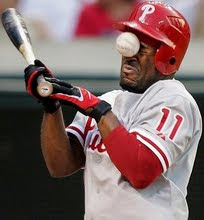
No wonder John Kruk predicted Randy Johnson to win 30 games in 2005
He didn't want to get on the Big Unit's Bad Side again.
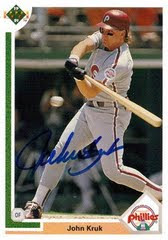
Furthermore, here is Krukie's 1991 Upper Deck card...

Little know fact: he actually struck out in this AB too.
And finally, Larry Walker and the short-lived backwards hat fad of the mid-90s.

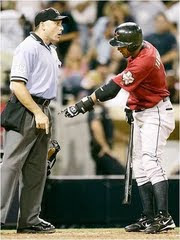
It's OK guys, Big Unit scares me too.
Furthermore, here is Krukie's 1991 Upper Deck card...

Little know fact: he actually struck out in this AB too.
And finally, Larry Walker and the short-lived backwards hat fad of the mid-90s.

It's OK guys, Big Unit scares me too.