On his [Justin Verlander's] deal with friend Daniel Hicks in 10th gradeAnd I thought Milk was expensive at $3.15 a gallon.
I wanted a chocolate milk that cost 50 cents, and I didn't have the money. So I said, "How about I give you. 1 percent of my pro signing bonus if you give me 50 cents now?" He found a napkin, wrote it up, and I signed it. I forgot about it, but after I signed, he comes over and whips out this old napkin. I'm like, Oh my God! My bonus was three-point-something million. Was a chocolate milk worth $3,000? I want to say yes. I was parched.
Showing posts with label Contract Law. Show all posts
Showing posts with label Contract Law. Show all posts
Justin Verlander Entered Into An Unconscionable, Voidable Contract For Milk In The 10th Grade
Per Sports Illustrated:


Chicago Landlord Suing Milton Bradley
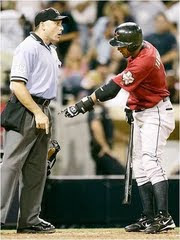
Milton Bradley has a history of problems. 2009 was no exception, as he hated on Cubs fans, fought with everyone from teammates to umpires, and even left games early when he got mad. But it was not just games that Milton Bradley skipped out on. According to the Chicago Sun-Times, Milton Bradley is being sued for walking out on a Condo-lease at the Magnificent Mile in Chicago. In the words of the author, "add his landlord to the list of people who don’t like former Cubs rightfielder Milton Bradley..."
The landlord is suing Bradley for $44,100 in back rent, late fees and interest through this month in addition to emotional damages for single-handedly ruining the Cubs 2009 season for fans everywhere.
The landlord is suing Bradley for $44,100 in back rent, late fees and interest through this month in addition to emotional damages for single-handedly ruining the Cubs 2009 season for fans everywhere.
The Marlins are REALLY cheap

The 2006 Florida Marlins' revenue stream took in $122 million. Where is that money going and why is Marlins owner Jeffrey Loria forcing the state to subsidize the Marlin's new stadium?? I'm shocked that the citizens of Florida are not more outraged that the city is funding approximately 75% of the $645 million new stadium in Miami. If the team wants to cut costs and increase profits by moving the team to a better location, they should do it on their own dime; it's called a business investment.
The New York Times article (the last link above) frames the issue particularly well:
The economic benefits could also prove illusory, analysts say, because spending at new stadiums often replaces money spent at old ones or comes at the expense of spending at theaters, restaurants and other entertainment sites.And yet, the Democrats of this country want more government. Go figure.
Eager to get the project rolling, Miami-Dade issued its bonds over the summer, when the municipal bond market was in flux. The county paid nearly a full percentage point more in interest to issue its bonds than if it had waited a few months. The Marlins agreed to buy the last $7 million of bonds that the county was unable to sell to the market.
As the recession has revealed, some conservative forecasts elsewhere proved too optimistic. In 1996, officials in Hamilton County, Ohio, expected their local sales tax revenue to grow 3 percent a year when they agreed to add a half-penny to pay for stadiums for the Cincinnati Reds and the Bengals. Instead, it has since grown 1.6 percent per year on average and fallen nearly 10 percent this year, forcing lawmakers to consider cutting the schools budget.
“Cincinnati is a smaller market, but it underscores that all these projects have risks, and Miami has to understand in the depths of this recession it may take longer to recover than people think,” said Mark Rosentraub, the author of “Major League Losers,” which examined stadium deals nationwide. Rosentraub called Miami’s agreement “reckless.”
This gallimaufry isn't just happening on the Eastern Seaboard. The Mariners pigeon-holed Seattle into building them a new stadium a decade ago and are now forcing the taxpayers to pay for essential repairs to the stadium. I guess the city is going to get the last laugh, however, as they recently approved building a strip club next door. Maybe they'll call it The Foul Pole (or Randy's Johnson).
(Check here to read the details of the Mariners contract with the city as cited in an except from King County v. Taxpayers of King County)
Sports and Basic Contract Law
Any above average sports fan knows how the contract situation in that sport goes. How the salary cap (of lack of one) affects how many year and how much money teams give to players. The ability to rework a players contract in football because those don't seem to be less set in stone versus a contract given to a hockey or basketball because of the salary cap is rigid because of the salary cap restrictions. These are extremely basic things that a sports fan like us would know just from watching the sports and ESPN in general. But after about a semester studying contracts in general (and believe me, I absolutely am not claiming to be an expert by any stretch of the imagination), it is interesting reading cases about how the laws of contracts that govern the actions of you and I affect the sports and instances we know and love.
The first case that I read recently involved the former #1 Boston Celtics pick Len Bias. Now basketball guys TBO and Cubsfan might know this case because the dude died of a cocaine overdose soon after getting drafted. What you may not know is that his his dad/ Estate sued the agent and agency representing Bias, because Bias' dad asked the agent to take out a $1,000,000.00 life insurance policy out on his life. The agent never did so and his dad did not do so because he thought the agent would. Bias's dad/ Estate sued the agency for essentially a breach of contract because the actions of the agent prevented the dad for taking out a life insurance policy which he soon after would have benefitted from.
The court in that case ruled that because the agent/agency proved that Bias was addicted to cocaine and because no insurance company would insure a cocaine user for $1,000,000.00, that the agent/agency did not do anything wrong.
Now the big case that came from Bias' death was a criminal charge regarding the people who supplied Bias was drugs and in fact caused Congress to pass a law colloquially known as "The Len Bias Law", but I did not read (and was not forced to read) that case so I am unfamiliar with it.
Another case that is probably more interesting because it involves minors playing basketball. This probably isn't in effect anymore because of NBA's new policy that you have to be one year removed from high school to play in the NBA, but the law opf contracts frowns upon minors enetering into contracts in general. Minors are viewed as not being competent to enter into contracts in general, so when young guys like Kobe, LeBron, and Darco Milic entered into the league, they were forced to sign contracts- yet were probably underage. Now, if you sign a contract with your parents (think student loans), then the contract becomes enforcable. Although I didn't see Kobe Doing Work, a line in the commercial was "I wasn't old enough to sign the contract from the Lakers; I had to have my parents sign it with me"
The reason I mentioned the shitty Darco Millic is being a case in my Contracts book discusses a case about him. When he was 16, he signed an exclusive endorsement with a sports management company. When he became 18 and a top draft pick (sidenote: he was drafted #2 over Dwayane Wade and Carmelo Anthony, oops) he offered to buy out this contract. When the company refused, Millic then opted out of the contract by himself saying he was too young too ever enter it to begin with- and the court allowed him to do that (However, Millic did end up having to return all the benefits he got from the management company).
Think about that. If Kobe had signed the contract with the Lakers alone, he probably could have opted out of that contract after a year or two. If he had played a year or two, shown how amazing he was, he possibly could have voided his own contract due to the age he was when he signed it and gotten a better one on the open market.
I'm not trying to make a point about anything here, I just personally find it interesting how the law has affected sports instances and I find it interesting when I read cases that involve sports or media instances.


The first case that I read recently involved the former #1 Boston Celtics pick Len Bias. Now basketball guys TBO and Cubsfan might know this case because the dude died of a cocaine overdose soon after getting drafted. What you may not know is that his his dad/ Estate sued the agent and agency representing Bias, because Bias' dad asked the agent to take out a $1,000,000.00 life insurance policy out on his life. The agent never did so and his dad did not do so because he thought the agent would. Bias's dad/ Estate sued the agency for essentially a breach of contract because the actions of the agent prevented the dad for taking out a life insurance policy which he soon after would have benefitted from.
The court in that case ruled that because the agent/agency proved that Bias was addicted to cocaine and because no insurance company would insure a cocaine user for $1,000,000.00, that the agent/agency did not do anything wrong.
Now the big case that came from Bias' death was a criminal charge regarding the people who supplied Bias was drugs and in fact caused Congress to pass a law colloquially known as "The Len Bias Law", but I did not read (and was not forced to read) that case so I am unfamiliar with it.
Another case that is probably more interesting because it involves minors playing basketball. This probably isn't in effect anymore because of NBA's new policy that you have to be one year removed from high school to play in the NBA, but the law opf contracts frowns upon minors enetering into contracts in general. Minors are viewed as not being competent to enter into contracts in general, so when young guys like Kobe, LeBron, and Darco Milic entered into the league, they were forced to sign contracts- yet were probably underage. Now, if you sign a contract with your parents (think student loans), then the contract becomes enforcable. Although I didn't see Kobe Doing Work, a line in the commercial was "I wasn't old enough to sign the contract from the Lakers; I had to have my parents sign it with me"
The reason I mentioned the shitty Darco Millic is being a case in my Contracts book discusses a case about him. When he was 16, he signed an exclusive endorsement with a sports management company. When he became 18 and a top draft pick (sidenote: he was drafted #2 over Dwayane Wade and Carmelo Anthony, oops) he offered to buy out this contract. When the company refused, Millic then opted out of the contract by himself saying he was too young too ever enter it to begin with- and the court allowed him to do that (However, Millic did end up having to return all the benefits he got from the management company).
Think about that. If Kobe had signed the contract with the Lakers alone, he probably could have opted out of that contract after a year or two. If he had played a year or two, shown how amazing he was, he possibly could have voided his own contract due to the age he was when he signed it and gotten a better one on the open market.
I'm not trying to make a point about anything here, I just personally find it interesting how the law has affected sports instances and I find it interesting when I read cases that involve sports or media instances.