The following is my latest article for The Hardball Times.
Today, the Cubs signed David DeJesus to a two-year, $8.5 million deal with a third-year option worth $6.5 million with a $1.5 million buyout. In other words, the Cubs signed a defensively adept outfielder/health risk with an average/slightly above average bat to a two-year, $10 million deal with a third-year marginal option cost of $5 million.
Using last year's market win value, they are essentially paying for a +1.0 WAR player each of the next two years (three, if they exercise his option). As identified in our 2012 Cubs offseason article, this is an excellent buy-low move.
Given DeJesus' age and health risks (he is 32 and only played a combined 222 games between 2010 and 2011, only once playing 150 games in a single season and only twice playing 140 over his eight-year major league career), $5 million a year might seem like merely fair compensation, while a two-year deal with a mandatory buyout might seem slightly generous.
However, contrary to that gut reaction, it is an extremely team-friendly deal in more ways than one. It not only is an expected surplus-value-providing contract, but, as will be explained below, it is also one that empowers the Cubs with extra payroll/positional flexibility to move Alfonso Soriano.
Let's begin by looking at DeJesus and his contract. First off, he is coming off his second-worst year in the majors since his rookie season. He only batted .240/.323/.376 (.309 wOBA), which is what enabled the Cubs to sign him so cheap in the first place.
However, even with such a poor batting line, DeJesus was still worth +2.2 WAR last season. Thanks to strong outfield defense (career +6 UZR/150 defender in the corners) and above-average base running (as measured by UBR) abilities (this despite being a career 51-for-97 base stealer), DeJesus is still an above-average major league player when his bat disappoints and he only plays 130 of his team's 162 games.
Accord to the world according to xBABIP, DeJesus was pretty unlucky with his balls in play in 2011. His .274 BABIP last year was a career low (by .015 points), and despite an uptick in strikeouts (17.0 percent compared to a career rate of 13.4 percent), DeJesus continued to drive the ball with authority (20.2 percent line drive rate). The result was an expected BABIP of .309, which was a full .035 points ahead of his actual results.
If we adjust DeJesus' batting line to reflect his xBABIP-based "true talent" line, then we should have expected him to hit .268/.347/.388 (.735 OPS) last season. Using his career BABIP rate (.316) in lieu of xBABIP, we could have expected a marginally better batting line of .273/.352/.393 (.745 OPS).
Oliver projects DeJesus for a .326 wOBA in Oakland for 2012 (.741 OPS). Such an improvement would mean the addition of 7-8 batting runs to DeJesus' 2011 batting value, bringing his expected 2011 WAR production to right about +3.0. And that's before you consider the move from spacious Oakland to Wrigley.
Those numbers might be off his career batting line of .284/.356/.421 (.776 OPS), but when you consider that the Oakland Colluseim played as a far worse hitters park than Kaufman Stadium last year, as it has for the past few seasons, especially for left handed batters—Kansas City has a slightly inflating wOBA index of 103 for lefties, while Oakland has a deflating index of 95—then the numbers really are not that far apart. And remember that offense around the league as a whole was down last year relative to the past few years.
So let's say DeJesus' talent line is not far off his career rate, maybe slightly below it. What can we expect from Wrigley's effects on DeJesus? For starters, it should help boost his very average power. Wrigley Field has a 120 index for left-handed home run power. That means DeJesus should be capable of 15 or more dingers if he can play 150 games (a big if, of course).
Wrigley also means that DeJesus should see a jump in his overall wOBA production. The Friendly Confines is one of the more notorious hitters parks in the National League, and as hinted above, the park tends to help left-handed hitters more than right-handed hitters.
Given that DeJesus was worth +2.2 WAR in only 131 games last season in one of baseball's most offense-zapping parks, I full expect him to be worth at least +3.0 WAR at Wrigley next season—keeping all else constant—with +4.0 WAR upside if he can stay healthy. At the very least, he should be able to turn in a pair of +2.0-2.5 WAR seasons for the Cubs.
If we pessimistically assume the DeJesus will only be worth between +4.0 and +5.0 cumulative WAR over the next two years, that makes his contract worth between $10 and $15 million dollars in "surplus" value to the team. If he is capable of something more, say +7.0 WAR over the next two years, that surplus value conceivably jumps to $25 million.
Let's take the pessimistic median of these projected ranges, for simplicity's sake, and assume for a moment that DeJesus' contract is worth a surplus value of $16 million over the next two years. What does this mean for the Cubs?
It means they are able to move Soriano without being prematurely forced to lean on Brett Jackson, for two reasons. First, DeJesus can simply take over Soriano's spot in the lineup. DeJesus has mostly played right the past few seasons, but he is no stranger to left (let alone center) field.
More importantly, however, it allows the Cubs to "eat" more of Soriano's salary without any real effect on the team's relative payroll and production. For every surplus production dollar that DeJesus is worth to the team, that is one dollar that can give away, for nothing, without changing the pre-signing status quo.
Soriano's remaining contract is essentially a three-year, $54 million deal. That's an $18 million annual expenditure, or $4 million more per year than Adam Dunn is making. If the Cubs were willing to eat half of Soriano's salary ($27 million) to move him before the DeJesus signing, this deal could potentially mean the team could eat up to an additional $16 million without being in any worse of a financial situation in terms of dollars spent and expected wins.
In other words, they potentially could be offering teams a three-year, $11 million-dollar commitment to obtain Soriano. That's roughly the fair market value of a single season of a player like Carlos Pena, which would make Soriano incredible attractive to even small-market teams.
More likely, however, it means the Cubs can now eat half of Soriano's salary without handcuffing their productive future (they go from "eating" $26 million to effective "eating" $10 million). While the money will still be sunk into Soriano's contract regardless, the value gained from the DeJesus deal will recoup much of that sunk cost.
Of course this all assumes a relatively flat aging curve and no adverse changes in health, which are bold assumptions. Nonetheless, I think this will prove to be a fantastic deal for the Cubs and a great sign of the shrewd, positive things to come during the Epstein/Hoyer era.
Showing posts with label Chicago Cubs. Show all posts
Showing posts with label Chicago Cubs. Show all posts
2012 Offseason Outlook: The Chicago Cubs
The following is a sneak peak of my upcoming article for The Hardball Times. The management section will be different, but I thought this draft would make an interesting read.
Hiring Theo Epstein and Jed Hoyer was a great step forward for the Cubs organization, whose last World Series appearance was 1945.
For the past 30 years, since the team passed from the Wrigley family, Cubs' ownership has rarely seen the team as anything more than a cash cow. Cubs games are a unique social experience that blend booze and brotherhood with more than 100 years of bad luck. Wrigleyville is a one-of-a-kind sports neighborhood that surrounds the field with good eats and plenty of bars. The atmosphere is safe and always welcoming (unless you are a Cardinals fan, in which case you get an in-all-good fun jostling). The slightly intoxicated Cubs fan -- second only to Wisconsin in inebriation per capita -- tends to be a complete 180 from the associated personality of a Philadelphia [choose your sport] fan*. This is why the Cubs are the lovable losers, who live at what has been dubbed the friendly confines. Heck, we're world famous for our bleacher bums.
*To be fair to those Phillies fans who threw batteries at J.D. Drew, some Cubs fan once threw a battery at former Cub Jacque Jones. Still, no stadium full of Cubs fans has ever booed Santa Claus."
Even though the Cubs are only sporadically good due to a history of poor management, unfortunate drafting and bad trades, their games have historically sold. People come for the environment more than the product on the field, to experience and take part in the fun. Over the past 30 years, the social aspect of Cubs games has grown from the bleacher bums, who are being phased out for overpriced corporate outings—the "white collar social." Wrigley Field has become the epitome of the casual—not to be confused with fair-weather—fan. It has evolved into more of a place to go than a place to truly care about the result.
Now, with more than a hundred years since the Cubs' last World Series win and with the losing teams of the past two seasons, fans are proving they are finally fed up with the way the organization has been run. This year, tickets to Cubs games could be purchased on StubHub for as low as $1. Even the "guaranteed to sell out" games, such as those against the Cardinals, did not sell out toward the end of the season. And even when the tickets sold—many purchased on speculation with the intent to resell—seats remained empty, poking holes in vending sales.
Firing general manager Jim Hendry in favor of guy who "embraces the numbers" was a big step forward for an organization that has not played "smart baseball." By all accounts, Hendry is one of the nicest guys in the business, and a real class act. Alas, Hendry's tenure as the Cubs' GM was marred by bad drafting, albatross contracts that featured no-trade clauses and player options, and disappointing failure despite three playoff runs. Hendry went all-in from 2007-2009. Had it paid off with a World Series berth, Cubs fans could probably stomach the team's current state of affairs as the cost of glorious success. But that success did not occur. Some great trades early in his role as the Cubs' G.M. (e.g., stealing Aramis Ramirez and Derek Lee), were countered by equally bad losses (the Juan Pierre deal and the Alfonso Soriano contract).
Even though the Cubs are one of the top five organizations in terms of revenue and payroll, throwing money around on players rarely solves one's problems unless you are New York. Even Boston, in a great position at the moment, has its issues due to a few big, bad salaries. If you are going to spend big, you need to hit. A big organization like the Cubs can afford to miss every now and then, but not consistently, and with the magnitude of commitment they did from 2007-2009.
New owner Tom Ricketts, in dropping Hendry in favor of Hoyer, and hiring Epstein as the president of baseball operations, indicated to Cubs fans that he cares about, and is committed to, winning. With Hoyer and Epstein aboard, and with the Cubs' payroll demons slowly but steadily shedding over the next two or three seasons (Soriano is signed through 2014), an era of sustainable success akin to Boston's past decade could be upon us. Drafting and prospect loading will be key over the next couple of years, as will be finding good low-risk, high-reward contracts that could return dividends.
The Cubs have a long way to go toward competing, but putting the right people in charge is a major first step. The Cubs have lacked a philosophy and direction, and this is one of the (many) things that has kept the Cubs from sustainable success. Since the mid-'90s, Cubs management has always talked about a youth movement when things got their roughest, only to catch lightning in a bottle a few years later and try to capitalize on that flash by sacrificing the future for the now. Toggling between rebuilding and going all-in over the past 15 years is just one reason the Cubs are in the position they are today, but it is a big one.
With the foundation laid, there is much work left ahead. Let's look at the state of the team, starting with the Cubs' strengths.
The Cubs' clearest strengths come at the hardest-to-fill positions. Between the young shortstop/second baseman Starlin Castro (depending on how his defense continues to develop) and the underrated power and patience of catcher Geovany Soto (new manager, less Koyie Hill?), the Cubs have mainstays at two of the most important spots on the field.
Provided the Cubs new manager gives Soto the playing time he deserves (despite being healthy over the past two seasons, he was in only a combined 230 games), they should see a modest offensive boost from 2011. Soto took a step back in terms of his walk rate and strikeout rate, which had progressed over the past few seasons, but still managed to turn in a respectable +2.1 WAR despite a .280 BABIP and limited playing time. The power that people were worried had disappeared stuck around, more or less. Power was down across the major leagues this year, and I expect Soto's ISO to be back over the .200 plateau in 2012. His defense, to the extent you trust the plus/minus system for catchers, has progressed from horrible to bad to average over the years, which is encouraging.
At second base, the Cubs have rookie Darwin Barney. Despite a hot-then-cold first/second half split, Barney was worth +2.2 WAR over 143 games. In other words, he is a slightly above average player making the league minimum for another two seasons. The Cubs could do worse, and keeping Barney frees up resources for the Cubs to spend elsewhere. If the Cubs want to take a low-risk, high-reward approach to the shallow free agent pool, however, Kelly Johnson could be a fit. That would slide Barney over to third base, where the Cubs have no one to play at the moment.
Johnson is a very attractive free agent because he possesses +4 WAR potential, as evidenced by 2007-08 and 2010, though 2010 was bookmarked by by two pretty disappointing seasons. If the Cubs do not sign a second baseman like Johnson and slide Barney over, they will need to bring in some outside help at third base, potentially in the form of Michael Cuddyer, but more on that below.
Meanwhile, in the upper minors, Brett Jackson continues to develop as the Cubs' center-fielder of the future. Jackson does not have an MVP or superstar ceiling, but he should be a consistent All-Star in his prime. Jackson has issues with strikeouts, but has a modest (20+ home run) power upside, speed and athleticism. Those should combine for a handful of 3-4+ WAR seasons if he can just cut down the whiff rate. That may be a big if, but Jackson is the most exciting Cubs hitting prospect to reach the upper minors in the past 10 years. He should arrive around the All-Star break.
Though the Cubs have strong enough starters, they lack depth up the middle. Their utility guy this year was a combination of Blake DeWitt, DJ LeMahieu and Jeff Baker, none of whom are anything but replacement level. LeMahieu probably has the most value of that group, given his age (23), but he is a light-hitting, no-walking, no-running middle infielder who is just a DL stopgap with a decent glove. If anyone up the middle for the Cubs gets injured for an ex tended time, there's not an even "average" replacement. Perhaps the Cubs will target a low-cost Jamey Carroll type in free agency; more likely, LeMahieu will have a graduated role in 2012 doing what he did down the stretch in 2011.
The Cubs are not just weak at the corners. They do not even have players reasonably scheduled to play third base, right field, or first base.
With Aramis Ramirez declining his player option (saving the Cubs $2 million in the process), the closest thing the Cubs have to a third baseman at the moment is Barney, who is playing second. Josh Vitters is the team's only prospect at the position, and he's been a massive disappointment to date, with neither walks nor power over the past three years. Vitters is only 22, so perhaps he has time, but it is hard to teach players with no patience at the plate how to walk. Vitters is playing pretty decently in the hitter-friendly Arizona Fall League, but those stats have to be taken with a grain of salt. A realistic outcome of the third base situation would be Johnson or Michael Cuddyer. He's 32, but third base is a vacuum for the Cubs and the third base free agency pool is shallower than the girls of the Jersey Shore. A three-year, $30-35 million deal may be in the cards for Cuddyer. Ramirez, to the extent he wants a four-year deal, is going to end up as an Oriole—where Cubs go to retire.
Right field is just as open as third base. Bryan LaHair could get first dibs on the gig in spring training, but, like many a Cubs hitting prospect over the past five years, he's approaching 30 has minimal major league experience. If the Cubs are going to give LaHair a chance at a full time gig, they might as well let him play first base. They would be better off letting the younger Jackson try out for right to get some major league experience for when he slides over to center field in 2013. That is not to say that LaHair isn't a promising power bat, but he is a first baseman in outfielder's clothing in right.
If the Cubs want to go outside the organization, Grady Sizemore on a one-year incentive-laden deal could make a lot of sense, as could a low-cost one- or two-year deal for David DeJesus as a stopgap until Jackson arrives. Either could get full-time outfield duties in 2012, and likely 2013, assuming Marlon Byrd gets traded to a contender in need of an outfielder upon Jackson's arrival. Josh Willingham could also fit as an interesting power bat if he is willing to take a two-, rather than three-, year deal.
In left field, Soriano is going nowhere. The Cubs could bring back Reed Johnson on another one-year deal as a fourth outfielder, but they also have Tony Campana and former first-round pick Luis Montanez trolling around as outfield defensive replacements at the league minimum.
The Cubs also need a first baseman, and lucky for them, not only is a lot of money coming off the books, but two of the four best guys are currently on the market. The Cubs, along with the Mariners and Nationals, are probably among the favorites to sign Prince Fielder. With the Cardinals having won the 2011 World Series in Disney-magic fashion, Albert Pujols leaving St. Louis seems a longshot at this point, but the Cubs are one of two teams, the other being Toronto, that could feasibly offer the slugger $300 million if they really wanted to.
Though both Fielder and Pujols are great players who would make great additions, the Cubs should save their money. Pujols, to the extent he would sign with someone other than the Cardinals, is more of a "win now" player. He will be 32 next season, and though his career-low WAR total is 5.1, that low figure came this year. Pujols should keep being great over the next few years, but aging curves are never gracious to athletes in their mid-30s who aren't on the juice. Pujols has been relatively healthy over the past few years, which is encouraging, but can he maintain health and production four, five, and even six years into a multi-year contract? Cubs fans know what happened to Soriano by 2009, and though Pujols is an infinitely better player than Soriano, there is no reason to expect him to maintain a +6-9 WAR pace into his age 35 season, which is what he would have to do to be worth his contract. Just ask the Yankees how that monstrous Alex Rodriguez deal is working out for them.
That said, Pujols has the type of plate discipline skills that age well, even with a power decline. But the Cubs are not in a position to win now. They are not even in a position to likely win in 2013. They need to rebuild. By the time the Cubs realistically can compete again, Pujols will be into his mid-30s, and by then, he will be eating up resources relative to his production that the Cubs could better allocate elsewhere.
Then what of Fielder, who is four years Pujols' junior? Fielder is probably the better player to sign for several reasons. The first is that he will cost less money than Pujols. Of course Fielder is also a lesser player than Pujols, but a lot of Pujols' superior present value would be lost on a non-contending team like the Cubs. Fielder is also younger, by four years, and he would still be in his prime, albeit the tail end of his prime, by the time the Cubs are competing again. Age and cost would make more sense as a long-term contract for a team that is not trying to "win now."
However, Fielder is not much of an "athlete" in the traditional sense of the word. We all know the real reason that the Brewers couldn't resign CC Sabathia after 2008 was that there was not enough food in Milwaukee to feed the two of them. Fangraphs had an excellent article about Fielder's expected aging curve a few weeks ago, noting that fat baseball players tend to age substantially less gracefully than other players:
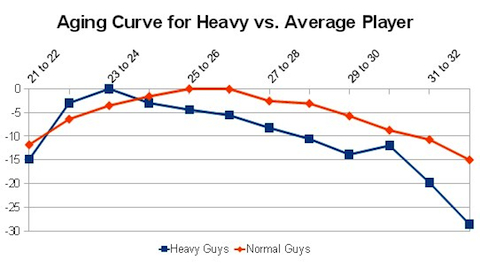
Do you remember what happened to Dmitri Young after he turned 31? Or Pat Burrell at 32? Or what happened to Adam Dunn this season? Nonathletic power hitters seem to fall rapidly when they hit their 30s, and even if their offense rebounds some, their defense remains atrocious. Fielder should be a fine player the next three or four seasons, but no better than Soriano by the time he is 33, and the Cubs would be paying him more than Soriano money for several years after that point.
So what should the Cubs do? In the short run, they'll certainly need a stopgap. This is where LaHair comes in. He has flashed really good power and patience for the Cubs (and before them, the Mariners) in the upper minors over the past few seasons. He also held his own for 20 games in the majors last season. Oliver projects LaHair as a .350-wOBA capable major league hitter (.800+ OPS) with a respectable on-base percentage and .200+ ISO power over the next two-plus years. His 2010 and 2009 major league equivalencies (MLEs) essentially agree. If nothing more, then, LaHair should be your very average first baseman, with some upside.
LaHair won't be a long term option, but he can certainly hold the place until 2014, when Joey Votto is a 30-year-old free agent. Votto is substantially more athletic than Fielder, and he'll be a couple of years younger than Pujols, and he is one of the most talented hitters in baseball. The Cubs would save money over the next two seasons, which could be allocated to Votto in the future, while being a better position to know what they'll need when they're in a position to compete, rather than guessing now and tossing around a lot of money to players who may or may not be worth it by 2014/2015.
Or the Cubs could turn back to Carlos Pena on another one-year deal, though the Pirates may offer two or three years out of desperation.
That is at least what I would do. However, the Cubs are probably going to sign Fielder for Carl Crawford money, in which case I hope I am dead wrong about how he'll age.
A major strength of the Cubs over the past decade, the rotation is currently in shambles and lacks an ace.
Matt Garza is the closest thing to an ace the Cubs have, but he's more an elite No. 2 type. Garza saw a huge jump in his strikeout rate when he moved to the National League this past season, though much of his whiff gain seemed to fizzle away in the second half. Garza's peripherals indicate he's capable of much better than his 2011 results in 2012. However, the Cubs gave up more in prospects to get Garza than the Brewers gave up to get Zack Greinke, and the value of a cost-controlled pitcher of Garza's talent is essentially lost on a team like the Cubs.
Ryan Dempster exercised his player option, and will return in 2012. Dempster was never an ace, but he's been a solid No. 2 starter for the past four years. Though 2011 was a disappointment by ERA/WHIP standards, Dempster's peripherals were essentially in line with his 2007-2009 performance heading into September, when he seemed to wear out down the stretch.
Beyond Dempster and Garza, the Cubs rotation has a lot of question marks. Will Carlos Zambrano be back? Probably not, and he most certainly will not return in 2013. Can Randy Wells and Andrew Cashner stay healthy for the Cubs? If each can, which Randy Wells—the one from the first or second half—will show up? Will Cashner's third pitch ever develop so that he can take the leap from questionable mid-rotation starter to a solid No. 2 type? Trey McNutt is the Cubs' top pitching prospect, but he took a major step back in Double-A last year—his strikeout rate fell and his walk rate spiked. McNutt looks to repeat Double-A next year, and could arrive in mid-2013 if all goes well, but he is no sure thing and is no ace even if he does pan out.
The Cubs gave a lot of starts to terrible pitchers in 2011. Among Casey Coleman, Doug Davis, Ramon Ortiz, Rodrigo Lopez, and James Russell, the Cubs gave 49 starts to substantially below-average pitchers. Of that group, only Lopez's 4.40 xFIP was within even 15 percent of league average. For 2012, the Cubs are going to need to bring in someone to shore up the back of the rotation. Joel Pinero is the most attractive and reasonably attainable free agent pitcher on the market for cheap. What Pinero lacks in strikeouts he makes up for in ground balls and a very limited walk rate. Pinero was kind of a disaster last year, so he should not cost too much on an incentive-laden one-year deal.
Javier Vazquez is another attractive name, worthy of a multi-year deal now that his velocity is back, but all signs currently point to him either retiring or returning to the Marlins. Likewise, Mark Buehrle would be a great innings eater, but would likely cost too much for what he does, and is more likely to stick with the White Sox or go to the Marlins, who probably will make a more attractive offer to fill out their team before the opening of their new stadium. The Cubs aren't likely to go after any of the "big" free agent pitchers, though a run at Yu Darvish could prove fruitful. Perhaps the Cubs can convince Roy Oswalt to come aboard at the right price, or woo Chris Capuano with a one-year deal.
In the bullpen, Carlos Marmol is still the Cubs closer, and Sean Marshall, who was a decent lefty starter a few years back, will remain an elite setup man. Kerry Wood could return on another one-year deal.
Jeff Samardzija will almost certainly be back; he has a $3 million option for 2012, which the Cubs probably will decline and work out a more team-friendly deal in light of how he's performed the past few years. Samardzija was serviceable in 2011, but he has to slash the walk rate. People not named Carlos Marmol have no excuse for walking 13.2 percent of the batters they face.
Chris Carpenter should be an interesting bullpen addition, assuming he is not converted back into a starter. Carpenter has control issues, but he also routinely hits triple digits on the radar gun and punches out a respectable number of batters with a strong groundball rate. If Carpenter cuts down the free passes, he could develop into an elite reliever for the Cubs. As a starter, he has a very limited ceiling because he really has only two pitches (and no control). Marco Mateo could also be good reliever, but like many before him, he is a high-strikeout, high-walk guy who cannot be relied upon in high-leverage situations. And if If Mateo is questionable, the rest of the bullpen is a double question mark. Between Chris Archer (in the Garza deal) and Jose Ceda (in the Kevin Gregg deal), the Cubs have traded away most of their electric relief arms in recent years. Jay Jackson has plateaued in talent as he reached the upper minors as a starter, so perhaps as a converted reliever he could develop into a reliable reliever for the Cubs given his good control and respectable strikeout rates as a starter. Rafael Dolis, a converted position player, could develop into a Sergio Santos type given his 96 mph fastball and supposedly electric slider/changeup combo, but his control needs a lot of work before he becomes a high-leverage reliever.
These question marks mean that the Cubs bullpen, outside its top three names (four, if Wood returns), is going to be a mess of young, rough, and still-developing pitchers unless Hoyer and Epstein find someone better (and relatively cheap) on the free agent market. On the brigh tside, the Cubs bullpen is entirely cost-controlled, so at least it won't be an expensive disaster when a starter gets knocked out early.
Tim Dierkes did a great job covering the Cubs' projected 2012 payroll situation last month.
Though the Cubs have had one of the highest payrolls in baseball in recent years, most of those contracts are finally starting to come off the books. Between Ramirez and Kosuke Fukudome, the Cubs are going to save $30 million in payroll. Another $5 million, half of Pena's salary, will be gone as well, though all of that and then some will go toward salary boosts for Soto, Garza and Byrd. John Grabow is off the books as well, which saves the Cubs roughly $5 million. If the Cubs can get some team to eat $5 million or so of Zambrano's salary (the Marlins?), they could free up between $30 and $40 million for 2012 when other players who will not be returning are considered.
In addition to that money, the Cubs will have Zambrano's $18 million, Dempster's $14 million, $6.5 million from Byrd, and another $5 million from Pena coming off the books for 2013, giving the Cubs between $50 and $60 million to work with over the next two seasons. Unfortunately, Soriano's $18 million per year will be around another three seasons, though the Cubs could move him to an AL team in need of a DH if they are willing to eat a lot of the salary. Even with Soriano on the books, Epstein andHoyer should be able to afford the necessary pieces, though one hopes a lot of the money is spent on the 2012 and 2013 drafts.
The Cubs' farm system is a disaster. Though they lacked a true star heading into 2011, the Cubs had enough depth to make them a borderline top 10 farm system. The Matt Garza deal eliminated almost all that depth, and what the Cubs are left with is a questionable No. 2 starterm in McNutt, a flawed but promising center field prospect in Jackson, and a prototypical Cubs prospect in Matt Szczur: a speedy "tools" guy who does not walk and has almost no power, like Montanez. The Cubs' top draft pick in 2012, Javier Baez, is a promising third base prospect (his shortstop defense is probably not good enough to stick), who could leapfrog Vitters with a good 2012 season in the minors. Hayden Simpson was a questionable pick in 2011, and his first year in the minors was a disaster.
Mike Quade is out, and it looks like Mike Maddux is the favorite to replace him. That could create an interesting dynamic because he could bring in his brother Greg to join the coaching staff. The Maddux brothers know quite a lot about pitching, and they could teach the Cubs young pitchers a lot of valuable game theory in addition to polishing their pitching mechanics. If Mike Maddux does not join the Cubs, Greg Maddux, who worked as a special consultant to Hendry, probably will not return in 2012 due to family issues.
The Cubs are a disaster at the moment, but Tom Ricketts is laying the foundation necessary to rebuild not only the team, but the franchise. Epstein and Hoyer have a long, uphill battle, but they are the right guys for the challenge. The Cubs have a foundation to build on with good up-the-middle starters. Corner positions are much easier to fill and the Cubs will have the payroll to make the necessary moves. The future of the Cubs rotation looks to be somewhat of a mess, with lots of question marks surrounding their prospects. They will need to bring in some outside help or make some very good draft picks and-or trades in the next couple of years.
What do you think about the Cubs' 2012 and future outlook? What moves would you like to see the Cubs make and why? Who is excited for the Epstein-Hoyer era to begin?
Hiring Theo Epstein and Jed Hoyer was a great step forward for the Cubs organization, whose last World Series appearance was 1945.
For the past 30 years, since the team passed from the Wrigley family, Cubs' ownership has rarely seen the team as anything more than a cash cow. Cubs games are a unique social experience that blend booze and brotherhood with more than 100 years of bad luck. Wrigleyville is a one-of-a-kind sports neighborhood that surrounds the field with good eats and plenty of bars. The atmosphere is safe and always welcoming (unless you are a Cardinals fan, in which case you get an in-all-good fun jostling). The slightly intoxicated Cubs fan -- second only to Wisconsin in inebriation per capita -- tends to be a complete 180 from the associated personality of a Philadelphia [choose your sport] fan*. This is why the Cubs are the lovable losers, who live at what has been dubbed the friendly confines. Heck, we're world famous for our bleacher bums.
*To be fair to those Phillies fans who threw batteries at J.D. Drew, some Cubs fan once threw a battery at former Cub Jacque Jones. Still, no stadium full of Cubs fans has ever booed Santa Claus."
Even though the Cubs are only sporadically good due to a history of poor management, unfortunate drafting and bad trades, their games have historically sold. People come for the environment more than the product on the field, to experience and take part in the fun. Over the past 30 years, the social aspect of Cubs games has grown from the bleacher bums, who are being phased out for overpriced corporate outings—the "white collar social." Wrigley Field has become the epitome of the casual—not to be confused with fair-weather—fan. It has evolved into more of a place to go than a place to truly care about the result.
Now, with more than a hundred years since the Cubs' last World Series win and with the losing teams of the past two seasons, fans are proving they are finally fed up with the way the organization has been run. This year, tickets to Cubs games could be purchased on StubHub for as low as $1. Even the "guaranteed to sell out" games, such as those against the Cardinals, did not sell out toward the end of the season. And even when the tickets sold—many purchased on speculation with the intent to resell—seats remained empty, poking holes in vending sales.
Firing general manager Jim Hendry in favor of guy who "embraces the numbers" was a big step forward for an organization that has not played "smart baseball." By all accounts, Hendry is one of the nicest guys in the business, and a real class act. Alas, Hendry's tenure as the Cubs' GM was marred by bad drafting, albatross contracts that featured no-trade clauses and player options, and disappointing failure despite three playoff runs. Hendry went all-in from 2007-2009. Had it paid off with a World Series berth, Cubs fans could probably stomach the team's current state of affairs as the cost of glorious success. But that success did not occur. Some great trades early in his role as the Cubs' G.M. (e.g., stealing Aramis Ramirez and Derek Lee), were countered by equally bad losses (the Juan Pierre deal and the Alfonso Soriano contract).
Even though the Cubs are one of the top five organizations in terms of revenue and payroll, throwing money around on players rarely solves one's problems unless you are New York. Even Boston, in a great position at the moment, has its issues due to a few big, bad salaries. If you are going to spend big, you need to hit. A big organization like the Cubs can afford to miss every now and then, but not consistently, and with the magnitude of commitment they did from 2007-2009.
New owner Tom Ricketts, in dropping Hendry in favor of Hoyer, and hiring Epstein as the president of baseball operations, indicated to Cubs fans that he cares about, and is committed to, winning. With Hoyer and Epstein aboard, and with the Cubs' payroll demons slowly but steadily shedding over the next two or three seasons (Soriano is signed through 2014), an era of sustainable success akin to Boston's past decade could be upon us. Drafting and prospect loading will be key over the next couple of years, as will be finding good low-risk, high-reward contracts that could return dividends.
The Cubs have a long way to go toward competing, but putting the right people in charge is a major first step. The Cubs have lacked a philosophy and direction, and this is one of the (many) things that has kept the Cubs from sustainable success. Since the mid-'90s, Cubs management has always talked about a youth movement when things got their roughest, only to catch lightning in a bottle a few years later and try to capitalize on that flash by sacrificing the future for the now. Toggling between rebuilding and going all-in over the past 15 years is just one reason the Cubs are in the position they are today, but it is a big one.
With the foundation laid, there is much work left ahead. Let's look at the state of the team, starting with the Cubs' strengths.
Up the middle
The Cubs' clearest strengths come at the hardest-to-fill positions. Between the young shortstop/second baseman Starlin Castro (depending on how his defense continues to develop) and the underrated power and patience of catcher Geovany Soto (new manager, less Koyie Hill?), the Cubs have mainstays at two of the most important spots on the field.
Provided the Cubs new manager gives Soto the playing time he deserves (despite being healthy over the past two seasons, he was in only a combined 230 games), they should see a modest offensive boost from 2011. Soto took a step back in terms of his walk rate and strikeout rate, which had progressed over the past few seasons, but still managed to turn in a respectable +2.1 WAR despite a .280 BABIP and limited playing time. The power that people were worried had disappeared stuck around, more or less. Power was down across the major leagues this year, and I expect Soto's ISO to be back over the .200 plateau in 2012. His defense, to the extent you trust the plus/minus system for catchers, has progressed from horrible to bad to average over the years, which is encouraging.
At second base, the Cubs have rookie Darwin Barney. Despite a hot-then-cold first/second half split, Barney was worth +2.2 WAR over 143 games. In other words, he is a slightly above average player making the league minimum for another two seasons. The Cubs could do worse, and keeping Barney frees up resources for the Cubs to spend elsewhere. If the Cubs want to take a low-risk, high-reward approach to the shallow free agent pool, however, Kelly Johnson could be a fit. That would slide Barney over to third base, where the Cubs have no one to play at the moment.
Johnson is a very attractive free agent because he possesses +4 WAR potential, as evidenced by 2007-08 and 2010, though 2010 was bookmarked by by two pretty disappointing seasons. If the Cubs do not sign a second baseman like Johnson and slide Barney over, they will need to bring in some outside help at third base, potentially in the form of Michael Cuddyer, but more on that below.
Meanwhile, in the upper minors, Brett Jackson continues to develop as the Cubs' center-fielder of the future. Jackson does not have an MVP or superstar ceiling, but he should be a consistent All-Star in his prime. Jackson has issues with strikeouts, but has a modest (20+ home run) power upside, speed and athleticism. Those should combine for a handful of 3-4+ WAR seasons if he can just cut down the whiff rate. That may be a big if, but Jackson is the most exciting Cubs hitting prospect to reach the upper minors in the past 10 years. He should arrive around the All-Star break.
Though the Cubs have strong enough starters, they lack depth up the middle. Their utility guy this year was a combination of Blake DeWitt, DJ LeMahieu and Jeff Baker, none of whom are anything but replacement level. LeMahieu probably has the most value of that group, given his age (23), but he is a light-hitting, no-walking, no-running middle infielder who is just a DL stopgap with a decent glove. If anyone up the middle for the Cubs gets injured for an ex tended time, there's not an even "average" replacement. Perhaps the Cubs will target a low-cost Jamey Carroll type in free agency; more likely, LeMahieu will have a graduated role in 2012 doing what he did down the stretch in 2011.
Corner infield
The Cubs are not just weak at the corners. They do not even have players reasonably scheduled to play third base, right field, or first base.
With Aramis Ramirez declining his player option (saving the Cubs $2 million in the process), the closest thing the Cubs have to a third baseman at the moment is Barney, who is playing second. Josh Vitters is the team's only prospect at the position, and he's been a massive disappointment to date, with neither walks nor power over the past three years. Vitters is only 22, so perhaps he has time, but it is hard to teach players with no patience at the plate how to walk. Vitters is playing pretty decently in the hitter-friendly Arizona Fall League, but those stats have to be taken with a grain of salt. A realistic outcome of the third base situation would be Johnson or Michael Cuddyer. He's 32, but third base is a vacuum for the Cubs and the third base free agency pool is shallower than the girls of the Jersey Shore. A three-year, $30-35 million deal may be in the cards for Cuddyer. Ramirez, to the extent he wants a four-year deal, is going to end up as an Oriole—where Cubs go to retire.
Right field is just as open as third base. Bryan LaHair could get first dibs on the gig in spring training, but, like many a Cubs hitting prospect over the past five years, he's approaching 30 has minimal major league experience. If the Cubs are going to give LaHair a chance at a full time gig, they might as well let him play first base. They would be better off letting the younger Jackson try out for right to get some major league experience for when he slides over to center field in 2013. That is not to say that LaHair isn't a promising power bat, but he is a first baseman in outfielder's clothing in right.
If the Cubs want to go outside the organization, Grady Sizemore on a one-year incentive-laden deal could make a lot of sense, as could a low-cost one- or two-year deal for David DeJesus as a stopgap until Jackson arrives. Either could get full-time outfield duties in 2012, and likely 2013, assuming Marlon Byrd gets traded to a contender in need of an outfielder upon Jackson's arrival. Josh Willingham could also fit as an interesting power bat if he is willing to take a two-, rather than three-, year deal.
In left field, Soriano is going nowhere. The Cubs could bring back Reed Johnson on another one-year deal as a fourth outfielder, but they also have Tony Campana and former first-round pick Luis Montanez trolling around as outfield defensive replacements at the league minimum.
The Cubs also need a first baseman, and lucky for them, not only is a lot of money coming off the books, but two of the four best guys are currently on the market. The Cubs, along with the Mariners and Nationals, are probably among the favorites to sign Prince Fielder. With the Cardinals having won the 2011 World Series in Disney-magic fashion, Albert Pujols leaving St. Louis seems a longshot at this point, but the Cubs are one of two teams, the other being Toronto, that could feasibly offer the slugger $300 million if they really wanted to.
Though both Fielder and Pujols are great players who would make great additions, the Cubs should save their money. Pujols, to the extent he would sign with someone other than the Cardinals, is more of a "win now" player. He will be 32 next season, and though his career-low WAR total is 5.1, that low figure came this year. Pujols should keep being great over the next few years, but aging curves are never gracious to athletes in their mid-30s who aren't on the juice. Pujols has been relatively healthy over the past few years, which is encouraging, but can he maintain health and production four, five, and even six years into a multi-year contract? Cubs fans know what happened to Soriano by 2009, and though Pujols is an infinitely better player than Soriano, there is no reason to expect him to maintain a +6-9 WAR pace into his age 35 season, which is what he would have to do to be worth his contract. Just ask the Yankees how that monstrous Alex Rodriguez deal is working out for them.
That said, Pujols has the type of plate discipline skills that age well, even with a power decline. But the Cubs are not in a position to win now. They are not even in a position to likely win in 2013. They need to rebuild. By the time the Cubs realistically can compete again, Pujols will be into his mid-30s, and by then, he will be eating up resources relative to his production that the Cubs could better allocate elsewhere.
Then what of Fielder, who is four years Pujols' junior? Fielder is probably the better player to sign for several reasons. The first is that he will cost less money than Pujols. Of course Fielder is also a lesser player than Pujols, but a lot of Pujols' superior present value would be lost on a non-contending team like the Cubs. Fielder is also younger, by four years, and he would still be in his prime, albeit the tail end of his prime, by the time the Cubs are competing again. Age and cost would make more sense as a long-term contract for a team that is not trying to "win now."
However, Fielder is not much of an "athlete" in the traditional sense of the word. We all know the real reason that the Brewers couldn't resign CC Sabathia after 2008 was that there was not enough food in Milwaukee to feed the two of them. Fangraphs had an excellent article about Fielder's expected aging curve a few weeks ago, noting that fat baseball players tend to age substantially less gracefully than other players:
Do you remember what happened to Dmitri Young after he turned 31? Or Pat Burrell at 32? Or what happened to Adam Dunn this season? Nonathletic power hitters seem to fall rapidly when they hit their 30s, and even if their offense rebounds some, their defense remains atrocious. Fielder should be a fine player the next three or four seasons, but no better than Soriano by the time he is 33, and the Cubs would be paying him more than Soriano money for several years after that point.
So what should the Cubs do? In the short run, they'll certainly need a stopgap. This is where LaHair comes in. He has flashed really good power and patience for the Cubs (and before them, the Mariners) in the upper minors over the past few seasons. He also held his own for 20 games in the majors last season. Oliver projects LaHair as a .350-wOBA capable major league hitter (.800+ OPS) with a respectable on-base percentage and .200+ ISO power over the next two-plus years. His 2010 and 2009 major league equivalencies (MLEs) essentially agree. If nothing more, then, LaHair should be your very average first baseman, with some upside.
LaHair won't be a long term option, but he can certainly hold the place until 2014, when Joey Votto is a 30-year-old free agent. Votto is substantially more athletic than Fielder, and he'll be a couple of years younger than Pujols, and he is one of the most talented hitters in baseball. The Cubs would save money over the next two seasons, which could be allocated to Votto in the future, while being a better position to know what they'll need when they're in a position to compete, rather than guessing now and tossing around a lot of money to players who may or may not be worth it by 2014/2015.
Or the Cubs could turn back to Carlos Pena on another one-year deal, though the Pirates may offer two or three years out of desperation.
That is at least what I would do. However, the Cubs are probably going to sign Fielder for Carl Crawford money, in which case I hope I am dead wrong about how he'll age.
Pitching
A major strength of the Cubs over the past decade, the rotation is currently in shambles and lacks an ace.
Matt Garza is the closest thing to an ace the Cubs have, but he's more an elite No. 2 type. Garza saw a huge jump in his strikeout rate when he moved to the National League this past season, though much of his whiff gain seemed to fizzle away in the second half. Garza's peripherals indicate he's capable of much better than his 2011 results in 2012. However, the Cubs gave up more in prospects to get Garza than the Brewers gave up to get Zack Greinke, and the value of a cost-controlled pitcher of Garza's talent is essentially lost on a team like the Cubs.
Ryan Dempster exercised his player option, and will return in 2012. Dempster was never an ace, but he's been a solid No. 2 starter for the past four years. Though 2011 was a disappointment by ERA/WHIP standards, Dempster's peripherals were essentially in line with his 2007-2009 performance heading into September, when he seemed to wear out down the stretch.
Beyond Dempster and Garza, the Cubs rotation has a lot of question marks. Will Carlos Zambrano be back? Probably not, and he most certainly will not return in 2013. Can Randy Wells and Andrew Cashner stay healthy for the Cubs? If each can, which Randy Wells—the one from the first or second half—will show up? Will Cashner's third pitch ever develop so that he can take the leap from questionable mid-rotation starter to a solid No. 2 type? Trey McNutt is the Cubs' top pitching prospect, but he took a major step back in Double-A last year—his strikeout rate fell and his walk rate spiked. McNutt looks to repeat Double-A next year, and could arrive in mid-2013 if all goes well, but he is no sure thing and is no ace even if he does pan out.
The Cubs gave a lot of starts to terrible pitchers in 2011. Among Casey Coleman, Doug Davis, Ramon Ortiz, Rodrigo Lopez, and James Russell, the Cubs gave 49 starts to substantially below-average pitchers. Of that group, only Lopez's 4.40 xFIP was within even 15 percent of league average. For 2012, the Cubs are going to need to bring in someone to shore up the back of the rotation. Joel Pinero is the most attractive and reasonably attainable free agent pitcher on the market for cheap. What Pinero lacks in strikeouts he makes up for in ground balls and a very limited walk rate. Pinero was kind of a disaster last year, so he should not cost too much on an incentive-laden one-year deal.
Javier Vazquez is another attractive name, worthy of a multi-year deal now that his velocity is back, but all signs currently point to him either retiring or returning to the Marlins. Likewise, Mark Buehrle would be a great innings eater, but would likely cost too much for what he does, and is more likely to stick with the White Sox or go to the Marlins, who probably will make a more attractive offer to fill out their team before the opening of their new stadium. The Cubs aren't likely to go after any of the "big" free agent pitchers, though a run at Yu Darvish could prove fruitful. Perhaps the Cubs can convince Roy Oswalt to come aboard at the right price, or woo Chris Capuano with a one-year deal.
In the bullpen, Carlos Marmol is still the Cubs closer, and Sean Marshall, who was a decent lefty starter a few years back, will remain an elite setup man. Kerry Wood could return on another one-year deal.
Jeff Samardzija will almost certainly be back; he has a $3 million option for 2012, which the Cubs probably will decline and work out a more team-friendly deal in light of how he's performed the past few years. Samardzija was serviceable in 2011, but he has to slash the walk rate. People not named Carlos Marmol have no excuse for walking 13.2 percent of the batters they face.
Chris Carpenter should be an interesting bullpen addition, assuming he is not converted back into a starter. Carpenter has control issues, but he also routinely hits triple digits on the radar gun and punches out a respectable number of batters with a strong groundball rate. If Carpenter cuts down the free passes, he could develop into an elite reliever for the Cubs. As a starter, he has a very limited ceiling because he really has only two pitches (and no control). Marco Mateo could also be good reliever, but like many before him, he is a high-strikeout, high-walk guy who cannot be relied upon in high-leverage situations. And if If Mateo is questionable, the rest of the bullpen is a double question mark. Between Chris Archer (in the Garza deal) and Jose Ceda (in the Kevin Gregg deal), the Cubs have traded away most of their electric relief arms in recent years. Jay Jackson has plateaued in talent as he reached the upper minors as a starter, so perhaps as a converted reliever he could develop into a reliable reliever for the Cubs given his good control and respectable strikeout rates as a starter. Rafael Dolis, a converted position player, could develop into a Sergio Santos type given his 96 mph fastball and supposedly electric slider/changeup combo, but his control needs a lot of work before he becomes a high-leverage reliever.
These question marks mean that the Cubs bullpen, outside its top three names (four, if Wood returns), is going to be a mess of young, rough, and still-developing pitchers unless Hoyer and Epstein find someone better (and relatively cheap) on the free agent market. On the brigh tside, the Cubs bullpen is entirely cost-controlled, so at least it won't be an expensive disaster when a starter gets knocked out early.
Payroll
Tim Dierkes did a great job covering the Cubs' projected 2012 payroll situation last month.
Though the Cubs have had one of the highest payrolls in baseball in recent years, most of those contracts are finally starting to come off the books. Between Ramirez and Kosuke Fukudome, the Cubs are going to save $30 million in payroll. Another $5 million, half of Pena's salary, will be gone as well, though all of that and then some will go toward salary boosts for Soto, Garza and Byrd. John Grabow is off the books as well, which saves the Cubs roughly $5 million. If the Cubs can get some team to eat $5 million or so of Zambrano's salary (the Marlins?), they could free up between $30 and $40 million for 2012 when other players who will not be returning are considered.
In addition to that money, the Cubs will have Zambrano's $18 million, Dempster's $14 million, $6.5 million from Byrd, and another $5 million from Pena coming off the books for 2013, giving the Cubs between $50 and $60 million to work with over the next two seasons. Unfortunately, Soriano's $18 million per year will be around another three seasons, though the Cubs could move him to an AL team in need of a DH if they are willing to eat a lot of the salary. Even with Soriano on the books, Epstein andHoyer should be able to afford the necessary pieces, though one hopes a lot of the money is spent on the 2012 and 2013 drafts.
Pipeline
The Cubs' farm system is a disaster. Though they lacked a true star heading into 2011, the Cubs had enough depth to make them a borderline top 10 farm system. The Matt Garza deal eliminated almost all that depth, and what the Cubs are left with is a questionable No. 2 starterm in McNutt, a flawed but promising center field prospect in Jackson, and a prototypical Cubs prospect in Matt Szczur: a speedy "tools" guy who does not walk and has almost no power, like Montanez. The Cubs' top draft pick in 2012, Javier Baez, is a promising third base prospect (his shortstop defense is probably not good enough to stick), who could leapfrog Vitters with a good 2012 season in the minors. Hayden Simpson was a questionable pick in 2011, and his first year in the minors was a disaster.
Management
Mike Quade is out, and it looks like Mike Maddux is the favorite to replace him. That could create an interesting dynamic because he could bring in his brother Greg to join the coaching staff. The Maddux brothers know quite a lot about pitching, and they could teach the Cubs young pitchers a lot of valuable game theory in addition to polishing their pitching mechanics. If Mike Maddux does not join the Cubs, Greg Maddux, who worked as a special consultant to Hendry, probably will not return in 2012 due to family issues.
Conclusion
The Cubs are a disaster at the moment, but Tom Ricketts is laying the foundation necessary to rebuild not only the team, but the franchise. Epstein and Hoyer have a long, uphill battle, but they are the right guys for the challenge. The Cubs have a foundation to build on with good up-the-middle starters. Corner positions are much easier to fill and the Cubs will have the payroll to make the necessary moves. The future of the Cubs rotation looks to be somewhat of a mess, with lots of question marks surrounding their prospects. They will need to bring in some outside help or make some very good draft picks and-or trades in the next couple of years.
What do you think about the Cubs' 2012 and future outlook? What moves would you like to see the Cubs make and why? Who is excited for the Epstein-Hoyer era to begin?


The Search for the Next Cubs GM
I started writing this article on the Cubs search for their next GM, but wasn’t able to finish it before it was announced that the Cubs have hired their new President of baseball Operations in Theo Epstein and General manager in Jed Hoyer. I decided to finish and post this article as planned and a future article will come on my opinion solely on the hire of the new Cubs front office with Epstein heading up baseball operations and the new direction for the organization. So please keep in mind that this article was written evaluating the Cubs front office and their options before they hired their new GM.
The Chicago Cubs will be looking for a new manager this off season. I am sure they have actually started their search since the day they announced they have let former General Manager Jim Hendry go. The Cubs have their handful finding the right guy to take over the reins for this job. The Cubs do not have anyone with baseball experience within their organization calling the shots now. Thus, the new General Manager will need to be very talented and insightful to clean up the mess he has inherited and build up the organization from the bottom up. The Cubs aren’t in the worse situation in the league, like some of the teams such as Houston, Seattle, to name a few. They have some prospects and some money off the books, but the new GM needs to build a plan for the organization, put an emphasize on the minor league system, stress the fundamentals from the minors league system to the Major league level, and find a Manager who knows how to coach. I figured we should look at some of the general manager candidates who may be mentioned and then those who probably won’t be considered, but should be who could possibly handle the job as General manager of the Chicago Cubs to end the drought and clean up the mess that keeps getting deeper from Ed Lynch to Andy MacPhail, to Jim Hendry.
The Cubs reached out to Hall of famer Pat Gillick recently and asked him to join the Cubs organization in some capacity such as a special assistant to the owner reporting to Tom Rickets. After Pat Gillick stepped down after the rigous duties of being an GM of the Phillies he became an advisor for them. The same type of role the Cubs have offered him. So why would he want to leave a team that when he took over as GM several years he built the team up to what it is today? They also have a great thing going in Philliadpha being a contender every year with the stellar rotation. If he left the good situation he is now to come to Chicago he would want a position of power to be able to steer this sinking ship in the right direction and get it pointed up instead of going further down. That is why he supposedly told the cubs he would only come as President. That way he would have control over the Cubs to set the direction for the organization from top to bottom. It is also rumored he doesn’t want to take orders from current Cubs president Crake Kennedy, even though he is a business guy. Because Kennedy is president he tries to get involved is all aspects of the club, even though his expertise is only business. Thus, having Kennedy as President has scared a Hall of famer like Gillick away. I would have liked them to bring Gillick in as President with him setting the tone for the organization and guiding the GM he picks. That way he can mentor someone who has some old school smarts like himself, but also may be a little more analytical and advanced stat savvy. Gillick coming to the Cubs is done so lets move on to possibly alternatives.
My first choice for GM would be Andrew Friedman whom I consider to be the best GM in baseball. He has one year left on his contract with the Rays, where he has a limited budget, and in a tough division with the Red Sox and Yankees. So I wouldn’t be surprised if he is interested in the Chicago Cubs job. He is very analytical, knows how to analyze numbers coming from wall street, and has experience running a baseball organization.
My second choice is Theo Epstein whom became the youngest GM at 28 for Boston. In 9 years he has won them 2 championships with a big payroll and rebuilt their farm system. He drafted superstars in Dustin Pedoria, Jacoby Ellsbury, Johnanton Pappelbon, and traded for many others to help them win their championship like Mike Lowell, Josh Beckett. He knows how to draft well and spend money wisely of a big market club, even though some may question that with the signings of John Lackey, Carl Crawford, and J.D. Drew. The only one of those that was really bad at the time and will be regretted is John Lackey. Oh, lets not forget about Dice-K.
Brian Chashman is rumored to be a candidate because his contract is up with the Yankees. I am not a big fan of Cashman though because I don’t know what he has done. He has an endless budget and has hired some good scouting directors to drafts some good talent to keep or use as trade bait. The Yankees may always be good and competeitve, but I don’t think Cashman could have the same success in Chicago and I think he would fail like MacPhail and Jim Hendry did.
Billy Beane has also been mentioned, but like I don’t think he is qualified for the difficulties of this job to turn things around. The Oakland Athletics’ haven’t been in the post season in years because other teams have adaptive to his style and he hasn’t adaptive to the game. He needs to balanced in his approach to the game to gain his advantage to put a winner on the field and he isn’t. That is why he isn’t our guy to run the Cubs.
The Cubs need someone who can turn around an entire organization from top to bottom and that is why Theo Epstein was a great choice. The Cubs have a few talented players thanks to Tim Wilken and isn’t in terrible shape like some teams, but needed someone like Epstein who is one on the few executives currently active in the game in the game that I like who is smart enough to turn around an organization in shambles!
The Chicago Cubs will be looking for a new manager this off season. I am sure they have actually started their search since the day they announced they have let former General Manager Jim Hendry go. The Cubs have their handful finding the right guy to take over the reins for this job. The Cubs do not have anyone with baseball experience within their organization calling the shots now. Thus, the new General Manager will need to be very talented and insightful to clean up the mess he has inherited and build up the organization from the bottom up. The Cubs aren’t in the worse situation in the league, like some of the teams such as Houston, Seattle, to name a few. They have some prospects and some money off the books, but the new GM needs to build a plan for the organization, put an emphasize on the minor league system, stress the fundamentals from the minors league system to the Major league level, and find a Manager who knows how to coach. I figured we should look at some of the general manager candidates who may be mentioned and then those who probably won’t be considered, but should be who could possibly handle the job as General manager of the Chicago Cubs to end the drought and clean up the mess that keeps getting deeper from Ed Lynch to Andy MacPhail, to Jim Hendry.
The Cubs reached out to Hall of famer Pat Gillick recently and asked him to join the Cubs organization in some capacity such as a special assistant to the owner reporting to Tom Rickets. After Pat Gillick stepped down after the rigous duties of being an GM of the Phillies he became an advisor for them. The same type of role the Cubs have offered him. So why would he want to leave a team that when he took over as GM several years he built the team up to what it is today? They also have a great thing going in Philliadpha being a contender every year with the stellar rotation. If he left the good situation he is now to come to Chicago he would want a position of power to be able to steer this sinking ship in the right direction and get it pointed up instead of going further down. That is why he supposedly told the cubs he would only come as President. That way he would have control over the Cubs to set the direction for the organization from top to bottom. It is also rumored he doesn’t want to take orders from current Cubs president Crake Kennedy, even though he is a business guy. Because Kennedy is president he tries to get involved is all aspects of the club, even though his expertise is only business. Thus, having Kennedy as President has scared a Hall of famer like Gillick away. I would have liked them to bring Gillick in as President with him setting the tone for the organization and guiding the GM he picks. That way he can mentor someone who has some old school smarts like himself, but also may be a little more analytical and advanced stat savvy. Gillick coming to the Cubs is done so lets move on to possibly alternatives.
My first choice for GM would be Andrew Friedman whom I consider to be the best GM in baseball. He has one year left on his contract with the Rays, where he has a limited budget, and in a tough division with the Red Sox and Yankees. So I wouldn’t be surprised if he is interested in the Chicago Cubs job. He is very analytical, knows how to analyze numbers coming from wall street, and has experience running a baseball organization.
My second choice is Theo Epstein whom became the youngest GM at 28 for Boston. In 9 years he has won them 2 championships with a big payroll and rebuilt their farm system. He drafted superstars in Dustin Pedoria, Jacoby Ellsbury, Johnanton Pappelbon, and traded for many others to help them win their championship like Mike Lowell, Josh Beckett. He knows how to draft well and spend money wisely of a big market club, even though some may question that with the signings of John Lackey, Carl Crawford, and J.D. Drew. The only one of those that was really bad at the time and will be regretted is John Lackey. Oh, lets not forget about Dice-K.
Brian Chashman is rumored to be a candidate because his contract is up with the Yankees. I am not a big fan of Cashman though because I don’t know what he has done. He has an endless budget and has hired some good scouting directors to drafts some good talent to keep or use as trade bait. The Yankees may always be good and competeitve, but I don’t think Cashman could have the same success in Chicago and I think he would fail like MacPhail and Jim Hendry did.
Billy Beane has also been mentioned, but like I don’t think he is qualified for the difficulties of this job to turn things around. The Oakland Athletics’ haven’t been in the post season in years because other teams have adaptive to his style and he hasn’t adaptive to the game. He needs to balanced in his approach to the game to gain his advantage to put a winner on the field and he isn’t. That is why he isn’t our guy to run the Cubs.
The Cubs need someone who can turn around an entire organization from top to bottom and that is why Theo Epstein was a great choice. The Cubs have a few talented players thanks to Tim Wilken and isn’t in terrible shape like some teams, but needed someone like Epstein who is one on the few executives currently active in the game in the game that I like who is smart enough to turn around an organization in shambles!
The Dismissal of Jim Hendry
The Jim Hendry era has come to an end. It is bittersweet that after 9 years as General Manager and 17 years in the organization Jim Hendry was let go in the middle of the season. The timing made no sense. The Cubs should have let him go before the draft so Tim Wilken who has a good reputation as a scouting director around the league can be left alone to do his league. Tom Rickets has also gone on the record that he also like Wilken a lot and wants him to continue to stay with the organization through the next regime (which I agree with) so why not fire Hendry before the draft because the draft is the scouting director’s job after the first round pick or two. Even the first pick or two is with the General Manager, but if your going to fire the GM do you want his input and him affecting the organization and prospects for another year? I also don’t understand why the Cubs fired Hendry, but then asked him to keep it a secret until after the trade deadline. The time they realized they were going to let him go they should have cut him loose. As Hendry said, he didn’t want to make trades at the deadline such as unloading Ramirez, Pena, Byrd, Marmol, who all should have been tradable and possibly give you good trade chips in return, but he felt it should be the next GM making those decision’s. So by not making a quick decision it actually hurt the organization, because if the new GM wants to move these players, the Cubs probably would have received better value at the trade deadline than in the off season. When Andy McPhail took over as GM of the Cubs in the early 90’s from his predecessor Ed Lynch, he kept him on as a special advisor to the GM (McPhail) for several year and was even on the payroll for many of the Hendry years I believe.
It seems like the Ricketts were trying to send a message to all Cubs fans by firing Hendry when they did instead of waiting until after the season, but like some of the other decisions they have made, or lack their of since they over the team, has it helped the team more than it hurt?
It seems like the Ricketts were trying to send a message to all Cubs fans by firing Hendry when they did instead of waiting until after the season, but like some of the other decisions they have made, or lack their of since they over the team, has it helped the team more than it hurt?
What is Geovany Soto's future with the Cubs?
I recently read a great article looking at Chicago Cubs catcher Geovany Soto and what his value is to the Chicago Cubs. Recently, TBO and myself went through every position on the Cubs and evaluated what the new GM will need to do at that position. Eventually we will have to actually podcast or write up that conversation, but there aren't many players the Cubs can build around for the future.
When we got to catcher and especially to Geovany Soto, TBO and myself disagreed. I like Soto, and think he is valuable compared to catchers around the league, but don't think he is consistent or reliable. I don't know if he is the answer as one of the building blocks for this team, but TBO thought he was. I don't think as highly as TBO does of him, but I do think he is the best catcher the Cubs will be able to get for the position, just not necessarily a building block for the team.
This article did a great job of breaking down the inconsistency’s of Geovany Soto.
When we got to catcher and especially to Geovany Soto, TBO and myself disagreed. I like Soto, and think he is valuable compared to catchers around the league, but don't think he is consistent or reliable. I don't know if he is the answer as one of the building blocks for this team, but TBO thought he was. I don't think as highly as TBO does of him, but I do think he is the best catcher the Cubs will be able to get for the position, just not necessarily a building block for the team.
This article did a great job of breaking down the inconsistency’s of Geovany Soto.
Mike Quade a Sitting Duck
Mike Quade was just hired to be the Cubs manager before this by season by general manager Jim Hendry and chairmen of the board Tom Rickets. The Cubs GM at the time, Jim Hendry made a list of potential manager candidates including Eric Wedge who had previous experience, fan favorite and up and coming name Ryne Sandberg who only had managerial experience in the Cubs minor league system. Then there was Mike Quade who Jim Hendry gave his endorsement too without formally doing so by naming him the interim manager when Lou Piniella decided to leave before last season ended. Typically the bench coach Alan Trammel should have taken over for the remainder of the season. By Hendry naming Quade, the Cubs third base coach, and a baseball lifer the interim manager he gave his endorsement. He could have promoted Ryne Sandberg to help out on the bench (once the minor league season was over), instead he called up Bobby Denier which was a knock on Cubs legend Ryne Sandberg.
Then Tom Rickets met with all of the short candidates finalized by Jim Hendry including Ryne Sandberg and Mike Quade. After this interview the Cubs chairmen from input from his trusted GM choose the experienced Mike Quade over Sandberg. Quade was Rickets choice, but with that said, Quade probably isn’t even on the hot seat anymore, he is probably a goner………………..after his disappointing season on the field the next GM will push him out the door.
Mike Quade became the Manager of the Chicago Cubs because of two things he did. The first was of the way he managed the Cubs at the end of last season when he took over for the great Lou Piniella. He was a guy with nothing to lose with a short audition and he managed like it. The other was his interview with Tom Rickets which supposedly went really well. His interview obviously went better than fan favorite Ryne Sandberg because Quade was able to come across more personal and that got him the edge. They wanted a manager that seemed to be the opposite of outgoing manager Lou and Quade came across that way being more personable and able to relate to the players.
Last season when Quade had nothing to lose he managed the Cubs differently than he has this season. That is why I think Quade has been on the hot seat and when Hendry was fired his days got numbered quickly. Even though Rickets selected him, it was from a short list compiled from Jim Hendry. Now that Hendry is gone so will Quade. The new GM will come in and want to hire his manager that is qualified to manage this club and make good in game decisions, unlike Quade even though he Rickets had the final say. Rickets doesn’t have a baseball background. Now the baseball guy that Rickets hires to handle baseball operations will want to hire a competent manager as he should so the Cubs can win as many games as they can. Quade has costed the Cubs games this season by making rookie mistakes, even though he has managed for years in the minors. One such mistake is having Pena hold on a runner in the 9th inning of a game. I talked about this with TBO and we both noted how Len and Bob on the telecast commented about there was no reason to hold the runner on.
Quade signed a two year deal not worth much money for his first chance to manage in the big leagues. So if the Cubs fire him with one year left on the deal it won’t cost them much. I think Quade makes around the same amount as the Cubs hitting coach Rudy Jarmillio. With Quade making rookie mistakes after coaching for may years, not making much money, and a new regime change starting over in Chicago this offseason look for Quade and the entire coaching staff to be out of town, except the highest paid coach in the league of course, Rudy Jarmillio.
The next general manager will have his work cut out for him starting with finding the talent, but then finding a whole new coaching staff besides for a hitting coach. Once the Cubs hire a new GM then we will have to see the type of manager he will hire.
Then Tom Rickets met with all of the short candidates finalized by Jim Hendry including Ryne Sandberg and Mike Quade. After this interview the Cubs chairmen from input from his trusted GM choose the experienced Mike Quade over Sandberg. Quade was Rickets choice, but with that said, Quade probably isn’t even on the hot seat anymore, he is probably a goner………………..after his disappointing season on the field the next GM will push him out the door.
Mike Quade became the Manager of the Chicago Cubs because of two things he did. The first was of the way he managed the Cubs at the end of last season when he took over for the great Lou Piniella. He was a guy with nothing to lose with a short audition and he managed like it. The other was his interview with Tom Rickets which supposedly went really well. His interview obviously went better than fan favorite Ryne Sandberg because Quade was able to come across more personal and that got him the edge. They wanted a manager that seemed to be the opposite of outgoing manager Lou and Quade came across that way being more personable and able to relate to the players.
Last season when Quade had nothing to lose he managed the Cubs differently than he has this season. That is why I think Quade has been on the hot seat and when Hendry was fired his days got numbered quickly. Even though Rickets selected him, it was from a short list compiled from Jim Hendry. Now that Hendry is gone so will Quade. The new GM will come in and want to hire his manager that is qualified to manage this club and make good in game decisions, unlike Quade even though he Rickets had the final say. Rickets doesn’t have a baseball background. Now the baseball guy that Rickets hires to handle baseball operations will want to hire a competent manager as he should so the Cubs can win as many games as they can. Quade has costed the Cubs games this season by making rookie mistakes, even though he has managed for years in the minors. One such mistake is having Pena hold on a runner in the 9th inning of a game. I talked about this with TBO and we both noted how Len and Bob on the telecast commented about there was no reason to hold the runner on.
Quade signed a two year deal not worth much money for his first chance to manage in the big leagues. So if the Cubs fire him with one year left on the deal it won’t cost them much. I think Quade makes around the same amount as the Cubs hitting coach Rudy Jarmillio. With Quade making rookie mistakes after coaching for may years, not making much money, and a new regime change starting over in Chicago this offseason look for Quade and the entire coaching staff to be out of town, except the highest paid coach in the league of course, Rudy Jarmillio.
The next general manager will have his work cut out for him starting with finding the talent, but then finding a whole new coaching staff besides for a hitting coach. Once the Cubs hire a new GM then we will have to see the type of manager he will hire.
Mark Prior Still working on Comeback
Mark Prior came up with the Chicago Cubs in 2002 and pitched for them until 2006. He was supposed to be one of the next Chicago Cubs great pitchers with Kerry Wood, Carlos Zambrano to anchor that rotation for years to come, but we see how that plan worked out.....................
Now in 2011 with Mark prior at 30 years old, he is still trying to get his career back on path, and back in the major leagues since 2006. Interesting that now he is changing his grip, an idea from Roy Halladay because he realized what he has been doing wasn't working for him.
Will Mark prior ever be back in the majors?
Now in 2011 with Mark prior at 30 years old, he is still trying to get his career back on path, and back in the major leagues since 2006. Interesting that now he is changing his grip, an idea from Roy Halladay because he realized what he has been doing wasn't working for him.
Will Mark prior ever be back in the majors?
Cubs Podcast with Cubsfan and TBO
New Cubs podcast is up! Enjoy it here
http://hundley21.podbean.com/2011/07/16/cubs-with-cubsfan-and-tbo/
http://hundley21.podbean.com/2011/07/16/cubs-with-cubsfan-and-tbo/
Greetings From the Chicago Cubs
You may be surprised to know that I am a fan of the Chicago Cubs. If you’re a loyal reader and have picked up on the hints over the years then you may know that I eat, sleep, and breath CUBBIE BLUE. The Chicago Cubs are always on my mind 365 days a year. Even in the middle on the off season I am day dreaming about their lineup for next year, thinking about who will lead off and what Rehab pitcher they may sign this offseason from Kevin Millwood to Brandon Webb. I make small decisions from scheduling my day around the games to life alerting decisions around my Cubbies. It is for this reason they sent me a Holiday card and I thought I would share it with the loyal GOI readers.
 I thought it was pretty cool of them to wish me a Happy Holidays!

I thought it was pretty cool of them to wish me a Happy Holidays!
Quick Chicago Baseball Notes
I am diligently working towards rounding out my third semester of law school, so let me make this post brief, to the point, and unsubstantiated by proof (like about 1/2 of all plaintiff law suits):
1. The Cubs signed Carlos Pena to a 1-year/$10 million dollar deal last night. I could not be happier. Sure, the Cubs will not be competition in 2010 (barring some unforeseen lightning in the bottle a la the 2010 Padres), but at least we'll be hitting home runs again. I can't remember the last time a Cub hit 40 home runs in a season. Oh wait, yes I can: 2005 Derrek Lee!
2. Speaking of home runs, the Cubs came this close to trading for my perpetual man crush, Chris Davis, last night. The deal would have sent catcher Robinson Chirinos (plus an unpolished 22-year old arm, Rafael Dolis, who has periodically hit triple digits on the radar gun) to the Rangers for Davis and Darren O'Day. Even with Pena briefly in the fold, I would like this deal (Davis is only 24, had 4 seasons of team control remaining) for the long term and even 2011, if the Cubs end up flipping Pena for a prospect mid-season. I won't repeat myself for the billionth time, but Davis is a high power, high strikeout, some walk, tons of line drives hitter. A .280/.335/.520 line is more than plausible at Wrigley.
3. White Sox re-sign aging Paul Konerko to a 3-year/$37.5 million dollar contract. Can't blame Kenny on this one. White Sox owner Jerry Reinsdorf stepped into Williams' affairs and pulled the trigger. Williams in now reporting the Sox are out of financial wiggle room, which might be problematic with 2 of the team's best bullpen arms (Putz, Jenks) leaving via free agency, while Linebrink (overpaid, but effective last year) has been traded away. The Sox seem to be riding big on Thornton/Santos/Pena in the pen with a splash of Chris Sale, who is supposed to be a promising starter, placed in the mix.
1. The Cubs signed Carlos Pena to a 1-year/$10 million dollar deal last night. I could not be happier. Sure, the Cubs will not be competition in 2010 (barring some unforeseen lightning in the bottle a la the 2010 Padres), but at least we'll be hitting home runs again. I can't remember the last time a Cub hit 40 home runs in a season. Oh wait, yes I can: 2005 Derrek Lee!
2. Speaking of home runs, the Cubs came this close to trading for my perpetual man crush, Chris Davis, last night. The deal would have sent catcher Robinson Chirinos (plus an unpolished 22-year old arm, Rafael Dolis, who has periodically hit triple digits on the radar gun) to the Rangers for Davis and Darren O'Day. Even with Pena briefly in the fold, I would like this deal (Davis is only 24, had 4 seasons of team control remaining) for the long term and even 2011, if the Cubs end up flipping Pena for a prospect mid-season. I won't repeat myself for the billionth time, but Davis is a high power, high strikeout, some walk, tons of line drives hitter. A .280/.335/.520 line is more than plausible at Wrigley.
3. White Sox re-sign aging Paul Konerko to a 3-year/$37.5 million dollar contract. Can't blame Kenny on this one. White Sox owner Jerry Reinsdorf stepped into Williams' affairs and pulled the trigger. Williams in now reporting the Sox are out of financial wiggle room, which might be problematic with 2 of the team's best bullpen arms (Putz, Jenks) leaving via free agency, while Linebrink (overpaid, but effective last year) has been traded away. The Sox seem to be riding big on Thornton/Santos/Pena in the pen with a splash of Chris Sale, who is supposed to be a promising starter, placed in the mix.
Carlos Zambrano Soccer bobblehead
On Friday Septmeber 3rd, 2010 the Chicago Cubs had Carlos Zambrano bobblehead day. The bobblehead was of Zambrano playing soccer. One thing that stood out to me as soon as I saw the Carlos Zambrano bobblehead was it didn't look like Zambrano!
Vmf0cgsBMgZCqIZ8g~~_12.jpg) Does this look like Zambrano to you?
Does this look like Zambrano to you?
Vmf0cgsBMgZCqIZ8g~~_12.jpg) Does this look like Zambrano to you?
Does this look like Zambrano to you?Instead this Zambrano bobblehead looks a lot like Derek Lee to me.
The Race For Last Place Takes Place Here
MLB Trade Rumors has "reverse standings" up on their website which measure draft pick compensation, rather than playoff odds.
According to the numbers, the Cubs are 3.5 losses away from a top 3 draft pick!
According to the numbers, the Cubs are 3.5 losses away from a top 3 draft pick!
Can The Cubs Please Fire Jim Hendry And Hire Josh Byrnes?
As you may or may not have heard, the Arizona Diamondbacks fired Josh Byrnes, one of baseball's smarter General Managers. As Dave Cameron of Fangraphs points out, ",if this was truly a decision made because of the D’Backs’ record the last few years, then I think their ownership just royally screwed up." I could not agree more.
Byrnes has built a quality young team in his brief tenure as GM and made some plus-quality moves this offseason in signing both Adam LaRoche and Kelly Johnson at basement bargain prices. Both players will likely fetch a quality investment return (both have already produced their salary's worth of production and could net a decent prospect) or, at least in Kelly Johnson's case, provide the Dbacks with a semi-long term, cost controlled option.
This move, a clear loss for the Dbacks organization, could be a big win for a team in need of a quality front office. Hint hint, Mr. Ricketts. This is the chance -- get rid of Hendry now and let Byrnes work his magic.
Byrnes has built a quality young team in his brief tenure as GM and made some plus-quality moves this offseason in signing both Adam LaRoche and Kelly Johnson at basement bargain prices. Both players will likely fetch a quality investment return (both have already produced their salary's worth of production and could net a decent prospect) or, at least in Kelly Johnson's case, provide the Dbacks with a semi-long term, cost controlled option.
This move, a clear loss for the Dbacks organization, could be a big win for a team in need of a quality front office. Hint hint, Mr. Ricketts. This is the chance -- get rid of Hendry now and let Byrnes work his magic.
A Pointless Look At The 2008 Cubs
A long time ago, in a galaxy far, far away...Bill James invented the Pythagorean Expectation Theorem (PET), a formula designed to estimate how many games a baseball team should, in theory, score based on their runs scored-allowed differential.
This theorem is calculated by the following formula:

In 2008, the Chicago Cubs led the major leagues with a 184 runs differential. They scored 855 and only allowed 671. Their PET calculated Win% was .619. Though the Cubs won 97 regular season games in 2008, their PET-predicted wins total was 100.25, meaning the Cubs "underperformed" by 3 wins.
Using the Cubs 2008 PET-based Win%, just how unlikely would it have been for the Cubs to win all 162 games? 1.725 x 10⁻³²% or 1 to 5.798 x 1033.
This theorem is calculated by the following formula:

In 2008, the Chicago Cubs led the major leagues with a 184 runs differential. They scored 855 and only allowed 671. Their PET calculated Win% was .619. Though the Cubs won 97 regular season games in 2008, their PET-predicted wins total was 100.25, meaning the Cubs "underperformed" by 3 wins.
Using the Cubs 2008 PET-based Win%, just how unlikely would it have been for the Cubs to win all 162 games? 1.725 x 10⁻³²% or 1 to 5.798 x 1033.
Carlos Zambrano Demoted To The Bullpen
Carlos Zambrano, holder of a 3.38 xFIP at the moment thanks to a refound strikeout talent and extremely abnormal/unlucky HR/FB%, was just demoted to the bullpen to make room for Ted Lilly. Not that Zambrano pitches like the ace he is paid like, but he easily one of the team's best pitchers. Zambrano is light years better than Big Fat Carlos Silva and he is substantially more durable (only last year did he fail to pitch 200+ innings and he still pitched 188). This move is so baffling that it hurts my brain. Lamenting the stupidity of the move further is almost pointless, as it is so self evident. I might rather have Omar Visquel DHing 162 games than Zambrano in the bullpen over Silva.
Lemme quote Fangraphs to get across the point that I think all Saber-minded Cubs fans are thinking at the moment:
MLB Trade Rumors asks readers if they have "[e]ver seen a $17.875MM reliever?" It took a horrendous 0-6 start (and 7.53 ERA) to the 2008 season before the Giants banished Barry Zito (paid $14.5 million that season) to the bullpen and even that experiment lasted all of zero games. To put this all in perspective, Barry Zito's xFIP was 6.27 when they "demoted" him, almost twice as high as Carlos Zambrano's current xFIP of 3.38.
This organization is in dire need of a top-down gutting and I am in dire need of a Tylenol. The post-Jim Hendry, Ryno-era can't come soon enough.
(On a side note, my first "real sports article" was published in print today. You can read the [heavily] edited version of it here.)
(Also, happy 100,000 visitors since instituting Site Meter in August! Congrats to everyone on this blog for a job well done.)

Lemme quote Fangraphs to get across the point that I think all Saber-minded Cubs fans are thinking at the moment:
Instead of getting 180-200 innings out of one of his top pitchers, Lou Piniella is instead opting for about 40 to 50 innings from him and then 100 to 150 out of a pitcher who projected as average at best coming into the season. The Cubs’ chances at the division were low coming into the season. If Piniella’s rash and irrational decision stays in place, they become virtually nil.Carlos Zambrano might not be the Cubs best starting pitcher option at this point, but he is clearly one of the top five. Check out the "Rest of Season projections" for the Cubs' six primary starting pitchers options, courtesy of ZiPS (as of April 21):
- Ted Lilly: 177 IP, 3.70 ERA
- Ryan Dempster: 177 IP, 3.71 ERA
- Carlos Zambrano: 179 IP, 3.82 ERA
- Randy Wells: 152 IP, 4.14 ERA
- Tom Gorzelanny: 139 IP, 4.40 ERA
- Carlos Silva: 98 IP, 4.96 ERA
MLB Trade Rumors asks readers if they have "[e]ver seen a $17.875MM reliever?" It took a horrendous 0-6 start (and 7.53 ERA) to the 2008 season before the Giants banished Barry Zito (paid $14.5 million that season) to the bullpen and even that experiment lasted all of zero games. To put this all in perspective, Barry Zito's xFIP was 6.27 when they "demoted" him, almost twice as high as Carlos Zambrano's current xFIP of 3.38.
This organization is in dire need of a top-down gutting and I am in dire need of a Tylenol. The post-Jim Hendry, Ryno-era can't come soon enough.
(On a side note, my first "real sports article" was published in print today. You can read the [heavily] edited version of it here.)
(Also, happy 100,000 visitors since instituting Site Meter in August! Congrats to everyone on this blog for a job well done.)


Win Probability

DME and I went to the Cubs game today against the Milwaukee Brewers. Things were looking bleak in the bottom of the 8th inning with 2 out and no one on base. Fangraphs had the Win Probability for the Cubs as a measly 2%. But that's when Latroy Hawkins entered the game and did what Latroy does. Couple walks. Couple hits. And the Cubs put up a 4 spot in the inning and increased their Win Probaility to 70%. Marmol struck out the side and all 40,000 in attendance went home happy. Oh, and I got a wicked tan. Great day
The Chicago Cubs Outrageous Ticket Price Situation
A few months ago, I compiled a chart comparing Cubs payroll and revenue to that of the MLB as a whole. I've reprinted the chart below (click to enlarge):

Since 2001, Cubs ticket prices have increased an average of 17.35% per season. The MLB average is 7.07%. That is a 245% difference; hefty inflation for a team which has not won a world series in over 100 seasons of play. Click here to see the the costs of beer, soft drinks, hot dogs, etc. by park for 2009. The 2009 report by Team Marketing, who has been tracking this data for almost a decade now, indicates that "a night at Wrigley field" tends to be the third most expensive in all of baseball, behind the Yankees and Red Sox. The margins in cost between the Cubs and Mets, the fourth most expensive team to watch at home, is quite significant too (almost twice as much as the difference between the Red Sox and Cubs).
All this considered, maybe the following news is not so shocking; I still find it so. According to ESPN and Team Marketing's 2010 data, The Chicago Cubs have the most expensive non-premium seat prices, on average, in all of baseball. According to the report,
A few weeks ago, I bought several half-price tickets on Cubs.com for the Bleacher Section to the Cubs day-after-the-home-opener-game on April 14. The cost of the ticket before taxes, handling, etc. was $25. By the time the transaction was over, the ticket prices came to about $25 a person. That's right. On a $12.50 ticket, there were about $12.50 in fees, handling charges, city taxes, etc. This is nothing short of outrageous
As Cubs fans, we should take a play out of the Network (1976 film) playbook. We're mad as hell as we're not going to take it anymore. No more cash cow, no more exploiting the fans. Cubs fans have been screwed by their owners since the Wrigley boys took over. I'm tired of watching the team squander money and raise prices.
The Cubs need to fire Hendry and find an intelligent front office guy who believes in marginal benefit analysis. A guy who knows how to evaluate WAR and maximize run differentials. We need someone who can draft and who is willing to sign guys who are not a part of "Jim Hendry's Guys" (a copyrighted term by TBO).
Of course, such a boycott would never happen. Cubs fans are too loyal/drunk/stupid/apathetic/rich to care. Still, I'm tired of watching my team lose and management think its OK. Can't The Cubs hire a Tom Tango or Dave Appleman to help with their decisions? For once, I want hope. Not the hope of luck, but the hope of the future. I want to know that everything is going towards some greater purpose.
Alas, we have Jim Hendry and a cash cow that will never stop getting fatter.

Since 2001, Cubs ticket prices have increased an average of 17.35% per season. The MLB average is 7.07%. That is a 245% difference; hefty inflation for a team which has not won a world series in over 100 seasons of play. Click here to see the the costs of beer, soft drinks, hot dogs, etc. by park for 2009. The 2009 report by Team Marketing, who has been tracking this data for almost a decade now, indicates that "a night at Wrigley field" tends to be the third most expensive in all of baseball, behind the Yankees and Red Sox. The margins in cost between the Cubs and Mets, the fourth most expensive team to watch at home, is quite significant too (almost twice as much as the difference between the Red Sox and Cubs).
All this considered, maybe the following news is not so shocking; I still find it so. According to ESPN and Team Marketing's 2010 data, The Chicago Cubs have the most expensive non-premium seat prices, on average, in all of baseball. According to the report,
The Cubs' average ticket went up 10.1 percent to $52.56 this season. The team raised prices on some seats, and was hit with a 1 percent increase in the amusement tax.The Cubs barely squeaked a .500 finish in 2010, they shipped off Milton Bradley for a few million dollars and a useless starter who should be cut, and (over)spent the majority of their offseason funds on a John Grabow extension and on such free agent fizzle signing as Xavier Nady and Marlon Byrd. The Cubs even considered giving Kevin Millar some money/playing time at some point, they were so desperate to waste money/wins. And yet, they raised the price of a ticket by 10%?? The average major league ticket costs 50% less and the White Sox, who play across town and have the fourth highest average ticket price in baseball, still charge $14 less per ticket on average.
A few weeks ago, I bought several half-price tickets on Cubs.com for the Bleacher Section to the Cubs day-after-the-home-opener-game on April 14. The cost of the ticket before taxes, handling, etc. was $25. By the time the transaction was over, the ticket prices came to about $25 a person. That's right. On a $12.50 ticket, there were about $12.50 in fees, handling charges, city taxes, etc. This is nothing short of outrageous
As Cubs fans, we should take a play out of the Network (1976 film) playbook. We're mad as hell as we're not going to take it anymore. No more cash cow, no more exploiting the fans. Cubs fans have been screwed by their owners since the Wrigley boys took over. I'm tired of watching the team squander money and raise prices.
The Cubs need to fire Hendry and find an intelligent front office guy who believes in marginal benefit analysis. A guy who knows how to evaluate WAR and maximize run differentials. We need someone who can draft and who is willing to sign guys who are not a part of "Jim Hendry's Guys" (a copyrighted term by TBO).
Of course, such a boycott would never happen. Cubs fans are too loyal/drunk/stupid/apathetic/rich to care. Still, I'm tired of watching my team lose and management think its OK. Can't The Cubs hire a Tom Tango or Dave Appleman to help with their decisions? For once, I want hope. Not the hope of luck, but the hope of the future. I want to know that everything is going towards some greater purpose.
Alas, we have Jim Hendry and a cash cow that will never stop getting fatter.