Showing posts with label Hall Of Fame. Show all posts

The Quick And Dirty HOF Case For Larry Walker

Larry Walker deserves to be in the Hall Of Fame (as should Andruw Jones and Scott Rolen upon retirement) because he meets the 70 career WAR rule despite falling in the grey area between “the best” and “great for really long time.” The 70 career WAR rule is meant to capture guys like Sandy Kofaux who burn brightest for a short period (the equivalent of 10+ WAR for 7+ years) or who, like Paul Molitor and Carlton Fisk, defined excellence by being perennial All Stars for a very long time (the equivalent of 3.5+ WAR for 20+ years). Guys like Jim Edmonds are the epitome of excellent players who were just not good enough and narrowly miss out.

Larry Walker was a great player, but he does not get the proper level of respect because his career falls in that grey area between “the best” and “excellent for really long time.” Larry Walker was neither Sandy Koufax-esque (burning brightest briefly), Pujolsian (truly one of the most elite ever), and certainly he did not stick around for 20+ years (although a fifteen-plus year major league career is nothing to sneeze at). Position differences aside (WAR accounts for that), Walker’s value and case reminds me a lot of Ron Santo with the off-the-field baggage. Nonetheless, Larry Walker's numbers stack up and are Hall of Fame worthy.

With two standout seasons (1997 and 2001) mixed amongst with many great ones, Walker falls much closer to the Moliter side of the Hall (excellent duration) than the Ted Williams (best of the best) or Sandy Kofaux (brightest briefly) side. Per Fangraphs, Walker logged seven seasons with 5+ WAR and ten seasons of 4+ WAR. Larry Walker only posted sub-3 WAR campaigns in a four seasons: 1989 [-0.1 WAR], when he received less than 60 trips to the plate in his first major league cup of tea; 1995 (+1.3 WAR), when he only played 83 games; 2000 (+2.0 WAR), when he only played 87 games; and 2005 (+2.6 WAR), when he only played 100 games. If we're being honest, Walker only had three sub-3 WAR campaigns, and they came in partial seasons where his full season pace was above the 3 WAR threshold. Larry Walker's career WAR per 650 PA is 5.9.

Going back to the Paul Molitor and Carlton Fisk analogy…


…Fangraphs’ WAR data shows him comfortably sandwiched in value between the two. He lasted fewer season than either Molitor or Fisk, but Walker had two better single seasons (1997 and 2001) than either Molitor or Fisk ever had.

More telling, perhaps, is a WAR comparison to three recent Hall of Fame inductees (although one was a second baseman):


Notice that Walker is close in value to the group for the majority of his career, edging the group out in 10 of 17 seasons (he also had the two single best seasons of the group).

If you want to be slightly more scientific, let's consult the Sabermetrician's check list:
  • Does he walk a lot? 11.4% career walk rate.
  • Does he hit for power? .252 career isolated power (ISO) and 383 career home runs.
  • How did he fair against the rest of the league? Career .414 wOBA, 142 wRC+.
  • If he stole bases, was he efficient? Career success rate slightly above 75%, so sure.
  • Did he play for an obscure franchise that Jonah Keri can rally around? Five-plus year tenured Expo!
Now I know what you are thinking when looking at that check list. 383 home runs is not a lot, and Walker played at Coors field. Let me address both issues in kind.

First and foremost, 383 home runs may not seem a lot by today's standards, but it is still top 70 in the history of baseball. Only 11 players in the history of the game have more home runs and more stolen bases than Larry Walker, who was a pretty good baserunner. Fangraphs only tracks relative baserunning from 2002 and beyond, but even then, in the "twilight" of his career, Walker’s baserunning added an extra 10 runs over the final 461 games of his career.

Second, while Coors may have inflated Walker's numbers, when park factors and relative league production is accounted for, Walker was still 42% better than the league average player at the time. His career wOBA is a superb .414. To put this relative career production in perspective, note that less than 35 qualified players own a career wOBA that is 50% better than their peers. Note further that of those 34 players, a handful are currently active players. A 142 wRC+ narrowly places Larry Walker in the top 55 to 60 range in terms of relative career production in the history of retired ballplayers.

In short, Larry Walker, with 73 WAR to his name, deserves a spot in Cooperstown. Jeff Bagwell may be more deserving, but that argument is for another day.

Jim Thome Hits 600 HR #HOF

Yesterday, on August 15, 2011, Jim Thome hit 2 home runs for the Minnesota Twins to make them 599 and 600 career home runs for the Southpaw Slugger.

You can read an old post I write about here or read what I wrote below:

Today, on July 31, 2011, Minnesota Twins DH Jim Thome hit his 597th home run. It is likely that he will hit his 600th career home run later this year. Maybe this post is more appropriate when Thome does end up getting three more dingers, but I'm bored right now and I want to make sure this post gets written as opposed to me wanting to write it but then claim I am too busy when that 600th hit comes.

Even though I am a White Sox fan and Thome only played four seasons on The South Side as opposed to 12 with a ChiSox inter division rival (the Indians), I will always love Jim Thome as a baseball fan. It also helps that I really only started getting into baseball in 2005.

The reason for this post is because I feel Thome gets no love. It doesn't help that he played the vast majority of his career in small markets. Cleveland will never get the kind of love on ESPN that Boston or New York gets. He played four seasons on the less covered Chicago team and is currently on his second season for the Twinkies in Minnesota. That is 18 out of his 21 year career on a non-major market team.

Everyone makes the biggest stink in the world about A-Rod's 600th home run and the overrated Derek Jeter's 3,000th hit but when a guy like Jim Thome has a countdown to a monumental feat, nobody (and by nobody I mean ESPN) seems to care.

However, Thome is one of the greatest offensive players of his generation. He played for that great Indians line up in the 90's that included greats like Albert Belle, Manny, Kenny Lofton, and Omar Vizquel. That line up was like the modern day Big Red Machine or the precursor to this 2011 Boston Beast.

For right now, I would like to take a look at Thome's career stats and just stare at awe and wonder at them and hope he gets your respect (if he hasn't already) that he deserves. Thome has a career .277 batting average to go along with his career .403 on base and .960 career OPS (for those of you who can not or do not want to do the math, that is a career .557 SLG).

Thome's 597 home runs are good for 8th best all time and is the 5th best player in history with a 13.8 at-bat per home run.

And Jim Thome did all of this in the steroid era without any whiff or hint that he ever took performance-enhancing drugs.

One last thing / anecdote before I leave. I was watching a White Sox game in 2006 when the camera panned to a young male fan in the stands holding up a sign. The sign read: "My mom thinks Scottie's [Scott Podsednik] a hottie but Thome's my homey" I feel like that's the kind of guy Thome was. He was a guy everyone loved. When Sox GM Kenny Williams shipped Thome off to the Dodgers in 2009, he convinced everyone in Chicago that this was best for the guy and we all seemed to like the move, even though it hurt the team in the long run. Thome had a much better chance at winning a title with playoff bound L.A. as opposed to the struggling White Sox. Even though Thome could and still can produce, we all just wanted what was best for Jim Thome and we didn't care about our silly ol' team.

*double chest pound with right fist* Props to you Jim Thome. May you get the respect you deserve.

Richard Dent Finally Makes It Into Canton!

Congratulations to former Bears defensive end and Superbowl 20 MVP Richard Dent to finally getting past the second to last hall of fame cut and making it past the last cut.

Richard Dent is one of the games best defensive ends of all time and is sixth all time in sacks.

Better Late Than Never, Bert

Today, Bert Blyleven finally got recognized for being the great pitcher he was. It took fourteen years, but always better late than never. Congratulations, Bert.

In the long, traditional and tainted history of baseball, you will find few players who were as good as Bert Blyleven. A pitcher who spent 86% of his career in the AL, Blyleven was not only one of the most durable pitchers to ever play the game (14th all time in innings pitched), but he also played each and every one of those innings, up until the last few years of his career, remarkably well and consistently. Blyleven was not just "good" at baseball, he was nothing short of great, and unlike Javier Vazquez, he did not underperform his stellar peripherals.

In terms of the topical, traditional statistics, Blyleven's career 3.31 ERA puts him in company with current/future Hall Of Famers Randy Johnson (career 3.29 ERA), Fergie Jenkins (career 3.34 ERA), Phil Niekro (career 3.35 ERA), and Robin Roberts (3.41 ERA). His ERA is also lower than that of Tom Glavine (career 3.54 ERA). You like wins? His 287 wins are give him one more than Robin Roberts, and makes him 27th all time. Only six other players in the history of baseball who have more wins than Blyleven Tommy John (288), Bobby Mathews (297), Randy Johnson (303), Tom Glavine (305), Roger Clemens (354), and Greg Maddux (355)) are not currently in the hall of fame, and five years from now, that number will dwindle down to two. Many pitchers with less wins are already in. Furthermore, Blyleven was never known as a jerk or cheater or drug user during his career, unlike Albert Belle, Ron Santo (God rest his soul), Tim Raines, Kenny Rogers, Barry Bonds, Roger Clemens, et al. Tto the contrary,Blyleven has a great sense of humor. But wins don't really matter, at least not in measuring a pitchers talent, and attitude has nothing to do with his talent and production on the field.

While Blyleven performed remarkably well in the surface stats that most Hall of Fame voters obsessively oogle, his underlying skill sets are equally impressive. Bert Blyleven ended his career with a 3.19 FIP over almost 5,000 innings pitched, making him top 50 all time amongst starting pitchers who threw 2500+ innings. A 3.19 FIP puts Blyleven in company with such current and future Hall Of Famers as Steve Carlton (career 3.15 FIP) and Jim Bunning (3.22 FIP) and ahead of such guys as Don Sutton (career 3.24 FIP), Greg Maddux (career 3.26 FIP), Fergie Jenkins (3.28 FIP), Dennis Eckersley (career 3.40 FIP), and Phil Niekro (career 3.60 FIP). In fact, Blyleven's FIP was only above 3.00 twice during his first nine major league seasons (one of which was his rookie year). Over those first nine years of his career, his career high FIP was 3.27. In his career, his FIP was above 4 only three times. His BB/9 was only three times above 3.00 in a season and only once above 3.50. Blyleven's K/9 (6.70 career) was also above average each season until his final three in the majors. With the exception of his final three seasons -- over which Blyleven's K/BB was 2.98, 2.76, and 2.41 -- Blyleven's K/9 was never below 6.0.

Blyleven's numbers are so good because his control was superb. It was not Greg Maddux-like, but a career 2.39 BB/9 is none the less fantastic. Blyleven posted a career 2.80 K/BB mark, which is top 35 amongst all pitchers who threw 2000+ innings (top 25 amongst all pitchers with 2500+ innings). And just in case Blyleven's career 2.80 K/BB does not sound sweet enough, between 1970 and 1992, the league average K/BB was only above 1.75 once (1988).

Fangraphs does not have any groundball data available for any season prior to 2002, but it is well known that Blyleven had a fantastic curveball and he kept the ball in the yard plenty with a 0.78 HR/9.

In sum, we have the portrait of a pitcher with great peripherals and quality surface stats. Blyleven was an almost entirely AL pitcher with a good reputation, a lot of wins, great control (in terms of both BB/9 and K/BB), and a very quality FIP and ERA. His 3,701 career strikeouts are fifth all time and he's better than many of the pitchers who are already honored (some of whom should not be...but that post is for another time) in the halls of history in Cooperstown, New York. Blyleven was one of baseball's true greats and I am glad his is finally being recognized as such. With luck, Blyleven's entry will pave the way for Mike Mussina.

On one final note, I would like to point out that Jeff Bagwell's snub, garnering less than 50% of the vote, seems awfully ridiculous. As Chris Jaffee noted earlier this week:

Some talk has surrounded Jeff Bagwell as a steroid taker. He's never been named as one, never tested positive, and there's no solid evidence or even evasive statements before Congress linking him to steroids. But he might be dinged by the power of gossip and innuendo.

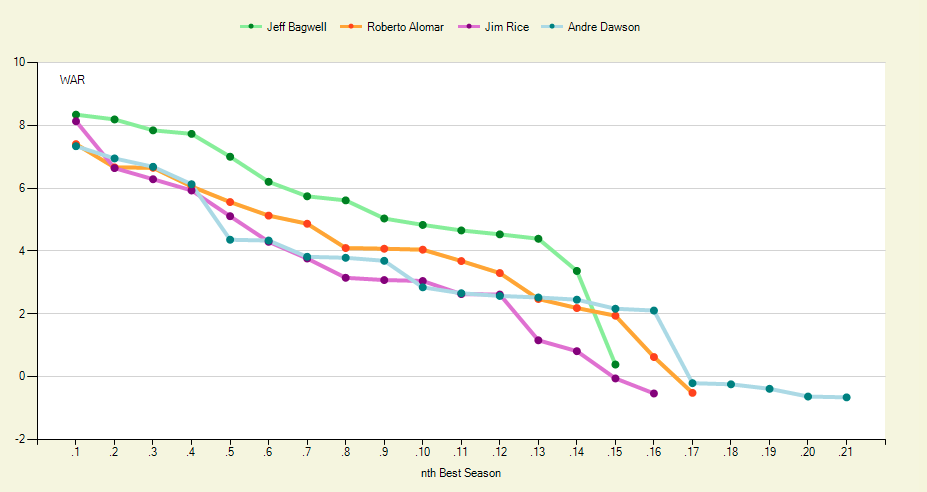
Rather than extol upon how unfair tainting innuendo is in our guilty until proven innocent until proven guilty society and rehash a long-winded argument in favor of Jeff Bagwell, I will instead let the numbers visually stand for themselves. Below, courtesy of Fangraphs's WAR graphs is a visual representation of the career of Jeff Bagwell (green) in comparison to the careers of the three most recently elected Hall of Fame hitters -- Roberto Alomar (congratulations!, orange), Andre Dawson (blue), and Jim Rice (purple):

image

Like I said, I think the image speaks for itself.

A Reminder Of Just How Good Chipper Jones Is

With Chipper Jones out for the season with a torn ACL and having previously expressed a desire to retire after the 2010 season, Atlanta's mainstay at the hot corner for the last two decades may have played his last major league game. Chipper is a sure-fire first round hall of famer, but I just want to remind everyone of just how good he is. We all know Chipper is great, but I figured I'll share his greatness in visual form. Below (click to enlarge), courtesy of Fangraphs' WAR graphing system, is a WAR graph comparing the careers of third basemen Ron Santo (+79.3 WAR, 8th all time amongst 3B), Paul Moliter (+75.2 WAR, 10th all time amongst 3B), and George Brett (+91.6 WAR, 6th all time amongst 3B) to Chipper Jones (+85.0 WAR, 7th all time amongst 3B):


Beautiful. Just beautiful.

-DME

Just How Good Is Javier Vazquez?

His 3.48 career K/BB rate is top five since 1900 (and top 10 all time) amongst pitchers with 2000+ IP to their name. That trails only Curt Schilling (4.38), Pedro Martinez (4.15), Jon Lieber (3.68) and Mike Mussina (3.58), surpassing future hall of famers Greg Maddux (3.37), Roy Halladay (3.29) and Randy Johnson (3.26) as well as current HOFers Fergie Jenkins (3.2), and Dennis Eckersley (3.25). Interestingly enough, of the top 13 K/BB pitchers all time with 2000+ IP, only 1800s pitcher John Ward is in the Hall of Fame right now.

Call Me Crazy, But Bert Blyleven Deserves To Be In The Hall Of Fame

(Skip down two paragraphs if you are not interested in reading my teary-eyed introduction)

Today, December 8, is the one-year anniversary of the creation of the Game Of Inches blog. We began our blog with a mission: "to prove that God doesn't exist and that athletes are merely cold, metal machines with no souls or heart." With the then-recent death of FireJoeMorgan.com and an ever growing appreciation of the deeper stories in baseball -- those told below the surface of Batting Average and ERA --we started a blog to join the realm of sabermetrics fans everywhere and help penetrate the myths, while often trying to be funny and relevant along the way.

It all began with a single post, written late one night, following a heated argument with a friend about whether or not Tom Glavine deserved to be in the Hall of Fame. Though we were then-inexperienced in the ways of FIP and wOBA and the likes, we still knew of the importance of strikeouts, walks, home runs and the gallimaufry of hits, total stolen bases, wins and ERA. From that post sprung many more and today we at Game Of Inches sit proudly today, exactly 1,200 posts later, having grown from nothing into what we are today. We would proudly like to thank you, the 400+ readers who visit this site daily, and Google Images, for making us the #1 search result for "lesbians."

It is only fitting that in honor of our anniversary and first post that I follow it up by expounding upon a question I raised in passing 365 days ago: why is Bert Blyleven not in the Hall Of Fame?

In the long, traditional and tainted history of baseball, you will find few players who were as good as Bert Blyleven. A pitcher who spent 86% of his career in the AL, Blyleven was not only one of the most durable pitchers to ever play the game (14th all time in innings pitched), but he also played each and every one of those innings, up until the last few years of his career, remarkably well and consistently. Blyleven was not just "good" at baseball, he was nothing short of great, and unlike Javier Vazquez, he did not underperform his stellar peripherals.

In terms of the topical, traditional and irrelevant statistics, Blyleven's career 3.31 ERA puts him in company with current/future Hall Of Famers Randy Johnson (career 3.29 ERA), Fergie Jenkins (career 3.34 ERA), Phil Niekro (career 3.35 ERA), and Robin Roberts (3.41 ERA). His ERA is also lower than that of Tom Glavine (career 3.54 ERA). You like wins? His 287 wins are give him one more than Robin Roberts, and makes him 27th all time. Only six other players in the history of baseball who have more wins than Blyleven (Tommy John (288), Bobby Mathews (297), Randy Johnson (303), Tom Glavine (305), Roger Clemens (354), and Greg Maddux (355)) are not currently in the hall of fame, and five years from now, that number will dwindle down to two. Many pitchers with less wins are already in. Furthermore, Blyleven was never known as a jerk or cheater or drug user like Albert Belle, Ron Santo, Tim Raines, Kenny Rogers, Barry Bonds, Roger Clemens, et al. (to the contrary,he has a good sense of humor). But wins don't really matter, attitude has nothing to do with talent and production on the field, and a career ERA may tell much about a pitcher's success over the years, but it does not necessarily showcase a pitcher's true talent (see Javier Vazquez). However, these are three of the most common factors by which voters approve or deny players into the Hall Of Fame. How Blyleven, who performed remarkably well in his surface stats and other irrelevant, but considered aspects of the game is not given due credit (he only got the nod from 62.7% voters last year) is downright puzzling.

Below the very quality surface stats, however, you find an even more impressive skill set. Bert Blyleven ended his career with a 3.19 FIP over almost 5,000 innings pitched, making him top 50 all time amongst starting pitchers who threw 2500+ innings. A 3.19 FIP puts Blyleven in company with such current/future Hall Of Famers as Steve Carlton (career 3.15 FIP) and Jim Bunning (3.22 FIP) and ahead of such guys as Don Sutton (career 3.24 FIP), Greg Maddux (career 3.26 FIP), Fergie Jenkins (3.28 FIP), Dennis Eckersley (career 3.40 FIP), and Phil Niekro (career 3.60 FIP). In fact, Blyleven's FIP was only above 3.00 twice during his first ninemajor league seasons (one of which was his rookie year). Over those first nine years of his career, his career high FIP was 3.27. In his career, his FIP was above 4 only three times. His BB/9 was only three times above 3.00 in a season and only once above 3.50. Blyleven's K/9 (6.70 career) was also above average each season until his final three in the majors. With the exception of his final three seasons -- over which Blyleven's K/BB was 2.98, 2.76, and 2.41 -- Blyleven's K/9 was never below 6.0.

Blyleven's numbers are so good because his control was superb. It was not Greg Maddux like, but his career 2.39 BB/9 is none the less fantastic. Blyleven posted a career 2.80 K/BB mark, which is top 35 amongst all pitchers who threw 2000+ innings (top 25 amongst all pitchers with 2500+ innings). And just in case Blyleven's career 2.80 K/BB does not sound sweet enough, between 1970 and 1992, the league average K/BB was only above 1.75 once (1988).

Fangraphs does not have any groundball data available for any season prior to 2002, but it is well known that Blyleven had a fantastic curveball and he kept the ball in the yard plenty with a 0.78 HR/9.

In sum, we have the portrait of a pitcher with great peripherals and quality surface stats. Blyleven was an almost entirely AL pitcher with a good reputation, a lot of wins, great control (in terms of both BB/9 and K/BB), and a very quality FIP and ERA. His 3,701 career strikeouts are fifth all time and he's better than many of the pitchers who are already honored (some of whom should not be...) in the halls of history in Cooperstown, NY. Blyleven was one of baseball's true greats and he is for some befuddling reason (perhaps it's the superfluous lack of 300 wins or the fact that Joe Morgan hates all non-Joe Morgan players) overlooked every year.

Blyleven still has a handful more years upon which his name will appear on the annual HOF ballot, but time is running out. The world of baseball needs to take a second look at Blyleven's career before it's too late and hopefully, in the process, the world of baseball will also catch notice of the career of Mike Mussina.

The Hall Of Fame*

With the increasing disillusionment that is steroids upon the national pastime, many players who were once thought to be shoo ins for Cooperstown -- guys like ManRam, A-Rod and Clemens -- are speculated to be unvotable into the hall of fame. Seen as disrespectful cheaters, many sportswriters claim (with good reason) that PED users should be left in the footnotes of history.

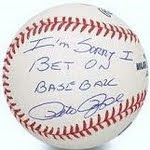
I tend to disagree with this statement on the basis that as a guy who hits 700+ home runs -- steroids or not -- still hit 700 homers, which is not a remotely simplefeat by any means. The records of these cheaters, unless overturned by MLB, will remain in place in history and the only real punishment incurred by these players (well, accept Manny, who also got a 50-game suspension) will be a ban from recognition as truly great and impactful upon the game of baseball.Is this really fair, however? On one hand, yes, they took steroids and cheated and tarnished the reputation of the sport. On the other hand, according to most accounts, steroids have long been utilized in the game. Who is to say that guys before Canseco and McGwire who are already in the hall weren't users? Who is to also say that simply using PEDs makes you an underserving cheater (it's not like guys who take steroids just inject themselves and then spend the offseason eating potato chips on the couch; they still have to work out very intensely and the steroids aid these "cheating" athletes in reaching the next level of super saiyan). Many of these cheaters", like Barry Bonds pre-1997, were still great (40/40, anyone?) before they started taking PEDs. Hell, even beyond PEDs, guys like Pete Rose, who tarnished the game in their own unique ways, were still among the game's great players.

For these reasons and many more that I am too lazy to list, I assert that we should start a new Hall of Fame for everyone who was great at baseball, but tarnished the sport in someway or another. We can call it The Hall Of Fame* and put a giant asterik over the entrance doors to the museum (perhaps the asteriks can be the door handles!). Here, in The Hall Of Fame*, we can chronical the history of the various players and events (ie, the Black Sox) that tainted the history and reputation of the sport. Rather than pretend steroids and cheating never happened, we can acknowledge it's existence and impact upon the game as we know it. That way, rather than pretending PEDs, gambling, cheating, etc. never happened, we can learn from the past and examine how it affects our present and will affect our future.

Knowing Bud Selig, however, if there were to ever be a Hall Of Fame*, he would probably hide it in the basement of the real Hall Of Fame.

Is Javier Vazquez Hall Of Fame Material?

It's an interesting question to ask. On the surface, Javier Vazquez seems like the most unclutch pitcher in the world. His ERA has been below 4.40 only once in the past five seasons and he is notorious for pitching poorly when the game matters most. If Win-Loss records meant anything (which they do not), his five year 63-61 mark would be nothing to talk about.

But that's where all my "criticism" of Javi ends. If you look beneath the situational numbers, you find one of baseball's premier pitchers. Over the past five seasons (1041.1 IP), Javier Vazquez has struck out 939 batters (8.12 K/9) and walked a mere 273 (2.39 BB/9). Even with his high 1.25 HR/9 rate over that five year period, Vasquez still managed to post a FIP just below 4 (3.99), despite playing 4 of those 5 seasons at baseball's most home run friendly parks. If you remove Vasquez's disastrous 2004 campaign from this analysis and we look at the four year period from 2005-2008, we find even more to love about Ozzie's whipping boy.

At HR friendly US Cellular and Chase Field between 2004 and 2008, Javier Vazquez struck out 789, walked 213 and only gave up 112 long balls in 843.1 IP. That's good for a 8.42 K/9, 2.27 BB/9, and remarkable (given the circumstance that Javi is a flyball pitcher at two home run inflating parks) 1.19 HR/9 -- significant improvements on his already great peripherals from the five year analysis. Javi's FIP over this period is a very respectable 3.81.

So if Javi is so great, why were his numbers so terrible over this period of time? The answers are simple.

Vazquez's stint on the Yankees in 2004 was just a down year. Vazquez gave a then career high amount of bombs (33) in a career low amount of innings (198). Vazquez, who had just moved from the NL to the AL that season had to make adjustments and in doing so, his K/9 fell from 9.40 per nine in 2003 to a career low 6.82 per nine in 2004. His walk rate, though not terrible, spiked to a career high 2.73 per nine. Following his down year on the Yankees, Vazquez adjusted and his peripherals returned to normal. His K/9 rose and BB/9 fell to match his career rates and would remain pretty consistent from 2005-2008. However, as Vazquez spent a lot of time in both Chase Field and US Cellular Field, he was still susceptible to the long ball. In 2005, Javier Vazquez topped his home run mark from 2004 with 35 bombs allowed, but did so in 18 extra innings of work. When Vazquez was traded from the Diamondbacks to the White Sox, he not only made the transition from the NL to the AL again (this time, Javi would make the necessary adjustments and his peripherals would remain constant), he moved to one of the worst defensive teams in all of baseball. With the notable exception of Joe Crede, who saw limited playing time due to back injury complications from 2006-2008, and Orlando Cabrera, who only played for the team for one season, the entire White Sox infield and outfield have not only been one of the most below average defensive teams in baseball, but also one of the least efficient at converting balls-in-play into outs. In 2007 and 2008, the White Sox respectively ranked 23rd and 20th in defensive efficiency. If not for Orlando Cabrera last season, the White Sox would have ranked even lower in 2008. Furthermore, in 2006 and 2008, Javier Vazquez's BABIPs were .321 and .328, both career high marks.

Some combination of bad luck, poor defense and home run inflating parks have resulted in a stigma being placed upon Javier Vazquez in both real life and fantasy baseball. His K/9 and BB/9 (and thus K/BB) rates have been top of the league since 2000. In fact, since 2000, the only players who have better control (K/BB) rates than Vazquez are Jake Peavy, Pedro Martinez, Josh Beckett, Randy Johnson and Roger Clemens. Pretty exclusive company.

Currently, 33 year old Javi has 11 seasons and 200 strikeouts to his name. Since 2000, Javi has managed to pitch 200+ innings in every seasons except 2004 (where he tossed 198 innings). If -- and with pitchers, this is a big if -- Vazquez can pitch another five seasons in the big leagues and maintain the same ratios he did last season (at offense inflating US Cellular Field), Vazquez will be able to reach the exclusive 3000 strikeout mark by the age of 38. If -- again, a BIG if -- he can pitch at this rate for ten seasons, he will reasonably be able to reach the 4,000 K plateau, something that only four other pitchers have ever been able to do.

Javier Vazquez may not have a sexy win total or ERA, but his ratios suggest that he's hall of fame material thus far into his career. If he reaches the 3,000 strikeout mark (let alone the 4,000 K mark), Javi should be a lock to get in by the time his career ends. If Vazquez were to pitch until he was 41 and eclipse the 3,000 K mark at age 38, he could easily pass Greg Maddux for 10th place on the all-time strikeouts list. Fuck Wins, Fuck ERA. Sub-poor offensive teams like the 1999-2003 Expos and 2007 White Sox have prevented Vazquez from racking up elite win totals, while poor defensive teams like the 2005 Diamondbacks and 2007-2008 White Sox have inflated his ERA. Javi deserves a spot in Cooperstown so far.

Now that Vazquez has moved from a offense-friendly park in the AL to an offense-neutral park in the NL, his numbers should only improve going as his K/9 increases/maintains and HR/9 declines. Expect big things from Vazquez going forward.

Call me crazy, but Tom Glavine does not deserve to be in the Hall Of Fame

In analyzing Tom Glavine, you need to put his 305 wins aside. Wins do not measure a pitchers talents because a guy can give up 10 runs in a game, but if his team scores 11, he still gets the win. I highly doubt anyone would argue such a pitcher, someone in the mold of say Jason Marquis, is such a good pitcher.

Tom Glavine's career line is 4413.1 IP, 1500 BB, 2607 K's. That's nothing impressive, by any means. He has a career K/BB ratio of approximately 1.7 (Greg Maddux's K/BB, by contrast, is a shade under 3.4 -- depressed by a nothing-special-but-well-above-average strikeout rate. More impressively, Maddux walked under 1000 batters in 5000 IP -- truly a king of control! The major league average for K/BB was 2.00 in 2007).

Glavine never once struck out over 200 batters in a single season and only once posted a strikeout rate above 7.0 (the league average is around 6.7). Strikeouts, of course, are not the only way to show how good a pitcher is at pitching, but it is a very pitcher-controlled and fairly consistent metric by which one can monitor a pitcher's consistency, ability to fool hitters and simply dominate with good stuff. He came close to 200 strikeouts once, in 1992, when he won a Cy Young with 192 K's. Far be it from me to DENY someone HOF votes because of a low strikeout rate, but a career 5.3 K/9 rate is far from anything impressive, and I want my HOF-ers to have impressive careers.

In fact, the only thing impressive about Glavine's career may be that he posted such a low ERA between 1991 and 2002 (under 3.00 six times, only above 4.00 once). His barely above-average strikeout rates and walk rates over this period were heavily distorted by an incredibly low HR/9 rate (which, however, deteriorated rapidly after the 1999 season). In 1992, with 225 IP, Glavine surrendered only 6 HR. In 1995, he followed that up with 199 IP, 9 HRs. From 1991 thru 1999 (including the 1999 season), Glavine gave up approximately 15 HRs per year and clocked in 225+ innings in all but two seasons (165 IP in 1994 and 199 IP in 1995). After the 1999 season, Glavine only once gave up under 20 HRs in a season (2005), while his IP per season fell to 211 (it was above 230 in seasons Glavine pitched 30+ games), only topping the 225 mark once (2000).

As evident by his career 3.5 ERA, Glavine was surely (and undeniably) a work horse who ended up giving his team a lot of quality innings. However, a lot of that "quality" simply seems to be the result of luck and circumstance. His career WHIP is above 1.3 and hasn't been below 1.28 since 1999. In fact, during his 1991-1999 seasons, his WHIP was more often above 1.4 than it was below 1.2. Glavine's WHIP was never below 1.1. For reference, Maddux's career WHIP is 1.14 and was below 1.1 nine times, almost consecutively. Now WHIP is hardly the tell-tale stat since hits are a volatile statistic. However, the stat does show that Glavine did not do much to limit baserunners and keep his team out of high leverage situations. Further, while Glavine's control element of WHIP was above average, it was hardly anything impressive. Whereas his teammate Maddux walked 20 batters in 233 innings in 1997 and posted ridiculous control numbers annually, Glavine's only elite walk rate year came in 1989.

Of course, we shouldn't by any means argue that "since Maddux was a much better pitcher, Glavine doesn't deserve to go" because Maddux, like Pedro and Clemens and arguably even Smoltz, is on a completely different plane of "greatness."

Still, when you look at the total of his peripherals, Glavine's numbers are not very impressive. He did not have great control (in fact, his control was below average) and he didn't have overwhelming "stuff" (again, below the major league average (league average K/9 was 6.67 in 2007)). He was simply a quality pitcher on a great team who got inordinately lucky because he induced plentiful ground balls to a great defense over the course of his career. The only metric from the Holy Trinity of Consistency for pitchers (HRs, Ks, BBs) that he was above average in is HRs -- and his above average-ness in that department didn't even last a decade (not that I believe that pitchers generally directly control their HR rates anyways).

To quote Ken Tremendous of FJM, whose assertion I entirely agree with,
When determining whether or not Player X belongs in the HOF, we must ask "do Player X's numbers show that he was one of the very best players in the game for a long time? Because there are a lot of guys who excel for 1-3 years and then kind of fade away. And the Hall should be reserved for the ones who don't fade away. Or, alternately, the guys whose careers were cut short for some tragic reason, but who were so insanely amazing at baseball -- so utterly and completely dominant -- that you cannot deny their outrageous shining brilliance."
While Glavine hardly faded away, he didn't really "shine" for more than a few seasons. His ERA+ was pretty damn good (130 or higher) in 9 of his seasons and above 100 (league average) every year but his first four, last two and one somewhere in the middle. However, ERA, as we all know, is often a byproduct of condition and luck (especially when your WHIP is in the 1.3's). I'd say -- and kill me if I'm out of line -- that Glavine's career is a lot like Carlos Zambrano's, only with less K's and less BB's. High WHIPs and mediocre control rates coupled by lower-than-expected ERAs and high win rates.

If anything, I would simply have to put Tom Glavine in what Tremendous called "The Hall of Very Good"

___

Let me just end this with a little post-script. I do strongly believe that Mike Mussina, who has a career ERA of 3.7 (in the AL, mind you) and is just 13 wins shy of 300, belongs in the HOF. His career K/BB is 3.6 and he only ONCE walked more than 55 batters in a single season (65 in 1996, where he logged a career high 243 IP). In fact, while averaging almost 200 IP across his whole career (215+, if you only look at his first 14 seasons), Mussina only walked more than 50 batters three times. His career BB/9 is under 2. He also struck out more than 200 batters more than few times in his career (four times, to be exact, though he did rack up 195 K's in 2003). If you ask me, Moose>Glavine.

Finally, just to postulate the question, why is Bert Blyleven not in the HOF?