David MVP Eckstein: Sportswriter
As of now, I've tentatively accepted a writing position for the sports section of DeKalb's Northern Star newspaper. I plan to continue my amazing blog contributions (and finally start watching football/basketball...sigh).


Sexy Rexy On Fantasy Focus: Baseball
After YEARS of writing in to ESPN's Fantasy Focus, a quick e-mail I shot them last night for giggles got read by Nate and Matthew. If you listen starting at 25:07 in, they read my question and answer it for the rest of the show (and for the record I did mean Matthew was the weasel, although I did only want Nate's advice anyway). Now I only have 14 minutes and 59 seconds left. Damn.
Go to the iTunes store, download the 4/6/10 version of the Fantasy Focus to keep this precious moment in time. Or you can listen here.
Go to the iTunes store, download the 4/6/10 version of the Fantasy Focus to keep this precious moment in time. Or you can listen here.

How Well Did You Draft?
We all love making trades. It's a part of baseball. Despite a recent GOI poll in which the vast majority of voters said they loved their team and would be top three in their league, we still make trades to make our team better. But I'm sure the vast majority of you are like me, you want to make trades but those trades you thought would be good for you ended up harming you. Sure, you made some good ones, but you also made some bad ones. So did you overall come out ahead or not? Well, for the eleven lucky of you in the GOI snake draft Mangolicious league, I've helped you answer that question.
I have created a league in which Ive re-created everyone's Mangolicious team. Throughout the season, I will update every team's pitchers and will rotate in offensive players when the starters have a day off. I will not make any trades and will not pick up anybody when a player goes on the DL.
Clearly, there are flaws in this system if I'm trying to re-create exactly what a team would look like if no one made any trades. The first one being that players get injured all the time- so no matter how well you drafted, you will still need to pick up players. The second flaw is that many owners like to rotate offenisve players. Many teams in this Mangolicius league used up their bench on hitting as opposed to a manager like me that wasted his bench on all pitchers- which affects other managers offensive stats.
Despite these flaws, I feel this is the best way to measure how your team would have performed if no one had made any trades. So let's begin!
NOTE: If you are a manager in Mangolicious and you would like to update this new no-trade team I have created (as opposed to me updating your team), contact me and I will give you the information needed so you can see how your team, with your managerial skills, would look like if you didn't make any trades.

I have created a league in which Ive re-created everyone's Mangolicious team. Throughout the season, I will update every team's pitchers and will rotate in offensive players when the starters have a day off. I will not make any trades and will not pick up anybody when a player goes on the DL.
Clearly, there are flaws in this system if I'm trying to re-create exactly what a team would look like if no one made any trades. The first one being that players get injured all the time- so no matter how well you drafted, you will still need to pick up players. The second flaw is that many owners like to rotate offenisve players. Many teams in this Mangolicius league used up their bench on hitting as opposed to a manager like me that wasted his bench on all pitchers- which affects other managers offensive stats.
Despite these flaws, I feel this is the best way to measure how your team would have performed if no one had made any trades. So let's begin!
NOTE: If you are a manager in Mangolicious and you would like to update this new no-trade team I have created (as opposed to me updating your team), contact me and I will give you the information needed so you can see how your team, with your managerial skills, would look like if you didn't make any trades.

Worthless 2010 Baseball Predictions: Standings
Despite that fact that 30 teams in 30 days was giant failure last year, I'm going to essentially the same thing- because hot damn do I love making predictions and do people love reading predictions. So here is my own worthless opinion (because I'm sure to be wrong) on how I think the MLB standings will look in 2010.
Note, that no one will ever be able to tell you where a team will finish because there will always be players that surprise you to help a team win and there will always be key drastic injuries. And despite what PECOTA will predict, there's a reason teams still play the game.
So I'm not going to comment on justifying my picks. Picks aren't based on rationality and even if you think they are, they are guaranteed to be wrong. All this is is my opinion and feel free to disagree with my subjective views.
AL EAST
1) New York Yankees
2) Boston Red Sox*
3) Tampa Bay Rays
4) Baltimore Orioles
5) Toronto Blue Jays
Yankees won 100+ games last year and added Granderson and Vazquez and will get more PA from A-Rod this year. Red Sox adding Cameron and Beltre makes them one of the best defensive teams in the league and adding Lackey just adds even more depth to the deepest rotation in baseball. Rays have probably a top six team in the league but play in the hardest division in baseball- so say goodbye to Pena and Crawford. Orioles will compete for this division (a la Rays in '08), but that won't happen for another few years. Blue Jays clearly are rebuilding so will be awful for a years as well.
AL CENTRAL
1) Detroit Tigers
2) Chicago White Sox
3) Minnesota Twins
4) Kansas City Royals
5) Cleveland Indians
I love the Sox pitching but I'm so pessimistic that I can't put them winning the division like ESPN does. So if it's between the Twins and Tigers I say the addition of Damon and Scherzer
AL WEST
1) Seattle Mariners
2) Los Angeles Angels
3) Texas Rangers
4) Oakland A's
Seattle will probably be the best defensive team in the AL and add a damn fine rotation of top of that with SAFECO's caverns and you have a recipe for success. Even though I think the Rangers have more talent, it's the still Angels and they will still be competitive and still win a crap ton of games. I like the Rangers line up but they are too injury prone and even though that rotation will over-perform, they have too big of a hurdle to overcome. They A's have no chance- not this year.
NL EAST
1) Philadelphia Phillies
2) Atlanta Braves*
3) New York Mets
4) Florida Marlins
5) Washington Nationals
I was going to pick the Nationals to win the wild card because every team Jason Marquis has been on has gone to the playoffs, but then I thought about it for more than two seconds. I also believe in my heart of hearts that the Marlins are better than the Mets, but the Mets are still the Mets and they still have money and they can't have that many injuries as they did last year, can they?
NL CENTRAL
1) St. Louis Cardinals
2) Chicago Cubs
2) Cincinnati Reds
4) Milwaukee Brewers
5) Houston Astros
6) Pittsburgh Pirates
I ranked the bottom four teams based upon how I think their rotations will be and I think Dave Duncan will beat the injury prone Cubs. Plus, I'm a White Sox so I OBVIOUSLY need to crap on the Cubs.
NL WEST
1) San Fransisco Giants
2) Colorado Rockies
3) Los Angeles Dodgers
4) Arizona Diamondbacks
5) San Diego Padres
This is the division I feel the least strongly about but I'll choose the Giants because Tim-freaking-Lincecum and Matt Cain along with guys like Madison Bumgardner and Jonathan Sanchez will make the Giants have a top five rotation and propel them to win the division.
*indicates wild card birth
Note, that no one will ever be able to tell you where a team will finish because there will always be players that surprise you to help a team win and there will always be key drastic injuries. And despite what PECOTA will predict, there's a reason teams still play the game.
So I'm not going to comment on justifying my picks. Picks aren't based on rationality and even if you think they are, they are guaranteed to be wrong. All this is is my opinion and feel free to disagree with my subjective views.
AL EAST
1) New York Yankees
2) Boston Red Sox*
3) Tampa Bay Rays
4) Baltimore Orioles
5) Toronto Blue Jays
Yankees won 100+ games last year and added Granderson and Vazquez and will get more PA from A-Rod this year. Red Sox adding Cameron and Beltre makes them one of the best defensive teams in the league and adding Lackey just adds even more depth to the deepest rotation in baseball. Rays have probably a top six team in the league but play in the hardest division in baseball- so say goodbye to Pena and Crawford. Orioles will compete for this division (a la Rays in '08), but that won't happen for another few years. Blue Jays clearly are rebuilding so will be awful for a years as well.
AL CENTRAL
1) Detroit Tigers
2) Chicago White Sox
3) Minnesota Twins
4) Kansas City Royals
5) Cleveland Indians
I love the Sox pitching but I'm so pessimistic that I can't put them winning the division like ESPN does. So if it's between the Twins and Tigers I say the addition of Damon and Scherzer
AL WEST
1) Seattle Mariners
2) Los Angeles Angels
3) Texas Rangers
4) Oakland A's
Seattle will probably be the best defensive team in the AL and add a damn fine rotation of top of that with SAFECO's caverns and you have a recipe for success. Even though I think the Rangers have more talent, it's the still Angels and they will still be competitive and still win a crap ton of games. I like the Rangers line up but they are too injury prone and even though that rotation will over-perform, they have too big of a hurdle to overcome. They A's have no chance- not this year.
NL EAST
1) Philadelphia Phillies
2) Atlanta Braves*
3) New York Mets
4) Florida Marlins
5) Washington Nationals
I was going to pick the Nationals to win the wild card because every team Jason Marquis has been on has gone to the playoffs, but then I thought about it for more than two seconds. I also believe in my heart of hearts that the Marlins are better than the Mets, but the Mets are still the Mets and they still have money and they can't have that many injuries as they did last year, can they?
NL CENTRAL
1) St. Louis Cardinals
2) Chicago Cubs
2) Cincinnati Reds
4) Milwaukee Brewers
5) Houston Astros
6) Pittsburgh Pirates
I ranked the bottom four teams based upon how I think their rotations will be and I think Dave Duncan will beat the injury prone Cubs. Plus, I'm a White Sox so I OBVIOUSLY need to crap on the Cubs.
NL WEST
1) San Fransisco Giants
2) Colorado Rockies
3) Los Angeles Dodgers
4) Arizona Diamondbacks
5) San Diego Padres
This is the division I feel the least strongly about but I'll choose the Giants because Tim-freaking-Lincecum and Matt Cain along with guys like Madison Bumgardner and Jonathan Sanchez will make the Giants have a top five rotation and propel them to win the division.
*indicates wild card birth


ESPN Has Scheyer On Front Page And Highly Overrated

It only occurred to me today to actually check Jon Scheyer's basketball statistics. You know, the quantifiable, measurable, numerical evidence that allows us to draw conclusions on athletes without biased, subjective opinions. With Duke in the final four for the first time since 2004, every media outlet is hyping up Jon Scheyer. Some have even claimed him as a legitimate national player of the year candidate. His reputation is even more pristine if you happen to reside in Chicago, his home town, because every conversation ends with us berating Bruce Weber for not keeping Scheyer in the state.
What if I told you that Scheyer is shooting 39% from the field this year? That's pretty low, especially for college basketball. And it is not an aberration. Scheyer has been a remarkably consistent 39% shooter for 3 out of his 4 years of eligibility. I think the only worse professional shooters are Jannero Pargo and Baron Davis. Yes, he is a great 3-point shooter at 38%, with more than half his shots coming from beyond the arc. Yes, he is a great free throw shooter(88%) and a decent distributor(4.8 assists). Since nearly all of his points come from outside the paint, with very limited ability to create his own shot, his shooting percentages are down. I'm pretty sure most NBA teams are not looking for anorexic white guys who can barely out-shoot Jannero Pargo in a game.
You may be screaming at the computer screen, "what about Stephen Curry? He's an anorexic white-ish guy who shoots 3's and made it in the NBA". Let's look at the numbers, shall we. In Curry's 3 years in college, he shot over 40% from 3 point land twice. Topping out at 44% his sophomore year. In addition, he shot between 45-48% from the field as a whole, much more impressive than Scheyer's 39%. This was mainly a result of Curry's ball handling skills and ability to create open shot and drive to the basket. Scheyer is white and has no such skills. Curry also outrebounded, assisted, and stole Scheyer while being the only player on his team that people worried about.
Jon Scheyer has had a very productive college career and god damn Bruce Weber for letting a jewish, chicago boy who played HS ball under Weber's brother go to Duke. But to inflate his game to legendary status the way ESPN and Coach K himself have done is misleading to say the least
The Chicago Tribune Stole My Idea!
Last summer, myself and GOI did a Characters Welcome! competition. I ranked the best TV characters and you loyal voters (all six of you at the time)voted on who you thought was the best. Dr. House barely edged out Homer Simpson as the best character and I plan on this competiton to come back so new shows like White Collar can be represented and old veterans like Larry David that I just plum forgot about also can get their due. But I guess the Chicago Now/Red Eye likes to steal my ideas and also have their own dumb little Best Characters Contest. Jerks. At least credit me!
http://www.chicagonow.com/blogs/show-patrol/2010/03/redeyes-best-tv-character-tournament-elite-8.html
http://www.chicagonow.com/blogs/show-patrol/2010/03/redeyes-best-tv-character-tournament-elite-8.html
Forecasting Jake Peavy For 2010
Sure, I've got a 30 page appellate brief due Monday, but baseball season, which is clearly more important, is only 3 days away and it's never too early to preempt the hopes and dreams and moronic arguments of White Sox fans everywhere. All I've heard this offseason is "Jake Peavy this" and "Jake Peavy that" (oh, and Ozzie Guillen ranting about the importance of letting everyone on the team run wild...).
Are White Sox fans entitled to feel so good about Jake Peavy, owner of a career ERA of 3.26 and K/9 of 9.02? Let's run the numbers
His split stats are not very encouraging. Peavy has a career Home ERA of 2.82 and Away ERA of 3.79. The latter is still good, but it's not exactly the creme de la creme "top ace material" Peavy's been billed as (unless you consider Carlos Zambrano a comparable "ace").
At age 29, Peavy is still very young though he is quite seasoned in the majors. He has a career xFIP of 3.58 and has averaged about 180.2 IP each of the last seven years. Using these as a baseline from which to do a quick 2010 forecast, we must first account for league adjustments, courtesy of data from The Hardball Times. A move from the NL to AL, on average, causes a 0.57 K/9 decrease and a 0.41 ERA increase. This put's Peavy's xERA for 2010 at 3.99 and K/9 rate at 8.45. Over 180.2 IP, this gives up a raw runs allowed total of 80.
Next, we need to account for park factors. According to Baseball Reference's multi-year park factor data, US Cellular Field has inflated run scoring by 4%. Accounting for the park change, Peavy's runs allowed total increases to 83.3 per 180.2 IP.
Finally, we need to account for defense. CHONE sees a defensive team composed of Konerko-Beckham-Teahen-Pierzynski-Pierre-Quentin-Rios-Ramirez as being cumulatively worth -10 Fielding Runs "Above" Replacement (FRAR) per 150 games played. Sure, back ups play too, but let's just pretend for the sake of simplicity that they do not factor in (especially since only a handful of White Sox utility men are projected to be not negative). Over 162 games played, this FRAR extrapolates to -11. The average baseball team played 1442 innings of defense last season and using this number as the baseline for White Sox defensive innings in 2010 (because extra inning games are impossible to predict), the Sox seem poised to forfeit .0076 runs per inning of defensive play. Per 180.2 innings, that is 1.37 runs forfeited due to poor defense (though the White Sox, to their credit, do project to have the best defensive DH in baseball by running Andruw Jones and Omar Visquel in a platoon).
All this factored in, Peavy is predicted to give up 84.67 runs per 180.2 IP with an 8.45 K/9 to boot. This amounts to a 4.22 ERA with 170 Ks to boot.
Plus-4 ERA, under 200 Ks for Peavy in 2010? Even if he pitches 200 innings, I'd say so. Put it on the board?
Are White Sox fans entitled to feel so good about Jake Peavy, owner of a career ERA of 3.26 and K/9 of 9.02? Let's run the numbers
His split stats are not very encouraging. Peavy has a career Home ERA of 2.82 and Away ERA of 3.79. The latter is still good, but it's not exactly the creme de la creme "top ace material" Peavy's been billed as (unless you consider Carlos Zambrano a comparable "ace").
At age 29, Peavy is still very young though he is quite seasoned in the majors. He has a career xFIP of 3.58 and has averaged about 180.2 IP each of the last seven years. Using these as a baseline from which to do a quick 2010 forecast, we must first account for league adjustments, courtesy of data from The Hardball Times. A move from the NL to AL, on average, causes a 0.57 K/9 decrease and a 0.41 ERA increase. This put's Peavy's xERA for 2010 at 3.99 and K/9 rate at 8.45. Over 180.2 IP, this gives up a raw runs allowed total of 80.
Next, we need to account for park factors. According to Baseball Reference's multi-year park factor data, US Cellular Field has inflated run scoring by 4%. Accounting for the park change, Peavy's runs allowed total increases to 83.3 per 180.2 IP.
Finally, we need to account for defense. CHONE sees a defensive team composed of Konerko-Beckham-Teahen-Pierzynski-Pierre-Quentin-Rios-Ramirez as being cumulatively worth -10 Fielding Runs "Above" Replacement (FRAR) per 150 games played. Sure, back ups play too, but let's just pretend for the sake of simplicity that they do not factor in (especially since only a handful of White Sox utility men are projected to be not negative). Over 162 games played, this FRAR extrapolates to -11. The average baseball team played 1442 innings of defense last season and using this number as the baseline for White Sox defensive innings in 2010 (because extra inning games are impossible to predict), the Sox seem poised to forfeit .0076 runs per inning of defensive play. Per 180.2 innings, that is 1.37 runs forfeited due to poor defense (though the White Sox, to their credit, do project to have the best defensive DH in baseball by running Andruw Jones and Omar Visquel in a platoon).
All this factored in, Peavy is predicted to give up 84.67 runs per 180.2 IP with an 8.45 K/9 to boot. This amounts to a 4.22 ERA with 170 Ks to boot.
Plus-4 ERA, under 200 Ks for Peavy in 2010? Even if he pitches 200 innings, I'd say so. Put it on the board?
DME's Fantasy Baseball Teams For 2010
This year, I've limited myself to five leagues. I really only plan on paying attention to three of them, my money leagues. These are my rosters as they stand before the season opener Sunday:
David MVP Eckstein -- Fantasyland 2 -- 12 man, 23 player, 5x5 std. roto auction:
C - Ryan Doumit ($1)
1B - Joey Votto ($28)
2B - Gordon Beckham ($15)
SS - Hanley Ramirez ($51)
3B - David Wright ($38)
OF - Grady Sizemore ($18)
OF - Alex Rios ($7)
OF - Franklin Gutierrez ($1)
DH - Chris Davis ($1)
SP - Josh Beckett ($18)
SP - Matt Cain ($19)
SP - Cole Hamels ($16)
RP - Heath Bell ($9)
RP - Jose Valverde ($7)
P - Colby Lewis ($1)
P - Phil Hughes ($1)
P - Bobby Jenks ($7)
P - Ricky Nolasco ($17)
BN - Nolan Reimold ($1)
BN - Martin Prado ($1)
BN - Franklin Morales ($1)
BN - Ryan Madson ($1)
BN - Justin Masterson ($1)
Comments: If you couldn't tell from the roster, I am attempting Stars & Scrubs this year. I definitely overspent too early on Hanley ($51), Wright ($38) and Votto ($28). I sent my entire budget in 13 players and watched depressingly as guys like Jay Bruce went for $3 in the final few picks. Next year, I'll save a few bucks for the end of the draft. My team is a little light on BA/SB's, but I think my team turned out quite well, all considered. If Nolan Reimold stays healthy, I think he is primed for a big season. I thought I was getting a great deal on elite closers for under $10 early on, but for some reason all of the closers went for around $5 in the league. Strange. I think this team's strong point is the pitching staff, though I will concede SexyRexy's is stronger thanks to his patient approach and aggressive bid war for King Felix.
David MVP Eckstein -- Mangolicious -- 12 man, 23 player, 5x5 std. draft league
C - Ryan Doumit
1B - Ryan Howard
2B - Chase Utley
SS - Derek Jeter
3B - David Wright
OF - Nelson Cruz
OF - Jay Bruce
OF - Carlos Gonzalez
DH - Carlos Quentin
SP - Felix Hernandez
SP - Cole Hamels
SP - Ricky Nolasco
RP - Billy Wagner
RP - Jose Valverde
P - John Lackey
P - Jason Frasor
P - Stephen Strausberg
P - Colby Lewis
BN - Chris Davis
BN - Brandon Lyon
BN - Brandon Webb
BN - Derek Lowe
BN - Drew Stubbs
Comments: You might notice a lot of overlap between this team and my auction team. I am expecting big things from my outfield this year, such as a .282/30/20 season from Nelson Cruz and a .278/35/10 season from Jay Bruce, but there is definitely some risk there. I by far have the best infield in the league, thanks to what used to be strong pitching depth. In a period of 24 hours, my entire roster changed. I traded away brand name studs like Jon Lester for "riskier" players like Nolasco, while upgrading other positions, while trading away seven closers to upgrade three. My team is a little light on strikeouts and steals at the moment, but I should be golden everywhere else. My big regret on the draft is taking Brandon Webb over Brett Anderson. At the time, my team had much more depth and I felt I could take a risk with Webb as the 120th overall pick. In hindsight, I could use another reliable starter, as Strausberg probably won't pitch in the majors till June. All in all, I love this team.
Jizz In My Pence -- Alcoholics '10 -- 10 man, 24 player, 5x5 std. draft league
C - Kurt Suzuki
1B - Adam Dunn
2B - Robinson Cano
SS - Hanley Ramirez
3B - Gordon Beckham
MI - Troy Tulowitzky
CI - Chris Davis
OF - Nick Markakis
OF - Jay Bruce
OF - Carlos Gonzalez
DH - Nyger Morgan
SP - Felix Hernandez
SP - Dan Haren
SP - Tommy Hanson
RP - Mike Gonzalez
RP - Billy Wagner
P - Josh Johnson
P - Ricky Nolasco
P - Max Scherzer
P - Bobby Jenks
BN - Franklin Moralez
BN - Alfonso Soriano
BN - Geovany Soto
BN - Martin Prado
Comments: I had the #2 pick overall in the league; there was no reason, even in a ten team league, that I should have been able to get both Hanley and Tulo. I have a gut feeling that the majority of the players in this league (I joined a random public league) are "amateurs" (not that I consider myself an expert). As strong as I think my offense is, it is my pitching staff that truly shines. I could use a little more batting average on my team, but if Soriano or Soto pans out with a strong comeback season, I'll have a valuable trade chip on my hands. I expect to dominate the league with this team, which is almost criminally amazing -- even for a 10-team league.
David MVP Eckstein -- Fantasyland 2 -- 12 man, 23 player, 5x5 std. roto auction:
C - Ryan Doumit ($1)
1B - Joey Votto ($28)
2B - Gordon Beckham ($15)
SS - Hanley Ramirez ($51)
3B - David Wright ($38)
OF - Grady Sizemore ($18)
OF - Alex Rios ($7)
OF - Franklin Gutierrez ($1)
DH - Chris Davis ($1)
SP - Josh Beckett ($18)
SP - Matt Cain ($19)
SP - Cole Hamels ($16)
RP - Heath Bell ($9)
RP - Jose Valverde ($7)
P - Colby Lewis ($1)
P - Phil Hughes ($1)
P - Bobby Jenks ($7)
P - Ricky Nolasco ($17)
BN - Nolan Reimold ($1)
BN - Martin Prado ($1)
BN - Franklin Morales ($1)
BN - Ryan Madson ($1)
BN - Justin Masterson ($1)
Comments: If you couldn't tell from the roster, I am attempting Stars & Scrubs this year. I definitely overspent too early on Hanley ($51), Wright ($38) and Votto ($28). I sent my entire budget in 13 players and watched depressingly as guys like Jay Bruce went for $3 in the final few picks. Next year, I'll save a few bucks for the end of the draft. My team is a little light on BA/SB's, but I think my team turned out quite well, all considered. If Nolan Reimold stays healthy, I think he is primed for a big season. I thought I was getting a great deal on elite closers for under $10 early on, but for some reason all of the closers went for around $5 in the league. Strange. I think this team's strong point is the pitching staff, though I will concede SexyRexy's is stronger thanks to his patient approach and aggressive bid war for King Felix.
David MVP Eckstein -- Mangolicious -- 12 man, 23 player, 5x5 std. draft league
C - Ryan Doumit
1B - Ryan Howard
2B - Chase Utley
SS - Derek Jeter
3B - David Wright
OF - Nelson Cruz
OF - Jay Bruce
OF - Carlos Gonzalez
DH - Carlos Quentin
SP - Felix Hernandez
SP - Cole Hamels
SP - Ricky Nolasco
RP - Billy Wagner
RP - Jose Valverde
P - John Lackey
P - Jason Frasor
P - Stephen Strausberg
P - Colby Lewis
BN - Chris Davis
BN - Brandon Lyon
BN - Brandon Webb
BN - Derek Lowe
BN - Drew Stubbs
Comments: You might notice a lot of overlap between this team and my auction team. I am expecting big things from my outfield this year, such as a .282/30/20 season from Nelson Cruz and a .278/35/10 season from Jay Bruce, but there is definitely some risk there. I by far have the best infield in the league, thanks to what used to be strong pitching depth. In a period of 24 hours, my entire roster changed. I traded away brand name studs like Jon Lester for "riskier" players like Nolasco, while upgrading other positions, while trading away seven closers to upgrade three. My team is a little light on strikeouts and steals at the moment, but I should be golden everywhere else. My big regret on the draft is taking Brandon Webb over Brett Anderson. At the time, my team had much more depth and I felt I could take a risk with Webb as the 120th overall pick. In hindsight, I could use another reliable starter, as Strausberg probably won't pitch in the majors till June. All in all, I love this team.
Jizz In My Pence -- Alcoholics '10 -- 10 man, 24 player, 5x5 std. draft league
C - Kurt Suzuki
1B - Adam Dunn
2B - Robinson Cano
SS - Hanley Ramirez
3B - Gordon Beckham
MI - Troy Tulowitzky
CI - Chris Davis
OF - Nick Markakis
OF - Jay Bruce
OF - Carlos Gonzalez
DH - Nyger Morgan
SP - Felix Hernandez
SP - Dan Haren
SP - Tommy Hanson
RP - Mike Gonzalez
RP - Billy Wagner
P - Josh Johnson
P - Ricky Nolasco
P - Max Scherzer
P - Bobby Jenks
BN - Franklin Moralez
BN - Alfonso Soriano
BN - Geovany Soto
BN - Martin Prado
Comments: I had the #2 pick overall in the league; there was no reason, even in a ten team league, that I should have been able to get both Hanley and Tulo. I have a gut feeling that the majority of the players in this league (I joined a random public league) are "amateurs" (not that I consider myself an expert). As strong as I think my offense is, it is my pitching staff that truly shines. I could use a little more batting average on my team, but if Soriano or Soto pans out with a strong comeback season, I'll have a valuable trade chip on my hands. I expect to dominate the league with this team, which is almost criminally amazing -- even for a 10-team league.
Padres Trade Gonzalez To ChiSox For Bechkam, Prospects
According to ESPN and MLBTradeRumors, Adrian Gonzalez has been traded to the Chicago White Sox for Gordan Beckham, Paul Konerko, and some pitching prospects.
This is great value for Adrian Gonzales owners in fantasy. AGon averages about 38-40 home runs in the most pitcher-friendly park and not moves to a park that has been top ten in home runs leaving yard. He could easily rival now Pujols and Howard as the top home run hitter in 2010.
However, from a reality perspective this isn't the greatest deal. The White Sox have a lot of money tied up in Rios and Peavy and I can't imagine they have a lot of money left over to re-sign Gonzalez to a long term deal. And giving away Bacon- who is dirt cheap for the team right now and a player the team could potentially have for another 7,8 years is not really worth the two they'll get from AGon.
Padres on the other hand got a steal. Sure, Konerko and Bacon's home run numbers will deflate- but the same flaws the White Sox had in this trade is an enormous benefit to the Padres. The padres couldn't afford AGon and they now get a top prospect for cheap for many years.
The prospects have not yet been announced in this deal.
This is great value for Adrian Gonzales owners in fantasy. AGon averages about 38-40 home runs in the most pitcher-friendly park and not moves to a park that has been top ten in home runs leaving yard. He could easily rival now Pujols and Howard as the top home run hitter in 2010.
However, from a reality perspective this isn't the greatest deal. The White Sox have a lot of money tied up in Rios and Peavy and I can't imagine they have a lot of money left over to re-sign Gonzalez to a long term deal. And giving away Bacon- who is dirt cheap for the team right now and a player the team could potentially have for another 7,8 years is not really worth the two they'll get from AGon.
Padres on the other hand got a steal. Sure, Konerko and Bacon's home run numbers will deflate- but the same flaws the White Sox had in this trade is an enormous benefit to the Padres. The padres couldn't afford AGon and they now get a top prospect for cheap for many years.
The prospects have not yet been announced in this deal.
Wishful Thinking: Manny Parra In Seattle
With Cliff Lee's recent injury (and five game suspension) and Erik Bedard's checkered injury past, the Mariners are rumored to be looking to add a starter. MLB Trade Rumors mentions a few names that may be available: Nate Robertson, Brian Tallet, and Manny Para. Of them and the available free agents (including Washburn and Pedro), Parra seems to be the most interesting name.
A 6'3" Lefty with a low 90s fastball and three other pitches, Parra was drafted in the 26th round of the 2001 baseball draft by the Milwaukee Brewers. Through his first 200 innings of play between A, AA and AAA ball over 2006 and 2007, Parra toyed with minor league hitters, posting a K/9 of 8.33 or higher at each level and a BB/9 under 3 at AA and AAA. Parra also kept the ball on the ground well, posting HR/9 rates below 0.40 once promoted to double A.
Parra got his first taste of the majors in late 2007. There, he flashed an 8.89 K/9 over a minute 26.1 IP sample size, but it came paired with a then-uncharacteristic 4.10 BB/9 and a 32.9% GB rate. Due to some Clayton Kershaw-like luck (3.1% HR/FB), Parra managed to keep his numbers respectable (3.76 ERA, 4.52 xFIP).
Parra nabbed a full time gig in 2008, pitching 166 major league innings with a slightly above average 4.39 ERA. Though Parra's wildness remained high (4.07 BB/9) and his strikeouts tumbled some (7.97 K/9), his groundball rate soared past the 50% mark (51.6% GB rate, 1.94 GB/FB ratio). This led to a 3.85 xFIP and the promise of future success; especially if Parra could trim down the walk rate (which his minor league numbers indicated was reasonable).
Parra entered 2009 as a sleeper on many draft lists, including my own. He profiled similarly to Ubaldo Jimenez: big strikeouts, lots of groundballs and pretty wild. However, whereas Ubaldo was being drafted much higher and whereas Ubaldo had never had any semblance of control entering 2009, Parra at least had AA and AAA numbers to back up a reasonable expectation of less free passes in 2009. Of course, as any 2009 Parra owner could tell you, it just was not destined to be.
Parra's walk rate soared in 2009, jumping up to 4.95 per nine. While the groudball rate was still promising (48.1%), hitters were making more contact with his pitches and the strikeout rate fell a tad more (7.46 K/9). Despite throwing less than 150 innings in 2009, Parra was 15th in total walks issued on the season (Brewers fans should note that the #1 and #3 pitchers on the list of who issued the most walks in 2009 were Doug Davis and Yovani Gallardo).
Parra is slated to begin the 2010 season in Triple-A Nashville. Like several other pitchers, Parra has loads of potential being hindered by lack of command and he's running out of options. What would happen if the Mariners were to acquire him?
Let's use 161 IP as the baseline, approximately how many innings the average fifth starter can expect to accumulate over the course of a season (and also of which will give us nice numbers to use in the analysis). Using Manny Parra's career numbers (7.83 K/9, 4.44 BB/9, 48.7% GB%), he profiles as a 4.23 xFIP pitcher. In moving from the AL to the NL, The Hardball Times found that, on average, a pitcher's K/9 rate would rise by 0.57 per nine and that their ERA would fall by 0.41 runs. Accounting for these factors, Parra would have a prospective 4.64 ERA and 7.26 K/9. Over 161 innings, that would result in 83 runs allowed.
Next, we need to accord for park factors. According to Baseball Reference's multi-year park data, Safe Co. Field has suppressed offense by 4%. This would bring Parra's 83 runs allowed total down to to 79.68.
Finally, we need to account for defense. Last season, the Mariners had the absolute best defense in baseball, worth +1.5 WAR compared to the next best fielding team (the Rays). In 2010, the team looks about the same with the subtraction of Adrian Beltre (+14.3 FRAR) and addition of Chone Figgins (projected +6.5 FRAR). If we hold the rest of the team's defense constant (you can adjust this if you think the Mariners will be better/worse defensively in 2010 compared to 2009), the team would prevent +0.53 runs per inning compared to the league average defense. In other words, over 161 innings, the Mariners defense alone would prevent 8.56 runs.
Subtract this from Parra's league and park adjusted runs allowed total and we get 71.12 runs allowed with a 7.26 K/9. Over 161 innings, Parra would then post a 4.00 ERA with 130 K's to boot. Not too shabby for a 5th starter. Just imagine what would happen if he cut down the Edwin Jackson-like walk rate.
A 6'3" Lefty with a low 90s fastball and three other pitches, Parra was drafted in the 26th round of the 2001 baseball draft by the Milwaukee Brewers. Through his first 200 innings of play between A, AA and AAA ball over 2006 and 2007, Parra toyed with minor league hitters, posting a K/9 of 8.33 or higher at each level and a BB/9 under 3 at AA and AAA. Parra also kept the ball on the ground well, posting HR/9 rates below 0.40 once promoted to double A.
Parra got his first taste of the majors in late 2007. There, he flashed an 8.89 K/9 over a minute 26.1 IP sample size, but it came paired with a then-uncharacteristic 4.10 BB/9 and a 32.9% GB rate. Due to some Clayton Kershaw-like luck (3.1% HR/FB), Parra managed to keep his numbers respectable (3.76 ERA, 4.52 xFIP).
Parra nabbed a full time gig in 2008, pitching 166 major league innings with a slightly above average 4.39 ERA. Though Parra's wildness remained high (4.07 BB/9) and his strikeouts tumbled some (7.97 K/9), his groundball rate soared past the 50% mark (51.6% GB rate, 1.94 GB/FB ratio). This led to a 3.85 xFIP and the promise of future success; especially if Parra could trim down the walk rate (which his minor league numbers indicated was reasonable).
Parra entered 2009 as a sleeper on many draft lists, including my own. He profiled similarly to Ubaldo Jimenez: big strikeouts, lots of groundballs and pretty wild. However, whereas Ubaldo was being drafted much higher and whereas Ubaldo had never had any semblance of control entering 2009, Parra at least had AA and AAA numbers to back up a reasonable expectation of less free passes in 2009. Of course, as any 2009 Parra owner could tell you, it just was not destined to be.
Parra's walk rate soared in 2009, jumping up to 4.95 per nine. While the groudball rate was still promising (48.1%), hitters were making more contact with his pitches and the strikeout rate fell a tad more (7.46 K/9). Despite throwing less than 150 innings in 2009, Parra was 15th in total walks issued on the season (Brewers fans should note that the #1 and #3 pitchers on the list of who issued the most walks in 2009 were Doug Davis and Yovani Gallardo).
Parra is slated to begin the 2010 season in Triple-A Nashville. Like several other pitchers, Parra has loads of potential being hindered by lack of command and he's running out of options. What would happen if the Mariners were to acquire him?
Let's use 161 IP as the baseline, approximately how many innings the average fifth starter can expect to accumulate over the course of a season (and also of which will give us nice numbers to use in the analysis). Using Manny Parra's career numbers (7.83 K/9, 4.44 BB/9, 48.7% GB%), he profiles as a 4.23 xFIP pitcher. In moving from the AL to the NL, The Hardball Times found that, on average, a pitcher's K/9 rate would rise by 0.57 per nine and that their ERA would fall by 0.41 runs. Accounting for these factors, Parra would have a prospective 4.64 ERA and 7.26 K/9. Over 161 innings, that would result in 83 runs allowed.
Next, we need to accord for park factors. According to Baseball Reference's multi-year park data, Safe Co. Field has suppressed offense by 4%. This would bring Parra's 83 runs allowed total down to to 79.68.
Finally, we need to account for defense. Last season, the Mariners had the absolute best defense in baseball, worth +1.5 WAR compared to the next best fielding team (the Rays). In 2010, the team looks about the same with the subtraction of Adrian Beltre (+14.3 FRAR) and addition of Chone Figgins (projected +6.5 FRAR). If we hold the rest of the team's defense constant (you can adjust this if you think the Mariners will be better/worse defensively in 2010 compared to 2009), the team would prevent +0.53 runs per inning compared to the league average defense. In other words, over 161 innings, the Mariners defense alone would prevent 8.56 runs.
Subtract this from Parra's league and park adjusted runs allowed total and we get 71.12 runs allowed with a 7.26 K/9. Over 161 innings, Parra would then post a 4.00 ERA with 130 K's to boot. Not too shabby for a 5th starter. Just imagine what would happen if he cut down the Edwin Jackson-like walk rate.
Forecasting Clayton Kershaw For 2010
As I hinted a few weeks ago in my Max Scherzer 2010 projection post, I am not a big fan of Clayton Kershaw. There is no doubt that he possesses a devastating Fastball/Change Up combo with a plus slider to boot. This leads to incredible strikeout totals (9.74 K/9 last season, 7th amongst starting pitchers). However, his lack of command also leads to an incredibly high high walk rate (4.79 BB/9 last season, compared to a 3.46 MLB average). Such numbers are quite reminisce of Rich Harden, who possesses a career 9.35 K/9 and 3.93 BB/9, and we all love Rich Harden (when healthy), right?
SexyRexy drilled upon the point of why I dislike Kershaw last month: his 4.1% HR/FB rate was the lowest amongst all major league pitchers to throw 100 or more innings. As I pointed out in my article explaining the important of xFIP and HR/FB rates earlier this year, "[t]he league, as a whole, averages a HR/FB rate in the 11% range, though most pitchers have HR/FB% which normalize to the 9-12% range (depending on where they play)." Thus, no matter where Kershaw plays, be it Dodger Stadium or Safe Co., there is really no way to reasonably expect him to maintain the 0.37 HR/9 rate that came with his sub-40% groundball rate last season. Put the sparkling 3.08 FIP out of your mind. What matters is the 3.90 xFIP.
Now a 3.90 xFIP is nothing terrible. It's actually quite decent. It's just not "ace material" or anything worth paying a top 100 pick for, especially when a comparably (if not better) guy like Max Scherzer is available much later. Of course, simply asserting Kershaw is overvalued is not my style. Let's project him.
Using Kershaw's 3.90 2009 xFIP as the baseline for his 2010 ERA, we need an innings projection for Kershaw. Innings projections are difficult to forecast and often arbitrary because predicting injury, playoff berths, managerial discretion, etc., is very difficult. CHONE says 151, Fangraphs users say 192, ZiPS says 176.2 and Bill James says 180. As with Max Scherzer, perhaps just so I can compare them a little easier, I am going to use 180 IP.
Over 180 IP, a 3.90 ERA would result in 78 runs allowed. Because Kershaw is not changing teams, there is no need to accord for park factors or a change in league. All that really needs to be factored in is the defensive posture of the 2010 Los Angeles Dodgers. In 2009, the team was cumulatively worth -0.1 Fielding Runs Above Replacement (FRAR). Their defense neither cost nor gained them any runs. Because the team essentially only swapped out Orlando Hudson for Ronnie Belliard this offseason, the team's defense should not change too much next year. If you think the Dodgers, as a team, over or underperformed their defensive abilities last year, adjust these projections accordingly. However, I am simply going to swap out Orlando Hudson's 2009 FRAR of -3.3 with that of Ronnie Belliard's 2010 FRAR projection, -6.1. This gives the Dodgers a projected team FRAR of -2.8. Per 1442 innings of play, the average amount of defensive innings each team played last season, the Dodger's marginally below average defense would cost the team .002 runs per inning or 0.35 runs per 180 innings. Factor this into Kershaw's projected 78 runs allowed per 180 IP, and you get an estimated 3.92 ERA.
If we keep the strikeout rates constant, Kershaw would yield about 195 strikeouts. Solid numbers, but nothing spectacular. Kershaw also managed a 1.23 WHIP to go alone with his 4.79 BB/9 and .274 BABIP. If we assume a correction in Kershaw's 2010 BABIP towards the .300 MLB average, then we cannot assume another sub 1.30 WHIP season.
According to Mock Draft Central's ADP data, Kershaw (ADP of 92) is being drafted in the immediate vicinity of such pitchers as Tommy Hanson, Yovanni Gallardo, Cole Hamels, Ubaldo Jimenez and Ricky Nolasco. Each of these pitchers has both risk and tremendous upside, but it simply seems that Kershaw's downside and high walk totals trump all of these pitchers except Yovanni Gallardo. Personally, I'm taking Hanson, Hamels, Nolasco, Ubaldo, and Gallardo (in that order) before I even touch Kershaw. Even still, there are a handful of pitchers like John Lackey (120), Chad Billingsley (122), and Brett Anderson (152) that I would rather choose well before I am forced to settle with Kershaw. Clayton may be a stud in 2010, but the downside risk is too high to justify a top 100 pick in my opinion. Perhaps I am just too risk averse. Where Brandon Funston only sees "Lincecum-type upside with Kershaw," I see the Rich Harden a la 2009-like downside. That and his price tag. Just my two cents.
SexyRexy drilled upon the point of why I dislike Kershaw last month: his 4.1% HR/FB rate was the lowest amongst all major league pitchers to throw 100 or more innings. As I pointed out in my article explaining the important of xFIP and HR/FB rates earlier this year, "[t]he league, as a whole, averages a HR/FB rate in the 11% range, though most pitchers have HR/FB% which normalize to the 9-12% range (depending on where they play)." Thus, no matter where Kershaw plays, be it Dodger Stadium or Safe Co., there is really no way to reasonably expect him to maintain the 0.37 HR/9 rate that came with his sub-40% groundball rate last season. Put the sparkling 3.08 FIP out of your mind. What matters is the 3.90 xFIP.
Now a 3.90 xFIP is nothing terrible. It's actually quite decent. It's just not "ace material" or anything worth paying a top 100 pick for, especially when a comparably (if not better) guy like Max Scherzer is available much later. Of course, simply asserting Kershaw is overvalued is not my style. Let's project him.
Using Kershaw's 3.90 2009 xFIP as the baseline for his 2010 ERA, we need an innings projection for Kershaw. Innings projections are difficult to forecast and often arbitrary because predicting injury, playoff berths, managerial discretion, etc., is very difficult. CHONE says 151, Fangraphs users say 192, ZiPS says 176.2 and Bill James says 180. As with Max Scherzer, perhaps just so I can compare them a little easier, I am going to use 180 IP.
Over 180 IP, a 3.90 ERA would result in 78 runs allowed. Because Kershaw is not changing teams, there is no need to accord for park factors or a change in league. All that really needs to be factored in is the defensive posture of the 2010 Los Angeles Dodgers. In 2009, the team was cumulatively worth -0.1 Fielding Runs Above Replacement (FRAR). Their defense neither cost nor gained them any runs. Because the team essentially only swapped out Orlando Hudson for Ronnie Belliard this offseason, the team's defense should not change too much next year. If you think the Dodgers, as a team, over or underperformed their defensive abilities last year, adjust these projections accordingly. However, I am simply going to swap out Orlando Hudson's 2009 FRAR of -3.3 with that of Ronnie Belliard's 2010 FRAR projection, -6.1. This gives the Dodgers a projected team FRAR of -2.8. Per 1442 innings of play, the average amount of defensive innings each team played last season, the Dodger's marginally below average defense would cost the team .002 runs per inning or 0.35 runs per 180 innings. Factor this into Kershaw's projected 78 runs allowed per 180 IP, and you get an estimated 3.92 ERA.
If we keep the strikeout rates constant, Kershaw would yield about 195 strikeouts. Solid numbers, but nothing spectacular. Kershaw also managed a 1.23 WHIP to go alone with his 4.79 BB/9 and .274 BABIP. If we assume a correction in Kershaw's 2010 BABIP towards the .300 MLB average, then we cannot assume another sub 1.30 WHIP season.
According to Mock Draft Central's ADP data, Kershaw (ADP of 92) is being drafted in the immediate vicinity of such pitchers as Tommy Hanson, Yovanni Gallardo, Cole Hamels, Ubaldo Jimenez and Ricky Nolasco. Each of these pitchers has both risk and tremendous upside, but it simply seems that Kershaw's downside and high walk totals trump all of these pitchers except Yovanni Gallardo. Personally, I'm taking Hanson, Hamels, Nolasco, Ubaldo, and Gallardo (in that order) before I even touch Kershaw. Even still, there are a handful of pitchers like John Lackey (120), Chad Billingsley (122), and Brett Anderson (152) that I would rather choose well before I am forced to settle with Kershaw. Clayton may be a stud in 2010, but the downside risk is too high to justify a top 100 pick in my opinion. Perhaps I am just too risk averse. Where Brandon Funston only sees "Lincecum-type upside with Kershaw," I see the Rich Harden a la 2009-like downside. That and his price tag. Just my two cents.
Stolen Goods: Fantasyland The Movie
 Fantasyland is a great novel from 2006 about fantasy baseball which details Sam Walker's experience as a rookie amongst a field of "seasoned experts" in one of fantasy baseball's highest profile leagues -- that which is known as Tout Wars. For more a little more about the book, you can read SexyRexy's old blurb about the book.
Anywho, a documentary based upon the premise of the book (aptly titled Fantasyland) was recently produced (partially by Terminator: Salvation director McG of all people) and released. There is no word on when the DVD will come out, but it is available to view online for free (I've embedded the film for viewing, via Hulu, below). It's a fairly interesting and worthwhile watch, though I found the book significantly more fascinated because it detailed the genesis of the game of fantasy baseball and its historical impact on the actual game.
The movie stars a Jed Latkin, a financial trader and fantasy baseball enthusiast, who is given entry into the elusive Tout Wars league in 2008 to, like Sam Walker before him (who is also in the movie), test the hypothesis of how successful an "amateur" could fair against the experts and lead authorities of fantasy baseball. Jed mostly does what Sam did before him, including making team T-Shirts for the players on his fantasy team, and breaks little new ground. Readers of the book will know what to expect, but those never before exposed to Fantasyland will be an awe of just how far fantasy baseball players are willing to go to win.
All in all, the film presents an interesting portrait about the world of and players of fantasy baseball worth indulging, even if you have read the book. The film is not dull at any moment and Jed's persona is charmingly quirky.
3 stars out of 4.
(Hat tip to SexyRexy for finding this movie)
___________________________
EDIT: I do have one gripe with the film. When I first saw it, I felt as though many scenes were dramatically contrived and beyond the scope of unbelievable-but-true realism from Walker's novel. Upon my second viewing, my suspicions have been confirmed, to some extent. Look at the following still (below) from a scene that supposedly occurred just before the start of the 2008 baseball season (click to enlarge):

Notice two things. First, there is an advertisement for 2009 MLB.TV on the MLB.com website. Why would MLB.TV be advertising for the 2009 season before the 2008 season has even begun? Secondly, Marcus Thames' actual 2008 stats are listed on his player page: .241 BA, 25 HR, 56 RBI. Additionally, at an earlier point from this scene, Latkins is looking over a stat sheet for Justin Verlander which lists Verlander's actual 2008 statistics. I understand that movies are filmed anachronistically for editing and logistical purposes, but the purely outlandish nature of some scenes and these continuity errors make me question the reality of certain scenes such as when Latkins spontaneously shows up to Ron Shandler's house to try and make a trade.
Nonetheless, still worth a viewing.
Joe Torre Is Terrible At His Job
My hatred of Joe Torre is well documented. He does everything wrong (playing Juan Pierre over Kemp/Ethier in 2007, batting Kemp in the bottom third of the order for the first half of the 2009 season, playing Ronnie Belliard over Orlando Hudson, starting Vincente Padilla (4.45 FIP last season) over Chad Billingsley (3.82 FIP last season), etc. etc.) but everything always goes right for him. He is without a doubt the luckiest manager in baseball.
So, not to out do himself, Torre is kicking off the season with a signature bad move: naming Vincente Padilla the opening day starter over Clayton Kershaw and Chad Billingsley. This move is so poor that it is almost self evident.
Chad Billingsley's projected FIP on Fangraphs is between 3.48 and 3.78
Clayton Kershaw's projected FIP on Fangraphs is between 3.41 and 3.61
Vincente Padilla's projected FIP on Fangraphs is between 4.46 and 4.70
God I hate Joe Torre.
So, not to out do himself, Torre is kicking off the season with a signature bad move: naming Vincente Padilla the opening day starter over Clayton Kershaw and Chad Billingsley. This move is so poor that it is almost self evident.
Chad Billingsley's projected FIP on Fangraphs is between 3.48 and 3.78
Clayton Kershaw's projected FIP on Fangraphs is between 3.41 and 3.61
Vincente Padilla's projected FIP on Fangraphs is between 4.46 and 4.70
God I hate Joe Torre.
The Indians Are A Dark Horse To Win The AL Central
Without a doubt, the weakest division in baseball this year is the AL Central. No single team in that division is particularly strong, nor are any few teams strong enough to make the division a challenge to win. Rather, it will be a test of the least average team. Each of the White Sox (offense), Tigers (defense, pitching depth) and Twins (health, offense beyond Mauer/Morneau) have big questions which keep any from running away with the division.
Given how up for grabs this division is, do not be shocked if the Cleveland Indians make a play for the division title. Check out CHONE projections for the starting nine and then the pitching staff:
C- Carlos Santana, +2.0 WAR (-2 offense, -10 defense, +20 replacement, +12.5 positional)
1B - Russell Branyan, +2.9 WAR (+16 offense, +0 defense, +20 replacement, -7.5 positional)
2B - Luis Valbuena +2.2 WAR (-2 offense, +1 defense, +20 replacement, +2.5 positional)
SS - Asdrubal Cabrera, +3.8 WAR (+13 offense, -2 defense, +20 replacement, +7.5 positional)
3B - Jhonny Peralta, +2.4 WAR (+0 offense, +1 defense, +20 replacement, +2.5 positional)
LF - Matt LaPorta, +2.0 WAR (+14 offense, -7 defense, +20 replacement, -7.5 positional)
CF - Grady Sizemore +5.8 WAR (+28 offense, +7 defense, +20 replacement, +2.5 positional)
RF - Shin-Soo Choo, +3.9 WAR (+24 offense, +2 defense, +20 replacement, -7.5 positional)
DH - Travis Hafner, +2.0 WAR (+17 offense, +20 replacement, -17.5 positional)
That's a strong core of offensive players, with no one projected to be worse than the replacement level player. It also features 3, maybe 4, all-star caliber players and one superstar. The Indians also have young CF prospect Michael Brantley waiting in the wings as their potential 4th OF, despite possessing starter level talent and ability.
Then there is the pitching staff:
SP1-Justin Masterson (4.19 FIP)
SP2-Jake Westbrook (4.38 FIP)
SP3-Aaron Laffey (4.50 FIP)
SP4-Fausto Carmona (4.55 FIP)
SP5-Jeremy Sowers (4.85 FIP)
Clearly, the starting pitching staff is nothing to brag home about, but they are all-around average (could be worse, I suppose) and I happen to be big on Justin Masterson as a breakout candidate for 2010.
The bullpen is much stronger than the starters:
Kerry Wood (3.42 FIP, if he ever pitches)
Tony Sipp (3.64 FIP)
Chris Perez (3.76 FIP)
Jason Grilli (3.77 FIP)
Jamey Wright (3.90 FIP)
Rafael Perez (3.80 FIP)
Jensen Lewis (3.89 FIP)
Jess Todd (4.02 FIP)
Joe Smith (3.89 FIP)
What I see here is a team with a strong offense, a solid bullpen, a quality defense and an average or slightly below average starting rotation. From here lie the pieces to compete now. As Fangraphs notes, several things will need to go right for the Indians to win in 2010. However, those things are all within the realm of possibility.
Additionally, ESPN2 just explained WAR on Baseball Tonight and featured analysis by David Appelman of Fangraphs (as opposed to Steve Phillips), so you know...anything's possible.
Given how up for grabs this division is, do not be shocked if the Cleveland Indians make a play for the division title. Check out CHONE projections for the starting nine and then the pitching staff:
C- Carlos Santana, +2.0 WAR (-2 offense, -10 defense, +20 replacement, +12.5 positional)
1B - Russell Branyan, +2.9 WAR (+16 offense, +0 defense, +20 replacement, -7.5 positional)
2B - Luis Valbuena +2.2 WAR (-2 offense, +1 defense, +20 replacement, +2.5 positional)
SS - Asdrubal Cabrera, +3.8 WAR (+13 offense, -2 defense, +20 replacement, +7.5 positional)
3B - Jhonny Peralta, +2.4 WAR (+0 offense, +1 defense, +20 replacement, +2.5 positional)
LF - Matt LaPorta, +2.0 WAR (+14 offense, -7 defense, +20 replacement, -7.5 positional)
CF - Grady Sizemore +5.8 WAR (+28 offense, +7 defense, +20 replacement, +2.5 positional)
RF - Shin-Soo Choo, +3.9 WAR (+24 offense, +2 defense, +20 replacement, -7.5 positional)
DH - Travis Hafner, +2.0 WAR (+17 offense, +20 replacement, -17.5 positional)
That's a strong core of offensive players, with no one projected to be worse than the replacement level player. It also features 3, maybe 4, all-star caliber players and one superstar. The Indians also have young CF prospect Michael Brantley waiting in the wings as their potential 4th OF, despite possessing starter level talent and ability.
Then there is the pitching staff:
SP1-Justin Masterson (4.19 FIP)
SP2-Jake Westbrook (4.38 FIP)
SP3-Aaron Laffey (4.50 FIP)
SP4-Fausto Carmona (4.55 FIP)
SP5-Jeremy Sowers (4.85 FIP)
Clearly, the starting pitching staff is nothing to brag home about, but they are all-around average (could be worse, I suppose) and I happen to be big on Justin Masterson as a breakout candidate for 2010.
The bullpen is much stronger than the starters:
Kerry Wood (3.42 FIP, if he ever pitches)
Tony Sipp (3.64 FIP)
Chris Perez (3.76 FIP)
Jason Grilli (3.77 FIP)
Jamey Wright (3.90 FIP)
Rafael Perez (3.80 FIP)
Jensen Lewis (3.89 FIP)
Jess Todd (4.02 FIP)
Joe Smith (3.89 FIP)
What I see here is a team with a strong offense, a solid bullpen, a quality defense and an average or slightly below average starting rotation. From here lie the pieces to compete now. As Fangraphs notes, several things will need to go right for the Indians to win in 2010. However, those things are all within the realm of possibility.
Additionally, ESPN2 just explained WAR on Baseball Tonight and featured analysis by David Appelman of Fangraphs (as opposed to Steve Phillips), so you know...anything's possible.
Real Law Cases
Greenman v. Yuba Power Products, Inc, 377 P.2d 897 (Cal. 1963).
This is a seminal case for strict liability relating to products liability. This was the first court to hold that:
The fact of the case are this: Charlie from It's Always Sunny In Philadelphia got dressed up as Greenman and took a power tool (created by the defendant) to capture some birds. When chasing the bird, the power tool explodes in his hand. Charlie sues Yuba pursuant to bird law seeing as Charlie is an expert in it, but his lawyer does some creative and actual lawyering and sued Yuba pursuant to strict liability and torts.
Barber v. Jacobs, 753 A.2d 430 (Conn.App.2000).
This case is a famous contracts case regarding a condition precedent (if an event does not occur, then the contract is voidable) that is present within a contract.
There was a contract between Tiki Barber and Brandon Jacobs. Barber, sick of running ALL the way down the field (because he he wasn't going to gain first downs, who would? Eli Manning? Please), entered into a contract with Jacobs. The contract stated that on the condition the team got to the red zone and Barber had run for at least 50 yards, Barber would leave the game and let Jacobs get the touchdown attempt.
Well after has Tiki had just ran for 60 yards one game and put the team on the 10 yard line, Barber refused to go out and scored a TD two plays later. Jacobs sued Barber for breach of contract.
The seminal language from this case is this:
O'Keeffe v. Snyder, 83 N.J. 478 (1980).
FACTS: Painter Georgia O'Keeffe and her husband Alfred Stiglitz owned an art gallery. One day, one of O'Keeffe's painting were stolen from there. This is an action by O'Keeffe to get her painting back.
Seminal quote
This is a seminal case for strict liability relating to products liability. This was the first court to hold that:
The liability is not governed by the law of contract warranties but by the law of strict liability in torts
The fact of the case are this: Charlie from It's Always Sunny In Philadelphia got dressed up as Greenman and took a power tool (created by the defendant) to capture some birds. When chasing the bird, the power tool explodes in his hand. Charlie sues Yuba pursuant to bird law seeing as Charlie is an expert in it, but his lawyer does some creative and actual lawyering and sued Yuba pursuant to strict liability and torts.
Barber v. Jacobs, 753 A.2d 430 (Conn.App.2000).
This case is a famous contracts case regarding a condition precedent (if an event does not occur, then the contract is voidable) that is present within a contract.
There was a contract between Tiki Barber and Brandon Jacobs. Barber, sick of running ALL the way down the field (because he he wasn't going to gain first downs, who would? Eli Manning? Please), entered into a contract with Jacobs. The contract stated that on the condition the team got to the red zone and Barber had run for at least 50 yards, Barber would leave the game and let Jacobs get the touchdown attempt.
Well after has Tiki had just ran for 60 yards one game and put the team on the 10 yard line, Barber refused to go out and scored a TD two plays later. Jacobs sued Barber for breach of contract.
The seminal language from this case is this:
Fuck you both, GO COWBOYS!
O'Keeffe v. Snyder, 83 N.J. 478 (1980).
FACTS: Painter Georgia O'Keeffe and her husband Alfred Stiglitz owned an art gallery. One day, one of O'Keeffe's painting were stolen from there. This is an action by O'Keeffe to get her painting back.
Seminal quote
Everyone in the art world has heard of Al-Fred Stig-Litz
This Is Why I (Generally) Don't Use Twitter
Kelly Ripa (picture #4), wearing a facial mask, is doing her best impression of Hannibal Lecter (click to enlarge):


Will The Real Chris Davis Please Stand Up?
 In 2008, Chris Davis exploded into the majors in a big way. After trolling through the minors with a .257+ ISO at every level of play, he smacked 17 HR in a mere 317 PA with a .285 Batting Average (AVG) and .264 ISO to boot. The strikeout rate was a bit high (29.8% in the majors that season), but acceptable for a power hitter like Davis -- especially given his prodigious line drive rate of 25.5%, a number which was top 10 amongst all major league hitters with 300 PA in 2008. Matched with a slightly below average, but acceptable 4.1 speed score, Davis seemed primed for a big season for Texas entering 2009. He had unquestionable power (40 HR between AA, AAA, and the majors in 2008) and the hitting abilities to sustain a quality batting average. This was especially important given the low walk rate (6.3% in 2008, MLB average was 8.7% that year).
Bill James pegged him for a monstrous 40 HR, .300 BA, 100+ R/RBI season. True, James is historically generous in his offensive predictions, but even by his standards, James was big on Davis. So were many fantasy owners; his MDC in early February 2009 over at MDC was top 70 and creeping up. Only one question lingered: what of the strikeout rate?
A 30% strikeout rate is clearly not desirable, but it is far from the end of the world. Other guys who struck out (much) more such as Justin Upton, Ryan Howard, Adam Dunn, and Carlos Pena all have managed to be valuable in both fantasy baseball and in real life. The strikeouts clearly limited Chris Davis' AVG upside, but much of this risk was mitigated by 1) a sweet swing and strong line drive talents and 2) a minor league strikeout rate of 24.3% through 1345 PA. At worse, a .250 AVG, a la Dunn or Pena, seemed to be the downside.
How wrong everyone was. Davis managed to disappoint in almost every way possible in his 2009 campaign. His strikeout rate was a toxic 38.4% (second only to Mark Reynolds), his ISO fell to .205 (still strong, just not as strong) and his AVG plummeted from .285 in 2008 to .238 in 2009. Most of the left handed hitters struggles came against lefties. Whereas Davis was able to hold his own against lefties in 2008 (.279 AVG, .314 ISO, 33.7% K), Davis was simply unable to hit them in 2009 (.189 AVG, .123 ISO, 40.2% K rate). His numbers against righties also took a sizable hit, but the .260 BA and .242 ISO against righties in 2009 were at least "acceptable" and within the foreseeable scope of Davis' risk when you drafted him. To make matters worse, Davis managed to do all of this with a .324 BABIP (.326 xBABIP).
Whereas many pegged Davis for a season of greatness (and paid a premium price for it), he barely managed to even get 417 PA of playing time. In no short sense of the term, Chris Davis burned many fantasy owners last year and he did it bad.
However, as I will outline below, there are reasons for hope. Chris Davis may be a, if not the, post-hype sleeper to own for 2010 and he's got a low enough ADP and a strong enough reverse brand name effect (see Liriano, Francisco) to deter people from drafting him too high (if at all) in 2010. What are these reasons for hope? Three words: decreased strikeout rate.
After posting a putrid 41.2% strikeout rate thru his first 277 PA, Davis was sent down to the minors to work on his plate approach. There, he managed to slice his strikeout rate to 23.6% over 194 PA and earn himself a mid-late August call up to the majors. Over those final 142 PA last season, Chris Davis only struck out 25.4% of the time. This, along with his strong line drive rate (over 22%), led to a .308 BA in his final 142 PA. He also smacked 6 HR to boot. This decreased propensity to strikeout has carried over to 2010. Through 51 spring PA, Chris Davis has only 12 strikeouts (23.5% K%) to his name. Yes, this is just spring training, but such is a very encouraging sign.
No one has ever doubted Chris Davis' power. Even last year, with a decreased ISO, he managed 27 between the majors and AAA. No one has likewise question his ability to hit when he makes contact. Even last year, Davis managed to post a 20.6% line drive rate, placing him in the quarter of all MLB hitters with 400+ PA. The only aspect of Davis' game which was ever in question was his propensity to swing (53.4% of the time vs the 45.2% MLB average) and miss (63.2% of the time vs the 80.5% MLB average). When you swing as much as Vladimir Guerrero but make contact like Carlos Pena, especially without the walks, there are serious questions regarding your ability to get on base and hit for average.
 However, the decreased strikeout rate in the majors/minors/spring training since lends me to believe that his 277 PA sample size from the first half of 2009 was a fluke. I won't peg Davis for a .300 AVG season any time soon, but a .280-.285 season, a la 2008? Why not? Who is to say Chris Davis cannot do in 2010 what he was largely forecast to do in 2009? Batting in the lower 1/3 of the order will surely not help his R/RBI totals, but a strong performance should lead to a promotion in a lineup that features such health risks as Ian Kinsler and Josh Hamilton.
I will concede that Davis may simply bust again in 2010. He still swings and misses a lot and does not walk. However, when he makes contact, it is of the best kind you could ask for. Davis won't cost you a lot, if anything, in most draft/auction leagues and he bring a lot of upside to the table. He is definitely worth the risk, in my opinion. I wouldn't necessarily bank your 2010 season on him (though I have Davis in all of my leagues, I also have Gordon Beckham or some other reliable backup option at my disposal), you should not be shocked to see him do big things for fantasy owners this year. Haters be warned. You officially have notice.
_______________________________________________
Speaking of notice, click here to follow Game Of Inches on Twitter.
The Health Care Crisis
Dear Readers,
I apologize for the non-sports nature of this post, but I feel it essential to address this topic due to the incredible impact it will have upon our nation. Up front and for the sake of transparency, I wish to disclose I am a Libertarian who believes in the free market and that they government's role therein is as a referee who steps in when parties do not follow the rules or where there are market failures.
Health care is not one such complete market failure. It is merely a market failure in the sense that the nation's health care system is fractured; there is no uniform tort law, no uniform definition or standard of "proper care" and no ability to buy health insurance interstate. Each of these factors, amongst a plethora of others, have led to a market which does not flow and function efficiently.
PROBLEM #1: Setting price ceilings and mandating health care only raises costs and creates shortages.
 Initially, you have a line -- people above "the line" can afford health care and people below it cannot. When the government institutes universal health care, the money has to come from somewhere. Those who can afford health care are forced to pay higher premiums to subsidize those who cannot. Let's ignore the question of "does everyone deserve health care" for a moment, as it is an economic misnomer to the question of whether or not this approach is a practical way to accomplish the goal of affordable and maintainable coverage.
Forcing those who can afford to pay for health care to subsidize those who cannot afford to pay for it raises the cost of health care for the consumer who can afford it. Thus, "the line" as illustrated creeps up and the marginal consumer who could barely afford health care before now cannot afford it. Thus, taxes or premiums must be raised again to cover this new batch of "people who cannot afford health care" and the line again creeps up. In simple terms, the price ceiling imposed by universal health care causes health care costs to rise.
PROBLEM #2: Rationing health care.
Where socialized medicine fails most is in terms of specialized treatment: oncologists, neurologists, cardiologist, etc. While socialized systems like that of Canada allow for greater public access to doctors, it simultaneously decreases access to specialists. According to an investigatory report by John Stossel for a 20/20 report a few years ago, Canadians have to wait an average of 17 weeks to see a specialist. 17 week is a long time to see a specialist, especially for those with heart conditions.
I spoke with cardiologist Robert Grodman a few years ago about heart disease. According to the standards of medical practice regarding patients who experience an acute heart attack, once an Emergency Room physicians feels that the patient is stable enough to be discharged, that person is released. HOWEVER, that patient, according to Dr. Grodman, needs to follow up and see a heart specialist within the immediate few weeks following the heart attack in order to undergo heart testing (such as a stress test) in order to further diagnose and treat potential problems.
Dr. Grodman claims that a person is most vulnerable for further complications related to a heart attack within the first few months following the most recent complication. Without proper treatment, serious complications can arise from untreated acute coronary syndrome such as a stroke, another, more severe heart attack or even death.
And this specific situation is not uncommon.
According the American Heart Association, of the 13 million living Americans who have a history of Coronary Artery Disease (CAD), 60% of them have experienced acute heart attacks. Of the 1.2 million Americans per year who experience Coronary Artery Disease related heart attacks, roughly one third of them die. Heart disease also accounts for approx. 20% of all deaths in America each year.
Simply put, 17 weeks is too long to wait for something that must be done immediately. As John Stossel concluded in his report, “government health care inevitably leads to rationing.” So socialized medicine can’t help regarding specialists. It might be cheaper to see a specialist in a socialized system, but if you die before you see one, it doesn’t do you much good.
PROPOSED SOLUTION: We just need to do four things in order to make health care affordable: we need to allow for interstate purchasing of health care plans, reform tort laws, remove state mandates and educate people about health care. The ultimate goal of these reforms is to decrease prices by increasing competition.
First and foremost, we must allow for the interstate purchasing of health care plans. Current health care structures are regulated (differently) state by state and policies cannot be bought across state lines. This, in essence, isolates each state’s health care market, which creates a problem for two reasons.
The first is market fracturing. Smaller markets are significantly less efficient and competitive than larger ones. This means that costs are higher. Secondly, different states have different tort laws. This, coped with isolated health care markets, breeds asymmetrical health care structures which attracts and repels specialists to and fro certain states. In states with stricter tort laws, specialists will leave and go to states with more favorable laws. This decreases competition within the high tort state. As a result of decreased competition, prices will naturally rise as remaining medical professionals gain monopoly power. Additionally, stricter tort laws produce higher insurance costs which raises health care prices and deters competitive medical practices from potentially opening. Why become a doctor when you can just become a lawyer and sue them for better pay? See John Edwards.
Through universal tort reform and interstate deregulation, health care markets will equalize and become significantly more competitive. By placing each state is on an even playing field in terms of tort law and by allowing Americans to purchase health care plans from nearby and far away states, something that technology allows us to do cheap and effectively, we force health care providers to become more competitive, more efficient and offer more competitive rates to its policy holders. With 300+ million people in the market, health care companies will have to offer competitive rates to attract customers.
Another way that the government can make health care affordable for its citizens is by removing state mandates. Each state has a different health care mandate which further drives asymmetrical market structures and raises costs for the consumer. When states intervene in the market and create price and/or quality floors, they disrupt the natural movement of the market. Unnatural changes in the market creates shortages which causes scarcity which in turn raises prices. Additionally, people need flexibility in their options. One plan does not fit all. Choice is an important component to competition.
Finally, we need to educate the people about healthy lifestyles. Many contributing factors to high health care costs are diseases like Diabetes that can be controlled through healthy lifestyles. By increasing health education in schools, we can decrease problems like obesity, heart disease, hypertension and diabetes in the long run. Healthy people get sick less frequently.
Additionally, by educating people about basic heath care, we can decrease the number of avoidable visits to health care professionals. After all, the less we use health care, the cheaper it is. Thus, if we teach consumers about basic health care, they won’t need to visit the doctors office for common ailments such as a cold.
The next question of course is who pays for health care. The answer should be the people for economic reasons. If the government purchases health care for the public, they are going to wheel and deal out 300+ million policies to a single health care company to save administrative costs. This vests undesirable monopoly power in a single company, which will gain great amounts of leverage over the people and its governments in time. Government regulation of monopolies is also a difficult and expensive task and it surely won’t make the costs to the taxpayer any cheaper than if they bought their own policy.
Also, who do you think will provide the health care? It’s going to be a large corporate political contributor, adding an element of big business clout that Americans are simple weary of.
Let’s return to a concept I introduced in a previous speech that I’ve dubbed line theory. You have a line -- people above the line can afford health care and people below it cannot. When the government institutes universal health care, those who can afford it are forced to pay higher costs to help pay for those who cannot. This raises the cost of health care to the consumer who can afford it. Thus, the line moves up and people who could barely afford health care before now cannot afford it. Thus, taxes must be raised again and the line again creeps up. In simple terms, the price ceiling imposed by universal health care causes health care costs to rise unnecessarily.
A more effective solution would be the following. Returning to the idea of the line, if the government issued tax rebates in the form of health savings accounts, money that can only be spent on health care, the cost of health care to the consumer would fall. People who barely could to afford health care before now can afford it. More people buying health care plans means that providers must offer more competitive rates to attract these new customers, causing prices to also fall. As a result, health care becomes more UNIVERSAL and AFFORDABLE than before. You might say that the best form of socialism is capitalism.
You spend your money better towards your own utility than does the government spending it for you. Let's throw a food metaphor in here; let's call health care a hamburger. The government spends as though a hamburger is a hamburger. It is fiscally impossible to administer programs which tailor consumer-by-consumer and they just want the best solution en masse. But what kind of hamburger fits you best? Let's say the government is giving out McDonald's hamburgers. Maybe you don't like McDonalds. You're a Burger King girl. Or a Applebee's guy. Maybe you're a vegetarian. Should you have to pay for the McDonald's hamburger you do not want and then have to shell out extra money for the hamburger you do want? Given the decreased pool of insured under private programs that would result from a public option, the costs thereof would inevitably decrease (premiums are inversely related to diversification).
Simply put, to make health care affordable, the government should be giving consumers the money the government would be spending on health care back to them. Let consumers price hunt for the best coverage - this forces providers to offer competitive rates and lower prices versus the government contracting health care out to a single uncompetitive company that donates a lot of campaign contributions every year.
And what of the field of "basic health care?" That of treating things which require a more base medical knowledge and less training than a decade of medical school. For example, a patient with strep throat. You might say that any doctor or nurse could treat it and prescribe the necessary medication, provided they have adequate basic medical training. Private companies, such as Walgreens, have taken notice of this opportunity and are opening low cost, flat rate "Take Care" clinics which provide basic health care without the premium cost of education factored into the pricing. An expansion of these alternative options to doctor treatment for basic health concerns seems to be the more practical approach to providing people with greater access to basic health care than socialization.
What's your take on this, TBO?
I apologize for the non-sports nature of this post, but I feel it essential to address this topic due to the incredible impact it will have upon our nation. Up front and for the sake of transparency, I wish to disclose I am a Libertarian who believes in the free market and that they government's role therein is as a referee who steps in when parties do not follow the rules or where there are market failures.
Health care is not one such complete market failure. It is merely a market failure in the sense that the nation's health care system is fractured; there is no uniform tort law, no uniform definition or standard of "proper care" and no ability to buy health insurance interstate. Each of these factors, amongst a plethora of others, have led to a market which does not flow and function efficiently.
PROBLEM #1: Setting price ceilings and mandating health care only raises costs and creates shortages.
 Initially, you have a line -- people above "the line" can afford health care and people below it cannot. When the government institutes universal health care, the money has to come from somewhere. Those who can afford health care are forced to pay higher premiums to subsidize those who cannot. Let's ignore the question of "does everyone deserve health care" for a moment, as it is an economic misnomer to the question of whether or not this approach is a practical way to accomplish the goal of affordable and maintainable coverage.
Forcing those who can afford to pay for health care to subsidize those who cannot afford to pay for it raises the cost of health care for the consumer who can afford it. Thus, "the line" as illustrated creeps up and the marginal consumer who could barely afford health care before now cannot afford it. Thus, taxes or premiums must be raised again to cover this new batch of "people who cannot afford health care" and the line again creeps up. In simple terms, the price ceiling imposed by universal health care causes health care costs to rise.
PROBLEM #2: Rationing health care.
Where socialized medicine fails most is in terms of specialized treatment: oncologists, neurologists, cardiologist, etc. While socialized systems like that of Canada allow for greater public access to doctors, it simultaneously decreases access to specialists. According to an investigatory report by John Stossel for a 20/20 report a few years ago, Canadians have to wait an average of 17 weeks to see a specialist. 17 week is a long time to see a specialist, especially for those with heart conditions.
I spoke with cardiologist Robert Grodman a few years ago about heart disease. According to the standards of medical practice regarding patients who experience an acute heart attack, once an Emergency Room physicians feels that the patient is stable enough to be discharged, that person is released. HOWEVER, that patient, according to Dr. Grodman, needs to follow up and see a heart specialist within the immediate few weeks following the heart attack in order to undergo heart testing (such as a stress test) in order to further diagnose and treat potential problems.
Dr. Grodman claims that a person is most vulnerable for further complications related to a heart attack within the first few months following the most recent complication. Without proper treatment, serious complications can arise from untreated acute coronary syndrome such as a stroke, another, more severe heart attack or even death.
And this specific situation is not uncommon.
According the American Heart Association, of the 13 million living Americans who have a history of Coronary Artery Disease (CAD), 60% of them have experienced acute heart attacks. Of the 1.2 million Americans per year who experience Coronary Artery Disease related heart attacks, roughly one third of them die. Heart disease also accounts for approx. 20% of all deaths in America each year.
Simply put, 17 weeks is too long to wait for something that must be done immediately. As John Stossel concluded in his report, “government health care inevitably leads to rationing.” So socialized medicine can’t help regarding specialists. It might be cheaper to see a specialist in a socialized system, but if you die before you see one, it doesn’t do you much good.
PROPOSED SOLUTION: We just need to do four things in order to make health care affordable: we need to allow for interstate purchasing of health care plans, reform tort laws, remove state mandates and educate people about health care. The ultimate goal of these reforms is to decrease prices by increasing competition.
First and foremost, we must allow for the interstate purchasing of health care plans. Current health care structures are regulated (differently) state by state and policies cannot be bought across state lines. This, in essence, isolates each state’s health care market, which creates a problem for two reasons.
The first is market fracturing. Smaller markets are significantly less efficient and competitive than larger ones. This means that costs are higher. Secondly, different states have different tort laws. This, coped with isolated health care markets, breeds asymmetrical health care structures which attracts and repels specialists to and fro certain states. In states with stricter tort laws, specialists will leave and go to states with more favorable laws. This decreases competition within the high tort state. As a result of decreased competition, prices will naturally rise as remaining medical professionals gain monopoly power. Additionally, stricter tort laws produce higher insurance costs which raises health care prices and deters competitive medical practices from potentially opening. Why become a doctor when you can just become a lawyer and sue them for better pay? See John Edwards.
Through universal tort reform and interstate deregulation, health care markets will equalize and become significantly more competitive. By placing each state is on an even playing field in terms of tort law and by allowing Americans to purchase health care plans from nearby and far away states, something that technology allows us to do cheap and effectively, we force health care providers to become more competitive, more efficient and offer more competitive rates to its policy holders. With 300+ million people in the market, health care companies will have to offer competitive rates to attract customers.
Another way that the government can make health care affordable for its citizens is by removing state mandates. Each state has a different health care mandate which further drives asymmetrical market structures and raises costs for the consumer. When states intervene in the market and create price and/or quality floors, they disrupt the natural movement of the market. Unnatural changes in the market creates shortages which causes scarcity which in turn raises prices. Additionally, people need flexibility in their options. One plan does not fit all. Choice is an important component to competition.
Finally, we need to educate the people about healthy lifestyles. Many contributing factors to high health care costs are diseases like Diabetes that can be controlled through healthy lifestyles. By increasing health education in schools, we can decrease problems like obesity, heart disease, hypertension and diabetes in the long run. Healthy people get sick less frequently.
Additionally, by educating people about basic heath care, we can decrease the number of avoidable visits to health care professionals. After all, the less we use health care, the cheaper it is. Thus, if we teach consumers about basic health care, they won’t need to visit the doctors office for common ailments such as a cold.
The next question of course is who pays for health care. The answer should be the people for economic reasons. If the government purchases health care for the public, they are going to wheel and deal out 300+ million policies to a single health care company to save administrative costs. This vests undesirable monopoly power in a single company, which will gain great amounts of leverage over the people and its governments in time. Government regulation of monopolies is also a difficult and expensive task and it surely won’t make the costs to the taxpayer any cheaper than if they bought their own policy.
Also, who do you think will provide the health care? It’s going to be a large corporate political contributor, adding an element of big business clout that Americans are simple weary of.
Let’s return to a concept I introduced in a previous speech that I’ve dubbed line theory. You have a line -- people above the line can afford health care and people below it cannot. When the government institutes universal health care, those who can afford it are forced to pay higher costs to help pay for those who cannot. This raises the cost of health care to the consumer who can afford it. Thus, the line moves up and people who could barely afford health care before now cannot afford it. Thus, taxes must be raised again and the line again creeps up. In simple terms, the price ceiling imposed by universal health care causes health care costs to rise unnecessarily.
A more effective solution would be the following. Returning to the idea of the line, if the government issued tax rebates in the form of health savings accounts, money that can only be spent on health care, the cost of health care to the consumer would fall. People who barely could to afford health care before now can afford it. More people buying health care plans means that providers must offer more competitive rates to attract these new customers, causing prices to also fall. As a result, health care becomes more UNIVERSAL and AFFORDABLE than before. You might say that the best form of socialism is capitalism.
You spend your money better towards your own utility than does the government spending it for you. Let's throw a food metaphor in here; let's call health care a hamburger. The government spends as though a hamburger is a hamburger. It is fiscally impossible to administer programs which tailor consumer-by-consumer and they just want the best solution en masse. But what kind of hamburger fits you best? Let's say the government is giving out McDonald's hamburgers. Maybe you don't like McDonalds. You're a Burger King girl. Or a Applebee's guy. Maybe you're a vegetarian. Should you have to pay for the McDonald's hamburger you do not want and then have to shell out extra money for the hamburger you do want? Given the decreased pool of insured under private programs that would result from a public option, the costs thereof would inevitably decrease (premiums are inversely related to diversification).
Simply put, to make health care affordable, the government should be giving consumers the money the government would be spending on health care back to them. Let consumers price hunt for the best coverage - this forces providers to offer competitive rates and lower prices versus the government contracting health care out to a single uncompetitive company that donates a lot of campaign contributions every year.
And what of the field of "basic health care?" That of treating things which require a more base medical knowledge and less training than a decade of medical school. For example, a patient with strep throat. You might say that any doctor or nurse could treat it and prescribe the necessary medication, provided they have adequate basic medical training. Private companies, such as Walgreens, have taken notice of this opportunity and are opening low cost, flat rate "Take Care" clinics which provide basic health care without the premium cost of education factored into the pricing. An expansion of these alternative options to doctor treatment for basic health concerns seems to be the more practical approach to providing people with greater access to basic health care than socialization.
What's your take on this, TBO?
My Bromance With King Felix
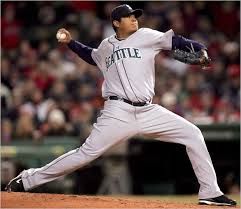
I made no qualms expressing my love for King Felix this year. I think Felix will be the second best pitcher (behind Lincecum and ahead of Halladay). I said if I had a very late pick in my snake draft and Lincecum was off the board, I would take Felix with my first or second pick (Although to be honest I'm happy it didn't come to that). I am all in on DME's praise for Jack Zduriencik and I think he's done a great job with the Mariners this year.
Now it's no shock Felix is good. Felix has a 31.08 ADP on MDC and after a 19 W, 2.49 ERA, 1.14 WHIP, with 217 strike outs and a runner up to the AL Cy Young, Felix is on everybody's radar. Yet I think Felix is underrated. MDC has The King as the 5th best pitcher behind Lincecum, Halladay, Sabathia, and Grienke, because like I said, I think Felix will be the second best.
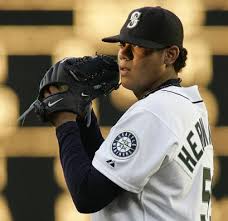
Here's some of Hernandez' stats like which would make him just very good:
- Felix has increased his K/9 the past three years (7.80, 7.85, 8.18)
- Felix has a great GB/FB ratio. His worst ratio was last year with a 1.79 groundball to flyball ratio
- Last year Felix took big jumps in FIP (3.80 to 3.09), xFIP (3.87 to 3.42), BB/9 (3.59 to 2.68), and WHIP (1.39 to 1.14)
- Felix started at least 30 games in the past four seasons
But the biggest reasons I like Felix is because of his age, his defense, and his ballpark
- Felix is only 24 years old (or he will be in a month). The guys already has had so much success and still has not entered into his prime
- Seattle is stockpiling defense. Last year, Seattle had the best defensive team anchored by CF Franklin Gutierrez (who was the best defensive outfielder with a minimum of 500 innings). Sure, their second best defender last year in Adrian Beltre was let go, but getting replaced by Chone Figgins is a damn good replacement. Figgins has a career 8.0 UZR/150 at third, but in the four out of the six season where Figgins had a positive UZR/150- he averaged a 14.6 UZR/150- with a career high last year.
- Here's some of the other few Mariners: Jack Wilson (career 5.9 UZR/150, averaged 18.5 his past two seasons), Ichiro (career 10.3 UZR/150 in the outfield), Gutierrez (career 26.3 UZR/150 at CF), Casey Kotchman (since 2006 he's had an average 11.1 UZR/150), and Jose Lopez (career 0.6 UZR/150 at second). Get the hint?
- Last year SAFECO was 24th in HR given up, 18th in hits given up, and 21st in runs given up. Not a bad place for a pitcher to call home. Plus, he gets to play his fair share of game in the Oakland Coliseum as well.
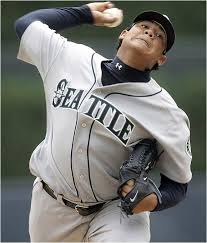
Felix's raw talent makes him a top ten pitcher. That talent combined with his youth, a great defense, and a pitcher friendly ballpark makes him the second best pitcher in my book.
FJM: Tiger Woods Time Magazine
In 2009, Time Magazine released an issue of the Top 100 most influential people in the world. Each selection had a short editorial written about him or her by a person who knows them best. Woods' editorial was written by his good Gillette buddy Roger Federer and it could not be more perfect in retrospect.
We are fortunate to live in the Tiger Woods era. Tiger, 33, is a model for how athletes should conduct themselves.Yes, we are fortunate. What other athlete could possible screw up his life so royally in front of the entire world? Finally, we have a model of how athletes DO conduct themselves, and it is awesome.
He handles himself with class, and he's articulate. There's no silly talk in public from Tiger. When he speaks, people listen.Uh, yeah. I set not one, but two alarm clocks to make sure and not miss Tiger's infamous "apology" for getting caught..errrrr..losing his sponsors..errrrr..destroying his family. And he's so articulate, perfect spelling and so visual in his texts.
That is an important part of why he's an idol for so many young athletes and why adults get giddy when they see him. They're not just awed by his great wins; they admire him as a person.If by giddy, he means horny, then yes adults get super giddy when they see the great Tiger. Whats not to admire. He's perfected putting it in the hole on and off the course.
I looked to Tiger for lessons on how philanthropy should be done. His philanthropic efforts are really unbelievable, and I plan to follow his example.Tiger never hesitates to get out his credit card when he sees someone in need of a plane ticket, hotel room, or even a diamond necklace. Those poor, tattooed little kiddies.
Tiger has become a close friend, and people would be surprised that under that serious game face is a big kid who loves to play jokes and have a good time.Just like Borat, beneath that serious face he love to make sexy time too
Stolen Goods: Disabled List Trends & Team Information
Jeff Zimmerman of Beyond The Boxscore has a great piece up comparing cumulative injury histories by team from 2002 to 2009. Care to guess which team has had the most/least number of injuries over the past seven years? Answers below (charts are from the link):


Will Sheets Of Webb Give Bedard A Harden?
Boom, look at how my creative juices are flowing with that amazing title!
There will always be risks when you draft for any fantasy league. When you draft for your first eight picks in your upcoming baseball draft, you want to take the least risky guys who you want to be studs for your team. But as you start getting later in the draft, you can and should start taking risks. You of course always want to minimize your risks (which is just true as an everyday life lesson), but as the pool to draft gets slimmer and slimmer, that option becomes less likely for you. You of course want to draft sleepers- guys who you think are undervalued so there going later in the draft who aren't risky (a la Max Scherzer), but even still, that pool starts to get slimmer and slimmer. If you can get every single one of your picks be high reward, low risk- then by all means use that strategy. But my guess is that you need to take at least a few high risk, high reward players.
The best players to take for high risk, high reward guys are those who have been proven to good when healthy, but are injury prone. This is because you assure yourself good statistics to accrue as opposed to taking risky players who might end up hurting your team. I believe the quintessential offensive players like this are Carlos Quentin and Josh Hamilton. But the four best high risk/ high reward pitchers are: Ben Sheets, Brandon Webb, Erik Bedard, and Rich Harden.
1) Brandon Webb
High Reward: Everyone knows how good Brandon Webb can be when healthy. He's a former Cy Young winner. Webb has started at least 33 games between 2004- 2008, has never had an ERA over 3.59 (which occurred in his first full season) and has had an ERA under 3.30 the past three years (excluding 2009). While Webb is the greatest at striking guys out (7.26 career K/9), he still will help your team averaging a little over 177 SO every year. Webb has a career 3.50 FIP (3.23 from '06-'08) and a career 3.31 xFIP (3.18 from '05-'08) along with a career 1.24 WHIP. And although you can and should never really predict wins, Webb has averaged 17.5 wins over his last four healthy seasons.
High Risk: Webb is probably the least risky out of all the four players which makes him the most valuable. Throughout Webb's career, he has never been an injury risk (unlike Sheets, Harden, and Bedard) but will most likely start the year on the DL. ESPN reports that Webb will probably come back late April/ early May- which means you will probably get about 25 starts from him. But Webb's biggest issue, as Stephania Bell reported in the fantasy focus podcast, that doctors aren't still 100% sure what exactly is the source of Webb's problems. But despite that all, given Webb's past durability and strong showings during spring training, it seems to be in Webb's favor to stay healthy and be effective over the course of a full baseball season once he comes back.
2) Ben Sheets
Despite Sheets missing all of last year and having an injury prone career, I still put him as the second best of this group.
High Reward: If you exclude 2006 and 2009: Sheets still has started at least 22 games per season and started 31 games in his past full season in 2008. Sheets is essentially a lock for a minimum of 10 wins, 140 strike outs, a 1.15 WHIP, and 3.80 ERA- which is essentially what Sheets performs every year. Sheets has a career 7.60 K/9, 3.85 K/BB, 1.20 WHIP, 2.56 FIP, and a 3.55 xFIP. Added to that that Sheets is now playing most of his games in the cavernous Oakland Coliseum and SAFECO along with a Billy Beane build defense will help add to Sheet's stats.
High Risk: It's never a good thing when a consistently injury prone pitcher misses an entire year. Sheets has not started over 32 games since 2004 and has only started over 24 games once since 2004 (31 in '08). There's also a slight strike out risk with Sheets because in '06 Sheets only gained 116 SO in '06 (granted in only 17 GS) and only 106 SO in '07 (24 GS). But his constant stints on the DL and missing all of 2009 makes Sheets very risky.
However, I would not put too much stock in Sheets getting rocked a week or two ago. It's spring training and not indicative of how Sheets will perform during the regular season
3) Erik Bedard
Although Bedard has only started 30 games in the past two years as opposed to the 51 started by Harden, Bedard is the better pitcher with the better defense and more favorable ball park.
High Reward: Bedard has a career 8.77 K/9, 3.66 FIP, and 3.88 FIP which should mean you will get pretty good ERA and SO totals from Bedard. Added to that that Bedard has the same effect as Sheets where he gets to play most of his games (assuming his health will correspond to it) in the favorable ballparks of SAFECO and Oakland Coliseum and will have a top three defense behind him will help Bedard put up pretty good numbers.
High Risk: Like all these pitchers, the biggest risk is health. But this is even more so for Bedard. He has only started 15 games per season since being traded to Seattle. Only getting 15 games from a pitcher is pretty bad and this is most evidenced by Bedard's win totals (11 wins the past two years). Bedard's high career 3.56 BB/9 doesn't help anything either showing up in Bedard's somewhat high 1.32 WHIP.
4) Rich Harden
Harden has a lot of games started the past two years should give him a slight edge over Sheets and Bedard, but the Rangers favorable hitter's ballpark and Harden moving from the NL to the AL makes Harden the worst candidate out of these four pitchers.
High Reward: This biggest reward Harden will give you in strike outs. Harden has a career 9.35 K/9 had a 10.91 K/9 in '09 and a 11.01 K/9 in '08. His sub-4.00 career FIP and xFIP (3.58 and 3.75 respectively) and decently low career 1.24 WHIP are all positives in Harden's favor. And although Harden's ballpark could hurt his numbers, that ballpark with his offense behind could help his W totals.
High Risk: Rangers Ballpark is the best hitter's home park Harden has ever played at and that, along with the move back to the AL, should mean a slight decrease in Harden's numbers. And although the Rangers offense could help Harden's wins, the fact that Harden does not go deep into games means it's less likely that that win total will increase. And although Harden has started over 25 games the past years, Harden also only has started a total of 16 games in '06 and '07.
So what can you take out of this?
My advice is that you take at least one of these pitchers. Despite all the negatives that have been discussed about each player, having one is worth your while because of when you need to take these players in your draft/ the cost the players will go for will be worth the 15-25 starts from them. Now drafting two or three, or even worse, all of these players is EXTREMELY risky (Yes, I'm talking to you TBO who has Bedard and Harden in one league and Bedard, Harden, and Sheets in another) and will most likely backfire on you. But having one of these guys is a good risk to take.
There will always be risks when you draft for any fantasy league. When you draft for your first eight picks in your upcoming baseball draft, you want to take the least risky guys who you want to be studs for your team. But as you start getting later in the draft, you can and should start taking risks. You of course always want to minimize your risks (which is just true as an everyday life lesson), but as the pool to draft gets slimmer and slimmer, that option becomes less likely for you. You of course want to draft sleepers- guys who you think are undervalued so there going later in the draft who aren't risky (a la Max Scherzer), but even still, that pool starts to get slimmer and slimmer. If you can get every single one of your picks be high reward, low risk- then by all means use that strategy. But my guess is that you need to take at least a few high risk, high reward players.
The best players to take for high risk, high reward guys are those who have been proven to good when healthy, but are injury prone. This is because you assure yourself good statistics to accrue as opposed to taking risky players who might end up hurting your team. I believe the quintessential offensive players like this are Carlos Quentin and Josh Hamilton. But the four best high risk/ high reward pitchers are: Ben Sheets, Brandon Webb, Erik Bedard, and Rich Harden.
1) Brandon Webb
High Reward: Everyone knows how good Brandon Webb can be when healthy. He's a former Cy Young winner. Webb has started at least 33 games between 2004- 2008, has never had an ERA over 3.59 (which occurred in his first full season) and has had an ERA under 3.30 the past three years (excluding 2009). While Webb is the greatest at striking guys out (7.26 career K/9), he still will help your team averaging a little over 177 SO every year. Webb has a career 3.50 FIP (3.23 from '06-'08) and a career 3.31 xFIP (3.18 from '05-'08) along with a career 1.24 WHIP. And although you can and should never really predict wins, Webb has averaged 17.5 wins over his last four healthy seasons.
High Risk: Webb is probably the least risky out of all the four players which makes him the most valuable. Throughout Webb's career, he has never been an injury risk (unlike Sheets, Harden, and Bedard) but will most likely start the year on the DL. ESPN reports that Webb will probably come back late April/ early May- which means you will probably get about 25 starts from him. But Webb's biggest issue, as Stephania Bell reported in the fantasy focus podcast, that doctors aren't still 100% sure what exactly is the source of Webb's problems. But despite that all, given Webb's past durability and strong showings during spring training, it seems to be in Webb's favor to stay healthy and be effective over the course of a full baseball season once he comes back.
2) Ben Sheets
Despite Sheets missing all of last year and having an injury prone career, I still put him as the second best of this group.
High Reward: If you exclude 2006 and 2009: Sheets still has started at least 22 games per season and started 31 games in his past full season in 2008. Sheets is essentially a lock for a minimum of 10 wins, 140 strike outs, a 1.15 WHIP, and 3.80 ERA- which is essentially what Sheets performs every year. Sheets has a career 7.60 K/9, 3.85 K/BB, 1.20 WHIP, 2.56 FIP, and a 3.55 xFIP. Added to that that Sheets is now playing most of his games in the cavernous Oakland Coliseum and SAFECO along with a Billy Beane build defense will help add to Sheet's stats.
High Risk: It's never a good thing when a consistently injury prone pitcher misses an entire year. Sheets has not started over 32 games since 2004 and has only started over 24 games once since 2004 (31 in '08). There's also a slight strike out risk with Sheets because in '06 Sheets only gained 116 SO in '06 (granted in only 17 GS) and only 106 SO in '07 (24 GS). But his constant stints on the DL and missing all of 2009 makes Sheets very risky.
However, I would not put too much stock in Sheets getting rocked a week or two ago. It's spring training and not indicative of how Sheets will perform during the regular season
3) Erik Bedard
Although Bedard has only started 30 games in the past two years as opposed to the 51 started by Harden, Bedard is the better pitcher with the better defense and more favorable ball park.
High Reward: Bedard has a career 8.77 K/9, 3.66 FIP, and 3.88 FIP which should mean you will get pretty good ERA and SO totals from Bedard. Added to that that Bedard has the same effect as Sheets where he gets to play most of his games (assuming his health will correspond to it) in the favorable ballparks of SAFECO and Oakland Coliseum and will have a top three defense behind him will help Bedard put up pretty good numbers.
High Risk: Like all these pitchers, the biggest risk is health. But this is even more so for Bedard. He has only started 15 games per season since being traded to Seattle. Only getting 15 games from a pitcher is pretty bad and this is most evidenced by Bedard's win totals (11 wins the past two years). Bedard's high career 3.56 BB/9 doesn't help anything either showing up in Bedard's somewhat high 1.32 WHIP.
4) Rich Harden
Harden has a lot of games started the past two years should give him a slight edge over Sheets and Bedard, but the Rangers favorable hitter's ballpark and Harden moving from the NL to the AL makes Harden the worst candidate out of these four pitchers.
High Reward: This biggest reward Harden will give you in strike outs. Harden has a career 9.35 K/9 had a 10.91 K/9 in '09 and a 11.01 K/9 in '08. His sub-4.00 career FIP and xFIP (3.58 and 3.75 respectively) and decently low career 1.24 WHIP are all positives in Harden's favor. And although Harden's ballpark could hurt his numbers, that ballpark with his offense behind could help his W totals.
High Risk: Rangers Ballpark is the best hitter's home park Harden has ever played at and that, along with the move back to the AL, should mean a slight decrease in Harden's numbers. And although the Rangers offense could help Harden's wins, the fact that Harden does not go deep into games means it's less likely that that win total will increase. And although Harden has started over 25 games the past years, Harden also only has started a total of 16 games in '06 and '07.
So what can you take out of this?
My advice is that you take at least one of these pitchers. Despite all the negatives that have been discussed about each player, having one is worth your while because of when you need to take these players in your draft/ the cost the players will go for will be worth the 15-25 starts from them. Now drafting two or three, or even worse, all of these players is EXTREMELY risky (Yes, I'm talking to you TBO who has Bedard and Harden in one league and Bedard, Harden, and Sheets in another) and will most likely backfire on you. But having one of these guys is a good risk to take.