Click here for Commenting Rules and how GOI's final list came together
Who's List Was This On
- The 'Bright' One- #1
TOTAL VOTES RECEIVED: 25
Directed By: Robert Zemeckis
Written By: Robert Zemeckis and Bob Gale
Starring: Michael J. Fox, Christopher Lloyd, Lea Thompson, and Thomas Wilson
The Plot
Marty McFly (Fox) and Doc Brown (Lloyd) go back to the future where Biff (Wilson) sneaks along, steals a sports almanac from the future, goes back to meet himself in the 1950's to give his past self the future almanac so that his past self can get rich by betting on sporting events. This creates an alternate timeline in which Biff rules and creates chaos. Marty and Doc Brown must go back to the 1950's to stop past Biff from getting a hold of the almanac.
Why This Movie Is Great
This was TBO's #1 selection and I wanted everybody to write a post on their #1 selection. I asked TBO to do the same and he responded with "I don't do movie reviews". I asked him to just write a few paragraphs on why he likes this movie and he responded with "Because it makes me happy." Therefore, I will write the review for this movie- which also means my own personal opinion will be interjected throughout the analysis.
If I were doing a list of the 100 greatest movies of the past twenty five years I don't think I would include Back to the Future Part II. The first movie was excellent but it was released in 1985- which means it was released 27 years ago and not eligible for this list. There are many sequels that stand up on its own (The Dark Knight, The Godfather Part II, Spiderman 2, The Empire Strikes Back just to name a few). Back to the Future Part II is not one of them. However, if TBO is trying to piggy back the original Back to the Future into this list, then that's at least understandable.
But not to shit on his selection so much, let me explain why the Back to the Future movies are awesome. Or at least attempt to do so. There is nothing technically spectacular about the movies. There's no underlying universal themes about human emotions or behavior, there's no acting performance that will blow you away, and there's no great directorial or camera tricks throughout the movies. However, the movies are just fun. I don't think anyone can sit through any Back to the Future movies (at least the first two) and not have the same reaction The 'Bright' One did. They just make you happy. The movies are a sci-fi roller coaster ride that you just want to watch again and again.
And as sports fans, we always wish we knew the outcome of games. We've all been in Biff's shoes wishing we knew how games ended so we can bet on them. Game of Inches has a Yahoo! group where we try and predict the outcome of every single NFL game. The internet is full of analysts trying to determine how games were won and lost. However, that's the way life is supposed to be. It's supposed to be uncertain. Not only would sports become boring but life would be boring. Back to the Future Part II shows the negative consequences of a world where a person knows the outcome of everything. 1985B is a terrible world to live in and Marty and Doc Brown have to go back in time and fix it.
There's something about time travel that everyone seems to enjoy. We all have made mistakes that we wish we could go back and correct and the Back to the Future trilogy shows us what a wild and crazy romp time travel can be.
FUN FACT: When Doc Brown and Marty McFly go to 2015 the newspaper said that the Chicago Cubs defeated the Miami team to win the World series. The Florida Marlins just changed their name to the Miami Marlins. However, both the Cubs and Marlins play in the NL so they can not face each other in the World Series. Also, in the movie, the Miami franchise is the Miami Gators.
Showing posts sorted by date for query marlins. Sort by relevance Show all posts
2012 Offseason Outlook: The Chicago Cubs
Posted by
David "MVP" Eckstein
on Friday, November 4, 2011
The following is a sneak peak of my upcoming article for The Hardball Times. The management section will be different, but I thought this draft would make an interesting read.
Hiring Theo Epstein and Jed Hoyer was a great step forward for the Cubs organization, whose last World Series appearance was 1945.
For the past 30 years, since the team passed from the Wrigley family, Cubs' ownership has rarely seen the team as anything more than a cash cow. Cubs games are a unique social experience that blend booze and brotherhood with more than 100 years of bad luck. Wrigleyville is a one-of-a-kind sports neighborhood that surrounds the field with good eats and plenty of bars. The atmosphere is safe and always welcoming (unless you are a Cardinals fan, in which case you get an in-all-good fun jostling). The slightly intoxicated Cubs fan -- second only to Wisconsin in inebriation per capita -- tends to be a complete 180 from the associated personality of a Philadelphia [choose your sport] fan*. This is why the Cubs are the lovable losers, who live at what has been dubbed the friendly confines. Heck, we're world famous for our bleacher bums.
*To be fair to those Phillies fans who threw batteries at J.D. Drew, some Cubs fan once threw a battery at former Cub Jacque Jones. Still, no stadium full of Cubs fans has ever booed Santa Claus."
Even though the Cubs are only sporadically good due to a history of poor management, unfortunate drafting and bad trades, their games have historically sold. People come for the environment more than the product on the field, to experience and take part in the fun. Over the past 30 years, the social aspect of Cubs games has grown from the bleacher bums, who are being phased out for overpriced corporate outings—the "white collar social." Wrigley Field has become the epitome of the casual—not to be confused with fair-weather—fan. It has evolved into more of a place to go than a place to truly care about the result.
Now, with more than a hundred years since the Cubs' last World Series win and with the losing teams of the past two seasons, fans are proving they are finally fed up with the way the organization has been run. This year, tickets to Cubs games could be purchased on StubHub for as low as $1. Even the "guaranteed to sell out" games, such as those against the Cardinals, did not sell out toward the end of the season. And even when the tickets sold—many purchased on speculation with the intent to resell—seats remained empty, poking holes in vending sales.
Firing general manager Jim Hendry in favor of guy who "embraces the numbers" was a big step forward for an organization that has not played "smart baseball." By all accounts, Hendry is one of the nicest guys in the business, and a real class act. Alas, Hendry's tenure as the Cubs' GM was marred by bad drafting, albatross contracts that featured no-trade clauses and player options, and disappointing failure despite three playoff runs. Hendry went all-in from 2007-2009. Had it paid off with a World Series berth, Cubs fans could probably stomach the team's current state of affairs as the cost of glorious success. But that success did not occur. Some great trades early in his role as the Cubs' G.M. (e.g., stealing Aramis Ramirez and Derek Lee), were countered by equally bad losses (the Juan Pierre deal and the Alfonso Soriano contract).
Even though the Cubs are one of the top five organizations in terms of revenue and payroll, throwing money around on players rarely solves one's problems unless you are New York. Even Boston, in a great position at the moment, has its issues due to a few big, bad salaries. If you are going to spend big, you need to hit. A big organization like the Cubs can afford to miss every now and then, but not consistently, and with the magnitude of commitment they did from 2007-2009.
New owner Tom Ricketts, in dropping Hendry in favor of Hoyer, and hiring Epstein as the president of baseball operations, indicated to Cubs fans that he cares about, and is committed to, winning. With Hoyer and Epstein aboard, and with the Cubs' payroll demons slowly but steadily shedding over the next two or three seasons (Soriano is signed through 2014), an era of sustainable success akin to Boston's past decade could be upon us. Drafting and prospect loading will be key over the next couple of years, as will be finding good low-risk, high-reward contracts that could return dividends.
The Cubs have a long way to go toward competing, but putting the right people in charge is a major first step. The Cubs have lacked a philosophy and direction, and this is one of the (many) things that has kept the Cubs from sustainable success. Since the mid-'90s, Cubs management has always talked about a youth movement when things got their roughest, only to catch lightning in a bottle a few years later and try to capitalize on that flash by sacrificing the future for the now. Toggling between rebuilding and going all-in over the past 15 years is just one reason the Cubs are in the position they are today, but it is a big one.
With the foundation laid, there is much work left ahead. Let's look at the state of the team, starting with the Cubs' strengths.
The Cubs' clearest strengths come at the hardest-to-fill positions. Between the young shortstop/second baseman Starlin Castro (depending on how his defense continues to develop) and the underrated power and patience of catcher Geovany Soto (new manager, less Koyie Hill?), the Cubs have mainstays at two of the most important spots on the field.
Provided the Cubs new manager gives Soto the playing time he deserves (despite being healthy over the past two seasons, he was in only a combined 230 games), they should see a modest offensive boost from 2011. Soto took a step back in terms of his walk rate and strikeout rate, which had progressed over the past few seasons, but still managed to turn in a respectable +2.1 WAR despite a .280 BABIP and limited playing time. The power that people were worried had disappeared stuck around, more or less. Power was down across the major leagues this year, and I expect Soto's ISO to be back over the .200 plateau in 2012. His defense, to the extent you trust the plus/minus system for catchers, has progressed from horrible to bad to average over the years, which is encouraging.
At second base, the Cubs have rookie Darwin Barney. Despite a hot-then-cold first/second half split, Barney was worth +2.2 WAR over 143 games. In other words, he is a slightly above average player making the league minimum for another two seasons. The Cubs could do worse, and keeping Barney frees up resources for the Cubs to spend elsewhere. If the Cubs want to take a low-risk, high-reward approach to the shallow free agent pool, however, Kelly Johnson could be a fit. That would slide Barney over to third base, where the Cubs have no one to play at the moment.
Johnson is a very attractive free agent because he possesses +4 WAR potential, as evidenced by 2007-08 and 2010, though 2010 was bookmarked by by two pretty disappointing seasons. If the Cubs do not sign a second baseman like Johnson and slide Barney over, they will need to bring in some outside help at third base, potentially in the form of Michael Cuddyer, but more on that below.
Meanwhile, in the upper minors, Brett Jackson continues to develop as the Cubs' center-fielder of the future. Jackson does not have an MVP or superstar ceiling, but he should be a consistent All-Star in his prime. Jackson has issues with strikeouts, but has a modest (20+ home run) power upside, speed and athleticism. Those should combine for a handful of 3-4+ WAR seasons if he can just cut down the whiff rate. That may be a big if, but Jackson is the most exciting Cubs hitting prospect to reach the upper minors in the past 10 years. He should arrive around the All-Star break.
Though the Cubs have strong enough starters, they lack depth up the middle. Their utility guy this year was a combination of Blake DeWitt, DJ LeMahieu and Jeff Baker, none of whom are anything but replacement level. LeMahieu probably has the most value of that group, given his age (23), but he is a light-hitting, no-walking, no-running middle infielder who is just a DL stopgap with a decent glove. If anyone up the middle for the Cubs gets injured for an ex tended time, there's not an even "average" replacement. Perhaps the Cubs will target a low-cost Jamey Carroll type in free agency; more likely, LeMahieu will have a graduated role in 2012 doing what he did down the stretch in 2011.
The Cubs are not just weak at the corners. They do not even have players reasonably scheduled to play third base, right field, or first base.
With Aramis Ramirez declining his player option (saving the Cubs $2 million in the process), the closest thing the Cubs have to a third baseman at the moment is Barney, who is playing second. Josh Vitters is the team's only prospect at the position, and he's been a massive disappointment to date, with neither walks nor power over the past three years. Vitters is only 22, so perhaps he has time, but it is hard to teach players with no patience at the plate how to walk. Vitters is playing pretty decently in the hitter-friendly Arizona Fall League, but those stats have to be taken with a grain of salt. A realistic outcome of the third base situation would be Johnson or Michael Cuddyer. He's 32, but third base is a vacuum for the Cubs and the third base free agency pool is shallower than the girls of the Jersey Shore. A three-year, $30-35 million deal may be in the cards for Cuddyer. Ramirez, to the extent he wants a four-year deal, is going to end up as an Oriole—where Cubs go to retire.
Right field is just as open as third base. Bryan LaHair could get first dibs on the gig in spring training, but, like many a Cubs hitting prospect over the past five years, he's approaching 30 has minimal major league experience. If the Cubs are going to give LaHair a chance at a full time gig, they might as well let him play first base. They would be better off letting the younger Jackson try out for right to get some major league experience for when he slides over to center field in 2013. That is not to say that LaHair isn't a promising power bat, but he is a first baseman in outfielder's clothing in right.
If the Cubs want to go outside the organization, Grady Sizemore on a one-year incentive-laden deal could make a lot of sense, as could a low-cost one- or two-year deal for David DeJesus as a stopgap until Jackson arrives. Either could get full-time outfield duties in 2012, and likely 2013, assuming Marlon Byrd gets traded to a contender in need of an outfielder upon Jackson's arrival. Josh Willingham could also fit as an interesting power bat if he is willing to take a two-, rather than three-, year deal.
In left field, Soriano is going nowhere. The Cubs could bring back Reed Johnson on another one-year deal as a fourth outfielder, but they also have Tony Campana and former first-round pick Luis Montanez trolling around as outfield defensive replacements at the league minimum.
The Cubs also need a first baseman, and lucky for them, not only is a lot of money coming off the books, but two of the four best guys are currently on the market. The Cubs, along with the Mariners and Nationals, are probably among the favorites to sign Prince Fielder. With the Cardinals having won the 2011 World Series in Disney-magic fashion, Albert Pujols leaving St. Louis seems a longshot at this point, but the Cubs are one of two teams, the other being Toronto, that could feasibly offer the slugger $300 million if they really wanted to.
Though both Fielder and Pujols are great players who would make great additions, the Cubs should save their money. Pujols, to the extent he would sign with someone other than the Cardinals, is more of a "win now" player. He will be 32 next season, and though his career-low WAR total is 5.1, that low figure came this year. Pujols should keep being great over the next few years, but aging curves are never gracious to athletes in their mid-30s who aren't on the juice. Pujols has been relatively healthy over the past few years, which is encouraging, but can he maintain health and production four, five, and even six years into a multi-year contract? Cubs fans know what happened to Soriano by 2009, and though Pujols is an infinitely better player than Soriano, there is no reason to expect him to maintain a +6-9 WAR pace into his age 35 season, which is what he would have to do to be worth his contract. Just ask the Yankees how that monstrous Alex Rodriguez deal is working out for them.
That said, Pujols has the type of plate discipline skills that age well, even with a power decline. But the Cubs are not in a position to win now. They are not even in a position to likely win in 2013. They need to rebuild. By the time the Cubs realistically can compete again, Pujols will be into his mid-30s, and by then, he will be eating up resources relative to his production that the Cubs could better allocate elsewhere.
Then what of Fielder, who is four years Pujols' junior? Fielder is probably the better player to sign for several reasons. The first is that he will cost less money than Pujols. Of course Fielder is also a lesser player than Pujols, but a lot of Pujols' superior present value would be lost on a non-contending team like the Cubs. Fielder is also younger, by four years, and he would still be in his prime, albeit the tail end of his prime, by the time the Cubs are competing again. Age and cost would make more sense as a long-term contract for a team that is not trying to "win now."
However, Fielder is not much of an "athlete" in the traditional sense of the word. We all know the real reason that the Brewers couldn't resign CC Sabathia after 2008 was that there was not enough food in Milwaukee to feed the two of them. Fangraphs had an excellent article about Fielder's expected aging curve a few weeks ago, noting that fat baseball players tend to age substantially less gracefully than other players:
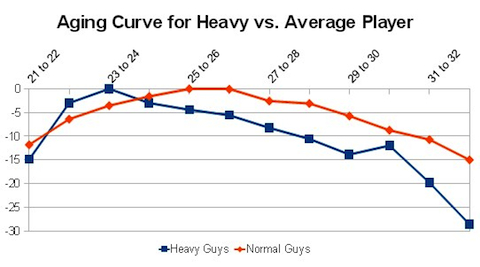
Do you remember what happened to Dmitri Young after he turned 31? Or Pat Burrell at 32? Or what happened to Adam Dunn this season? Nonathletic power hitters seem to fall rapidly when they hit their 30s, and even if their offense rebounds some, their defense remains atrocious. Fielder should be a fine player the next three or four seasons, but no better than Soriano by the time he is 33, and the Cubs would be paying him more than Soriano money for several years after that point.
So what should the Cubs do? In the short run, they'll certainly need a stopgap. This is where LaHair comes in. He has flashed really good power and patience for the Cubs (and before them, the Mariners) in the upper minors over the past few seasons. He also held his own for 20 games in the majors last season. Oliver projects LaHair as a .350-wOBA capable major league hitter (.800+ OPS) with a respectable on-base percentage and .200+ ISO power over the next two-plus years. His 2010 and 2009 major league equivalencies (MLEs) essentially agree. If nothing more, then, LaHair should be your very average first baseman, with some upside.
LaHair won't be a long term option, but he can certainly hold the place until 2014, when Joey Votto is a 30-year-old free agent. Votto is substantially more athletic than Fielder, and he'll be a couple of years younger than Pujols, and he is one of the most talented hitters in baseball. The Cubs would save money over the next two seasons, which could be allocated to Votto in the future, while being a better position to know what they'll need when they're in a position to compete, rather than guessing now and tossing around a lot of money to players who may or may not be worth it by 2014/2015.
Or the Cubs could turn back to Carlos Pena on another one-year deal, though the Pirates may offer two or three years out of desperation.
That is at least what I would do. However, the Cubs are probably going to sign Fielder for Carl Crawford money, in which case I hope I am dead wrong about how he'll age.
A major strength of the Cubs over the past decade, the rotation is currently in shambles and lacks an ace.
Matt Garza is the closest thing to an ace the Cubs have, but he's more an elite No. 2 type. Garza saw a huge jump in his strikeout rate when he moved to the National League this past season, though much of his whiff gain seemed to fizzle away in the second half. Garza's peripherals indicate he's capable of much better than his 2011 results in 2012. However, the Cubs gave up more in prospects to get Garza than the Brewers gave up to get Zack Greinke, and the value of a cost-controlled pitcher of Garza's talent is essentially lost on a team like the Cubs.
Ryan Dempster exercised his player option, and will return in 2012. Dempster was never an ace, but he's been a solid No. 2 starter for the past four years. Though 2011 was a disappointment by ERA/WHIP standards, Dempster's peripherals were essentially in line with his 2007-2009 performance heading into September, when he seemed to wear out down the stretch.
Beyond Dempster and Garza, the Cubs rotation has a lot of question marks. Will Carlos Zambrano be back? Probably not, and he most certainly will not return in 2013. Can Randy Wells and Andrew Cashner stay healthy for the Cubs? If each can, which Randy Wells—the one from the first or second half—will show up? Will Cashner's third pitch ever develop so that he can take the leap from questionable mid-rotation starter to a solid No. 2 type? Trey McNutt is the Cubs' top pitching prospect, but he took a major step back in Double-A last year—his strikeout rate fell and his walk rate spiked. McNutt looks to repeat Double-A next year, and could arrive in mid-2013 if all goes well, but he is no sure thing and is no ace even if he does pan out.
The Cubs gave a lot of starts to terrible pitchers in 2011. Among Casey Coleman, Doug Davis, Ramon Ortiz, Rodrigo Lopez, and James Russell, the Cubs gave 49 starts to substantially below-average pitchers. Of that group, only Lopez's 4.40 xFIP was within even 15 percent of league average. For 2012, the Cubs are going to need to bring in someone to shore up the back of the rotation. Joel Pinero is the most attractive and reasonably attainable free agent pitcher on the market for cheap. What Pinero lacks in strikeouts he makes up for in ground balls and a very limited walk rate. Pinero was kind of a disaster last year, so he should not cost too much on an incentive-laden one-year deal.
Javier Vazquez is another attractive name, worthy of a multi-year deal now that his velocity is back, but all signs currently point to him either retiring or returning to the Marlins. Likewise, Mark Buehrle would be a great innings eater, but would likely cost too much for what he does, and is more likely to stick with the White Sox or go to the Marlins, who probably will make a more attractive offer to fill out their team before the opening of their new stadium. The Cubs aren't likely to go after any of the "big" free agent pitchers, though a run at Yu Darvish could prove fruitful. Perhaps the Cubs can convince Roy Oswalt to come aboard at the right price, or woo Chris Capuano with a one-year deal.
In the bullpen, Carlos Marmol is still the Cubs closer, and Sean Marshall, who was a decent lefty starter a few years back, will remain an elite setup man. Kerry Wood could return on another one-year deal.
Jeff Samardzija will almost certainly be back; he has a $3 million option for 2012, which the Cubs probably will decline and work out a more team-friendly deal in light of how he's performed the past few years. Samardzija was serviceable in 2011, but he has to slash the walk rate. People not named Carlos Marmol have no excuse for walking 13.2 percent of the batters they face.
Chris Carpenter should be an interesting bullpen addition, assuming he is not converted back into a starter. Carpenter has control issues, but he also routinely hits triple digits on the radar gun and punches out a respectable number of batters with a strong groundball rate. If Carpenter cuts down the free passes, he could develop into an elite reliever for the Cubs. As a starter, he has a very limited ceiling because he really has only two pitches (and no control). Marco Mateo could also be good reliever, but like many before him, he is a high-strikeout, high-walk guy who cannot be relied upon in high-leverage situations. And if If Mateo is questionable, the rest of the bullpen is a double question mark. Between Chris Archer (in the Garza deal) and Jose Ceda (in the Kevin Gregg deal), the Cubs have traded away most of their electric relief arms in recent years. Jay Jackson has plateaued in talent as he reached the upper minors as a starter, so perhaps as a converted reliever he could develop into a reliable reliever for the Cubs given his good control and respectable strikeout rates as a starter. Rafael Dolis, a converted position player, could develop into a Sergio Santos type given his 96 mph fastball and supposedly electric slider/changeup combo, but his control needs a lot of work before he becomes a high-leverage reliever.
These question marks mean that the Cubs bullpen, outside its top three names (four, if Wood returns), is going to be a mess of young, rough, and still-developing pitchers unless Hoyer and Epstein find someone better (and relatively cheap) on the free agent market. On the brigh tside, the Cubs bullpen is entirely cost-controlled, so at least it won't be an expensive disaster when a starter gets knocked out early.
Tim Dierkes did a great job covering the Cubs' projected 2012 payroll situation last month.
Though the Cubs have had one of the highest payrolls in baseball in recent years, most of those contracts are finally starting to come off the books. Between Ramirez and Kosuke Fukudome, the Cubs are going to save $30 million in payroll. Another $5 million, half of Pena's salary, will be gone as well, though all of that and then some will go toward salary boosts for Soto, Garza and Byrd. John Grabow is off the books as well, which saves the Cubs roughly $5 million. If the Cubs can get some team to eat $5 million or so of Zambrano's salary (the Marlins?), they could free up between $30 and $40 million for 2012 when other players who will not be returning are considered.
In addition to that money, the Cubs will have Zambrano's $18 million, Dempster's $14 million, $6.5 million from Byrd, and another $5 million from Pena coming off the books for 2013, giving the Cubs between $50 and $60 million to work with over the next two seasons. Unfortunately, Soriano's $18 million per year will be around another three seasons, though the Cubs could move him to an AL team in need of a DH if they are willing to eat a lot of the salary. Even with Soriano on the books, Epstein andHoyer should be able to afford the necessary pieces, though one hopes a lot of the money is spent on the 2012 and 2013 drafts.
The Cubs' farm system is a disaster. Though they lacked a true star heading into 2011, the Cubs had enough depth to make them a borderline top 10 farm system. The Matt Garza deal eliminated almost all that depth, and what the Cubs are left with is a questionable No. 2 starterm in McNutt, a flawed but promising center field prospect in Jackson, and a prototypical Cubs prospect in Matt Szczur: a speedy "tools" guy who does not walk and has almost no power, like Montanez. The Cubs' top draft pick in 2012, Javier Baez, is a promising third base prospect (his shortstop defense is probably not good enough to stick), who could leapfrog Vitters with a good 2012 season in the minors. Hayden Simpson was a questionable pick in 2011, and his first year in the minors was a disaster.
Mike Quade is out, and it looks like Mike Maddux is the favorite to replace him. That could create an interesting dynamic because he could bring in his brother Greg to join the coaching staff. The Maddux brothers know quite a lot about pitching, and they could teach the Cubs young pitchers a lot of valuable game theory in addition to polishing their pitching mechanics. If Mike Maddux does not join the Cubs, Greg Maddux, who worked as a special consultant to Hendry, probably will not return in 2012 due to family issues.
The Cubs are a disaster at the moment, but Tom Ricketts is laying the foundation necessary to rebuild not only the team, but the franchise. Epstein and Hoyer have a long, uphill battle, but they are the right guys for the challenge. The Cubs have a foundation to build on with good up-the-middle starters. Corner positions are much easier to fill and the Cubs will have the payroll to make the necessary moves. The future of the Cubs rotation looks to be somewhat of a mess, with lots of question marks surrounding their prospects. They will need to bring in some outside help or make some very good draft picks and-or trades in the next couple of years.
What do you think about the Cubs' 2012 and future outlook? What moves would you like to see the Cubs make and why? Who is excited for the Epstein-Hoyer era to begin?
Hiring Theo Epstein and Jed Hoyer was a great step forward for the Cubs organization, whose last World Series appearance was 1945.
For the past 30 years, since the team passed from the Wrigley family, Cubs' ownership has rarely seen the team as anything more than a cash cow. Cubs games are a unique social experience that blend booze and brotherhood with more than 100 years of bad luck. Wrigleyville is a one-of-a-kind sports neighborhood that surrounds the field with good eats and plenty of bars. The atmosphere is safe and always welcoming (unless you are a Cardinals fan, in which case you get an in-all-good fun jostling). The slightly intoxicated Cubs fan -- second only to Wisconsin in inebriation per capita -- tends to be a complete 180 from the associated personality of a Philadelphia [choose your sport] fan*. This is why the Cubs are the lovable losers, who live at what has been dubbed the friendly confines. Heck, we're world famous for our bleacher bums.
*To be fair to those Phillies fans who threw batteries at J.D. Drew, some Cubs fan once threw a battery at former Cub Jacque Jones. Still, no stadium full of Cubs fans has ever booed Santa Claus."
Even though the Cubs are only sporadically good due to a history of poor management, unfortunate drafting and bad trades, their games have historically sold. People come for the environment more than the product on the field, to experience and take part in the fun. Over the past 30 years, the social aspect of Cubs games has grown from the bleacher bums, who are being phased out for overpriced corporate outings—the "white collar social." Wrigley Field has become the epitome of the casual—not to be confused with fair-weather—fan. It has evolved into more of a place to go than a place to truly care about the result.
Now, with more than a hundred years since the Cubs' last World Series win and with the losing teams of the past two seasons, fans are proving they are finally fed up with the way the organization has been run. This year, tickets to Cubs games could be purchased on StubHub for as low as $1. Even the "guaranteed to sell out" games, such as those against the Cardinals, did not sell out toward the end of the season. And even when the tickets sold—many purchased on speculation with the intent to resell—seats remained empty, poking holes in vending sales.
Firing general manager Jim Hendry in favor of guy who "embraces the numbers" was a big step forward for an organization that has not played "smart baseball." By all accounts, Hendry is one of the nicest guys in the business, and a real class act. Alas, Hendry's tenure as the Cubs' GM was marred by bad drafting, albatross contracts that featured no-trade clauses and player options, and disappointing failure despite three playoff runs. Hendry went all-in from 2007-2009. Had it paid off with a World Series berth, Cubs fans could probably stomach the team's current state of affairs as the cost of glorious success. But that success did not occur. Some great trades early in his role as the Cubs' G.M. (e.g., stealing Aramis Ramirez and Derek Lee), were countered by equally bad losses (the Juan Pierre deal and the Alfonso Soriano contract).
Even though the Cubs are one of the top five organizations in terms of revenue and payroll, throwing money around on players rarely solves one's problems unless you are New York. Even Boston, in a great position at the moment, has its issues due to a few big, bad salaries. If you are going to spend big, you need to hit. A big organization like the Cubs can afford to miss every now and then, but not consistently, and with the magnitude of commitment they did from 2007-2009.
New owner Tom Ricketts, in dropping Hendry in favor of Hoyer, and hiring Epstein as the president of baseball operations, indicated to Cubs fans that he cares about, and is committed to, winning. With Hoyer and Epstein aboard, and with the Cubs' payroll demons slowly but steadily shedding over the next two or three seasons (Soriano is signed through 2014), an era of sustainable success akin to Boston's past decade could be upon us. Drafting and prospect loading will be key over the next couple of years, as will be finding good low-risk, high-reward contracts that could return dividends.
The Cubs have a long way to go toward competing, but putting the right people in charge is a major first step. The Cubs have lacked a philosophy and direction, and this is one of the (many) things that has kept the Cubs from sustainable success. Since the mid-'90s, Cubs management has always talked about a youth movement when things got their roughest, only to catch lightning in a bottle a few years later and try to capitalize on that flash by sacrificing the future for the now. Toggling between rebuilding and going all-in over the past 15 years is just one reason the Cubs are in the position they are today, but it is a big one.
With the foundation laid, there is much work left ahead. Let's look at the state of the team, starting with the Cubs' strengths.
Up the middle
The Cubs' clearest strengths come at the hardest-to-fill positions. Between the young shortstop/second baseman Starlin Castro (depending on how his defense continues to develop) and the underrated power and patience of catcher Geovany Soto (new manager, less Koyie Hill?), the Cubs have mainstays at two of the most important spots on the field.
Provided the Cubs new manager gives Soto the playing time he deserves (despite being healthy over the past two seasons, he was in only a combined 230 games), they should see a modest offensive boost from 2011. Soto took a step back in terms of his walk rate and strikeout rate, which had progressed over the past few seasons, but still managed to turn in a respectable +2.1 WAR despite a .280 BABIP and limited playing time. The power that people were worried had disappeared stuck around, more or less. Power was down across the major leagues this year, and I expect Soto's ISO to be back over the .200 plateau in 2012. His defense, to the extent you trust the plus/minus system for catchers, has progressed from horrible to bad to average over the years, which is encouraging.
At second base, the Cubs have rookie Darwin Barney. Despite a hot-then-cold first/second half split, Barney was worth +2.2 WAR over 143 games. In other words, he is a slightly above average player making the league minimum for another two seasons. The Cubs could do worse, and keeping Barney frees up resources for the Cubs to spend elsewhere. If the Cubs want to take a low-risk, high-reward approach to the shallow free agent pool, however, Kelly Johnson could be a fit. That would slide Barney over to third base, where the Cubs have no one to play at the moment.
Johnson is a very attractive free agent because he possesses +4 WAR potential, as evidenced by 2007-08 and 2010, though 2010 was bookmarked by by two pretty disappointing seasons. If the Cubs do not sign a second baseman like Johnson and slide Barney over, they will need to bring in some outside help at third base, potentially in the form of Michael Cuddyer, but more on that below.
Meanwhile, in the upper minors, Brett Jackson continues to develop as the Cubs' center-fielder of the future. Jackson does not have an MVP or superstar ceiling, but he should be a consistent All-Star in his prime. Jackson has issues with strikeouts, but has a modest (20+ home run) power upside, speed and athleticism. Those should combine for a handful of 3-4+ WAR seasons if he can just cut down the whiff rate. That may be a big if, but Jackson is the most exciting Cubs hitting prospect to reach the upper minors in the past 10 years. He should arrive around the All-Star break.
Though the Cubs have strong enough starters, they lack depth up the middle. Their utility guy this year was a combination of Blake DeWitt, DJ LeMahieu and Jeff Baker, none of whom are anything but replacement level. LeMahieu probably has the most value of that group, given his age (23), but he is a light-hitting, no-walking, no-running middle infielder who is just a DL stopgap with a decent glove. If anyone up the middle for the Cubs gets injured for an ex tended time, there's not an even "average" replacement. Perhaps the Cubs will target a low-cost Jamey Carroll type in free agency; more likely, LeMahieu will have a graduated role in 2012 doing what he did down the stretch in 2011.
Corner infield
The Cubs are not just weak at the corners. They do not even have players reasonably scheduled to play third base, right field, or first base.
With Aramis Ramirez declining his player option (saving the Cubs $2 million in the process), the closest thing the Cubs have to a third baseman at the moment is Barney, who is playing second. Josh Vitters is the team's only prospect at the position, and he's been a massive disappointment to date, with neither walks nor power over the past three years. Vitters is only 22, so perhaps he has time, but it is hard to teach players with no patience at the plate how to walk. Vitters is playing pretty decently in the hitter-friendly Arizona Fall League, but those stats have to be taken with a grain of salt. A realistic outcome of the third base situation would be Johnson or Michael Cuddyer. He's 32, but third base is a vacuum for the Cubs and the third base free agency pool is shallower than the girls of the Jersey Shore. A three-year, $30-35 million deal may be in the cards for Cuddyer. Ramirez, to the extent he wants a four-year deal, is going to end up as an Oriole—where Cubs go to retire.
Right field is just as open as third base. Bryan LaHair could get first dibs on the gig in spring training, but, like many a Cubs hitting prospect over the past five years, he's approaching 30 has minimal major league experience. If the Cubs are going to give LaHair a chance at a full time gig, they might as well let him play first base. They would be better off letting the younger Jackson try out for right to get some major league experience for when he slides over to center field in 2013. That is not to say that LaHair isn't a promising power bat, but he is a first baseman in outfielder's clothing in right.
If the Cubs want to go outside the organization, Grady Sizemore on a one-year incentive-laden deal could make a lot of sense, as could a low-cost one- or two-year deal for David DeJesus as a stopgap until Jackson arrives. Either could get full-time outfield duties in 2012, and likely 2013, assuming Marlon Byrd gets traded to a contender in need of an outfielder upon Jackson's arrival. Josh Willingham could also fit as an interesting power bat if he is willing to take a two-, rather than three-, year deal.
In left field, Soriano is going nowhere. The Cubs could bring back Reed Johnson on another one-year deal as a fourth outfielder, but they also have Tony Campana and former first-round pick Luis Montanez trolling around as outfield defensive replacements at the league minimum.
The Cubs also need a first baseman, and lucky for them, not only is a lot of money coming off the books, but two of the four best guys are currently on the market. The Cubs, along with the Mariners and Nationals, are probably among the favorites to sign Prince Fielder. With the Cardinals having won the 2011 World Series in Disney-magic fashion, Albert Pujols leaving St. Louis seems a longshot at this point, but the Cubs are one of two teams, the other being Toronto, that could feasibly offer the slugger $300 million if they really wanted to.
Though both Fielder and Pujols are great players who would make great additions, the Cubs should save their money. Pujols, to the extent he would sign with someone other than the Cardinals, is more of a "win now" player. He will be 32 next season, and though his career-low WAR total is 5.1, that low figure came this year. Pujols should keep being great over the next few years, but aging curves are never gracious to athletes in their mid-30s who aren't on the juice. Pujols has been relatively healthy over the past few years, which is encouraging, but can he maintain health and production four, five, and even six years into a multi-year contract? Cubs fans know what happened to Soriano by 2009, and though Pujols is an infinitely better player than Soriano, there is no reason to expect him to maintain a +6-9 WAR pace into his age 35 season, which is what he would have to do to be worth his contract. Just ask the Yankees how that monstrous Alex Rodriguez deal is working out for them.
That said, Pujols has the type of plate discipline skills that age well, even with a power decline. But the Cubs are not in a position to win now. They are not even in a position to likely win in 2013. They need to rebuild. By the time the Cubs realistically can compete again, Pujols will be into his mid-30s, and by then, he will be eating up resources relative to his production that the Cubs could better allocate elsewhere.
Then what of Fielder, who is four years Pujols' junior? Fielder is probably the better player to sign for several reasons. The first is that he will cost less money than Pujols. Of course Fielder is also a lesser player than Pujols, but a lot of Pujols' superior present value would be lost on a non-contending team like the Cubs. Fielder is also younger, by four years, and he would still be in his prime, albeit the tail end of his prime, by the time the Cubs are competing again. Age and cost would make more sense as a long-term contract for a team that is not trying to "win now."
However, Fielder is not much of an "athlete" in the traditional sense of the word. We all know the real reason that the Brewers couldn't resign CC Sabathia after 2008 was that there was not enough food in Milwaukee to feed the two of them. Fangraphs had an excellent article about Fielder's expected aging curve a few weeks ago, noting that fat baseball players tend to age substantially less gracefully than other players:

Do you remember what happened to Dmitri Young after he turned 31? Or Pat Burrell at 32? Or what happened to Adam Dunn this season? Nonathletic power hitters seem to fall rapidly when they hit their 30s, and even if their offense rebounds some, their defense remains atrocious. Fielder should be a fine player the next three or four seasons, but no better than Soriano by the time he is 33, and the Cubs would be paying him more than Soriano money for several years after that point.
So what should the Cubs do? In the short run, they'll certainly need a stopgap. This is where LaHair comes in. He has flashed really good power and patience for the Cubs (and before them, the Mariners) in the upper minors over the past few seasons. He also held his own for 20 games in the majors last season. Oliver projects LaHair as a .350-wOBA capable major league hitter (.800+ OPS) with a respectable on-base percentage and .200+ ISO power over the next two-plus years. His 2010 and 2009 major league equivalencies (MLEs) essentially agree. If nothing more, then, LaHair should be your very average first baseman, with some upside.
LaHair won't be a long term option, but he can certainly hold the place until 2014, when Joey Votto is a 30-year-old free agent. Votto is substantially more athletic than Fielder, and he'll be a couple of years younger than Pujols, and he is one of the most talented hitters in baseball. The Cubs would save money over the next two seasons, which could be allocated to Votto in the future, while being a better position to know what they'll need when they're in a position to compete, rather than guessing now and tossing around a lot of money to players who may or may not be worth it by 2014/2015.
Or the Cubs could turn back to Carlos Pena on another one-year deal, though the Pirates may offer two or three years out of desperation.
That is at least what I would do. However, the Cubs are probably going to sign Fielder for Carl Crawford money, in which case I hope I am dead wrong about how he'll age.
Pitching
A major strength of the Cubs over the past decade, the rotation is currently in shambles and lacks an ace.
Matt Garza is the closest thing to an ace the Cubs have, but he's more an elite No. 2 type. Garza saw a huge jump in his strikeout rate when he moved to the National League this past season, though much of his whiff gain seemed to fizzle away in the second half. Garza's peripherals indicate he's capable of much better than his 2011 results in 2012. However, the Cubs gave up more in prospects to get Garza than the Brewers gave up to get Zack Greinke, and the value of a cost-controlled pitcher of Garza's talent is essentially lost on a team like the Cubs.
Ryan Dempster exercised his player option, and will return in 2012. Dempster was never an ace, but he's been a solid No. 2 starter for the past four years. Though 2011 was a disappointment by ERA/WHIP standards, Dempster's peripherals were essentially in line with his 2007-2009 performance heading into September, when he seemed to wear out down the stretch.
Beyond Dempster and Garza, the Cubs rotation has a lot of question marks. Will Carlos Zambrano be back? Probably not, and he most certainly will not return in 2013. Can Randy Wells and Andrew Cashner stay healthy for the Cubs? If each can, which Randy Wells—the one from the first or second half—will show up? Will Cashner's third pitch ever develop so that he can take the leap from questionable mid-rotation starter to a solid No. 2 type? Trey McNutt is the Cubs' top pitching prospect, but he took a major step back in Double-A last year—his strikeout rate fell and his walk rate spiked. McNutt looks to repeat Double-A next year, and could arrive in mid-2013 if all goes well, but he is no sure thing and is no ace even if he does pan out.
The Cubs gave a lot of starts to terrible pitchers in 2011. Among Casey Coleman, Doug Davis, Ramon Ortiz, Rodrigo Lopez, and James Russell, the Cubs gave 49 starts to substantially below-average pitchers. Of that group, only Lopez's 4.40 xFIP was within even 15 percent of league average. For 2012, the Cubs are going to need to bring in someone to shore up the back of the rotation. Joel Pinero is the most attractive and reasonably attainable free agent pitcher on the market for cheap. What Pinero lacks in strikeouts he makes up for in ground balls and a very limited walk rate. Pinero was kind of a disaster last year, so he should not cost too much on an incentive-laden one-year deal.
Javier Vazquez is another attractive name, worthy of a multi-year deal now that his velocity is back, but all signs currently point to him either retiring or returning to the Marlins. Likewise, Mark Buehrle would be a great innings eater, but would likely cost too much for what he does, and is more likely to stick with the White Sox or go to the Marlins, who probably will make a more attractive offer to fill out their team before the opening of their new stadium. The Cubs aren't likely to go after any of the "big" free agent pitchers, though a run at Yu Darvish could prove fruitful. Perhaps the Cubs can convince Roy Oswalt to come aboard at the right price, or woo Chris Capuano with a one-year deal.
In the bullpen, Carlos Marmol is still the Cubs closer, and Sean Marshall, who was a decent lefty starter a few years back, will remain an elite setup man. Kerry Wood could return on another one-year deal.
Jeff Samardzija will almost certainly be back; he has a $3 million option for 2012, which the Cubs probably will decline and work out a more team-friendly deal in light of how he's performed the past few years. Samardzija was serviceable in 2011, but he has to slash the walk rate. People not named Carlos Marmol have no excuse for walking 13.2 percent of the batters they face.
Chris Carpenter should be an interesting bullpen addition, assuming he is not converted back into a starter. Carpenter has control issues, but he also routinely hits triple digits on the radar gun and punches out a respectable number of batters with a strong groundball rate. If Carpenter cuts down the free passes, he could develop into an elite reliever for the Cubs. As a starter, he has a very limited ceiling because he really has only two pitches (and no control). Marco Mateo could also be good reliever, but like many before him, he is a high-strikeout, high-walk guy who cannot be relied upon in high-leverage situations. And if If Mateo is questionable, the rest of the bullpen is a double question mark. Between Chris Archer (in the Garza deal) and Jose Ceda (in the Kevin Gregg deal), the Cubs have traded away most of their electric relief arms in recent years. Jay Jackson has plateaued in talent as he reached the upper minors as a starter, so perhaps as a converted reliever he could develop into a reliable reliever for the Cubs given his good control and respectable strikeout rates as a starter. Rafael Dolis, a converted position player, could develop into a Sergio Santos type given his 96 mph fastball and supposedly electric slider/changeup combo, but his control needs a lot of work before he becomes a high-leverage reliever.
These question marks mean that the Cubs bullpen, outside its top three names (four, if Wood returns), is going to be a mess of young, rough, and still-developing pitchers unless Hoyer and Epstein find someone better (and relatively cheap) on the free agent market. On the brigh tside, the Cubs bullpen is entirely cost-controlled, so at least it won't be an expensive disaster when a starter gets knocked out early.
Payroll
Tim Dierkes did a great job covering the Cubs' projected 2012 payroll situation last month.
Though the Cubs have had one of the highest payrolls in baseball in recent years, most of those contracts are finally starting to come off the books. Between Ramirez and Kosuke Fukudome, the Cubs are going to save $30 million in payroll. Another $5 million, half of Pena's salary, will be gone as well, though all of that and then some will go toward salary boosts for Soto, Garza and Byrd. John Grabow is off the books as well, which saves the Cubs roughly $5 million. If the Cubs can get some team to eat $5 million or so of Zambrano's salary (the Marlins?), they could free up between $30 and $40 million for 2012 when other players who will not be returning are considered.
In addition to that money, the Cubs will have Zambrano's $18 million, Dempster's $14 million, $6.5 million from Byrd, and another $5 million from Pena coming off the books for 2013, giving the Cubs between $50 and $60 million to work with over the next two seasons. Unfortunately, Soriano's $18 million per year will be around another three seasons, though the Cubs could move him to an AL team in need of a DH if they are willing to eat a lot of the salary. Even with Soriano on the books, Epstein andHoyer should be able to afford the necessary pieces, though one hopes a lot of the money is spent on the 2012 and 2013 drafts.
Pipeline
The Cubs' farm system is a disaster. Though they lacked a true star heading into 2011, the Cubs had enough depth to make them a borderline top 10 farm system. The Matt Garza deal eliminated almost all that depth, and what the Cubs are left with is a questionable No. 2 starterm in McNutt, a flawed but promising center field prospect in Jackson, and a prototypical Cubs prospect in Matt Szczur: a speedy "tools" guy who does not walk and has almost no power, like Montanez. The Cubs' top draft pick in 2012, Javier Baez, is a promising third base prospect (his shortstop defense is probably not good enough to stick), who could leapfrog Vitters with a good 2012 season in the minors. Hayden Simpson was a questionable pick in 2011, and his first year in the minors was a disaster.
Management
Mike Quade is out, and it looks like Mike Maddux is the favorite to replace him. That could create an interesting dynamic because he could bring in his brother Greg to join the coaching staff. The Maddux brothers know quite a lot about pitching, and they could teach the Cubs young pitchers a lot of valuable game theory in addition to polishing their pitching mechanics. If Mike Maddux does not join the Cubs, Greg Maddux, who worked as a special consultant to Hendry, probably will not return in 2012 due to family issues.
Conclusion
The Cubs are a disaster at the moment, but Tom Ricketts is laying the foundation necessary to rebuild not only the team, but the franchise. Epstein and Hoyer have a long, uphill battle, but they are the right guys for the challenge. The Cubs have a foundation to build on with good up-the-middle starters. Corner positions are much easier to fill and the Cubs will have the payroll to make the necessary moves. The future of the Cubs rotation looks to be somewhat of a mess, with lots of question marks surrounding their prospects. They will need to bring in some outside help or make some very good draft picks and-or trades in the next couple of years.
What do you think about the Cubs' 2012 and future outlook? What moves would you like to see the Cubs make and why? Who is excited for the Epstein-Hoyer era to begin?
Looking ahead: 2011 xBABIP-adjusted batting lines
Posted by
David "MVP" Eckstein
on Friday, October 28, 2011
The following is from my latest article for The Hardball Times.
Don't forget to follow THTFantasy on Twitter. A special shout-out thanks to Yizhe Shen for helping me compile the data for players on multiple teams this year.
Each of the past two seasons, I have made it a habit to use The Hardball Times' expected BABIP (xBABIP) formula in an attempt to take a somewhat luck-neutral look at batting lines from the previous year to help better forecast relative value for the (ages away) upcoming season. Not to break habit, what follows is a breakdown of 2011 batting lines.
Before I present the data, which can be accessed and sorted by clicking here, let me explain my methodology and the crucial-to-understand underlying assumptions. If you have not yet read Chris Dutton and Peter Bendix's article on their xBABIP formula, I suggest doing so before proceeding, because I use their formula.
Step one is calculating each player's xBABIP. This can be done through a variety of methods, but as I have indicated above, I use Chris Dutton and Peter Bendix's xBABIP formula. It is worth noting that other xBABIP formulas do exist, such as the one posted by slash12 a couple of years ago on Beyond The Boxscore. xBABIP is a theoretical model, and each formula has its own pros and cons.
I prefer to use The Hardball Times' version because 1) I'm a company man and 2) it accounts for park (though admittedly, the park factor data are a few years old now, and for a few teams—the Yankees, Twins, Mets, and starting next year, the Marlins—the park factors are entirely obsolete). Feel free to use the follow methodology of determining batting line with whatever formulation of xBABIP you choose.
Once you have calculated each player's xBABIP (a feat easier said than done, especially if you have to account for partial seasons and league/park factors), you will need to apply it using fancy algebra to determine a player's expected, luck-neutralized batting average (xAVG), on base percentage (xOBP), and slugging percentage (xSLG).
To calculate expected batting average, you begin by calculating the expected hits differential between a player's actual BABIP and his expected BABIP. To calculate a player's expected hits total, simply rearrange the BABIP formula using xBABIP in place of actual BABIP.
In other words, a player's expected hits are equal to that player's actual home run total plus his xBABIP times the following: At-bats minus strikeouts minus home runs plus sacrifice flies. In other words, xH=HR+xBABIP*(AB-K-HR+SF). Take this expected hits total and divide by at-bats to get xAVG.
Next, you will need to calculate xOBP. This is done by simply taking the quotient of the sum of hits, walks and hit by pitches and dividing that by the sum of at bats, walks, hit by pitches, and sacrifice flies. Not too complicated.
Calculating xSLG is at least as easy as calculating xOBP, but how you calculate it largely depends on how you perceive xBABIP to affect hits. If you think that a player's power rate would remain constant irrespective of BABIP luck, then you simply calculate a player's actual ISO (slugging percentage minus batting average) and add that value to his expected batting average.
If you pessimistically/optimistically believe that all hits gained/lost to BABIP luck were singles, then you calculate xSLG as by adding the difference between expected hits and actual hits to a player's singles total, and then dividing the sum of singles plus two times doubles plus three times triples plus four times home runs by at-bats.
As may be obvious, both methods have their own issues with calculating the expected power of the hits gained/saved through BABIP luck.
The first xSLG method holds power constant, which seems nice in theory. However, given that home runs totals are generally not affected by BABIP luck hit changes, using ISO either over/underestimates power depending on whether xBABIP would either subtract or add hits to a player's final line.
With the hits-added method, a player would be adding non-home run hits at an ISO pace that includes home runs. Alternatively, if hits are subtracted, it is subtracting some home run power value.
The "be overly pessimistic/optimistic approach" of course greatly oversimplifies this error, but it does so with a degree of skepticism. For hits added, we see what life would be like if all hits were singles, and think that there's power upside to be had in the projection.
Alternatively, for hits subtracted, we get some dose of reality with the understanding that there's a little more risk than the downward adjustment the numbers indicate. You might think of a hits-subtracted situation assuming all singles as the "upside" of luck-adjustment.
So pick you method of xSLG; each has its own vices. I prefer to use the first method (constant ISO adjustment), so that is what you will find in my spreadsheet of numbers below.
The methodology laid out, there are a few crucial points that must be addressed before the data are presented.
First is the people included in my data set. My data address only players who accumulated 300 or more plate appearances. With the exception of infield flyballs, pretty much all of the rest of the relevant xBABIP data stabilize by a half season's worth of plate appearances.
However, several players of interest were fewer than 15 plate appearances under the threshold (Desmond Jennings, Justin Morneau, Grady Sizemore, Chris Coghlan and John Mayberry) who I decided to add to the sample out of personal interest nonetheless.
Second, you are probably wondering how to use a different xBABIP formula (particularly slash12's) to get all the relevant numbers without having to do any additional, unnecessary work on your own. As a guy with a background in economics, I understand that desire to do the least amount of additional work necessary to capture the benefit sought, and accordingly, making an xBABIP formula adjustment is very easy with my spreadsheet.
All you need to do is change the formula in the xBABIP cell for the first player to reflect your favored xBABIP formula. Then, drag that cell down vertically to the bottom of the data set. Voila! All of the resulting changes and math will be done for you.
Finally, it is worth reminding you that the default xBABIP method used in my spreadsheet has slightly obsolete data (it's multi-year data from a couple of years ago) that is totally obsolete with respect to a few teams: The Mets, Yankees and Twins. With these three teams, you will need to mentally adjust the numbers to reflect the differential between these teams' old parks and their new ones.
Beyond just the limits of my particular data set, there is also an important assumption that underlies xBABIP that is critical to note. This assumption—which will be true of any xBABIP formula (well, unless that formula regresses a player's numbers towards some skill-based mean, which in and of itself would raise its own issues)—is that a player's xBABIP from year N will remain constant in year N+1. This is a bold assumption, and highly unlikely to be true in any single case.
xBABIP analyzes past luck based on past results, but it does not forecast the underlying elements that go in to figuring out the difference between skill and luck-based reality for future situations. To the extent a player's expected future walk rate, strikeout rate, groundball rate, flyball rate, infield flyball rate, line drive rate and home run rate—to name a few areas—could/will deviate next year from this year, xBABIP will not reflect those deviations.
Hence, if you think a player's line drive rate will increase in 2012 compared to 2011, then you should assume that his real expected future BABIP will be higher than his xBABIP. Let's call this difference nominal xBABIP and real xBABIP.
You should be particularly wary of players who had abnormally high/low home run rates last year. To the extent that home runs will increase or decrease in 2012, that will be a major factor that will impact the player's real versus nominal xBABIP figure. My spreadsheet calculates nominal xBABIP and makes adjustments accordingly. You will need to calculate or mentally adjust real xBABIP on your own.
That said, let's look at the data. In case you have not already, you can download the spreadsheet by clicking here. If the column header has an "x" in front of the stat, it is xBABIP adjusted. If there is no "x," then that stat is the player's actual 2011 stat. For example, "AVG" is the player's 2011 batting average, whereas "xAVG" is his expected batting average based on xBABIP.
If the column header has a "d" in front of the stat, then it is a differential. For example "dBABIP" is the difference between a player's xBABIP and actual BABIP.
Looking through the 275-player spreadsheet, only 61 players (22 percent) have xBABIPs below their actual BABIPs, a testament to another year of excellent pitching and defense. The average actual batting average of the player sample is .267, while the average expected batting average was .281.
Clearly the data are a bit skewed on the high end. I tested the data set with slash12's xBABIP formula, and it also had an average expected batting average that was more than .10 points above the actual league batting average. Fewer than 30 qualified players had a batting average of or above .300 this year; xBABIP believes that that number should have been 42.
Turning to the data, let's first look at the "unluckiest" batters of 2011—those who are most likely to see the sharpest batting average improvements in 2012 (dBABIP greater than .050):
As you might expect, a lot of the guys with some of the lowest batting averages in baseball populate this list. Those players, though mostly terrible, were not nearly as terrible as their batting lines from last year indicate. For example, Alex Rios was likely more a .260-.270 than a .227 hitter, and Adam Dunn should have hit closer to .200 than .159.
Mingled in with the bad players with bad luck last year, however, are a few really interesting names. The one that most stands out is Ian Kinsler, who I already explained could be a first-round caliber player next season. In addition to Kinsler are Evan Longoria and Hanley Ramirez. Long-time fans of the pair can take a cautious sigh of relief if they were worried about spending a third-round pick on either. Mark Texeira is on this list, but I am more skeptical than I am with Ramirez and Longoria that he can bounce back to previous batting average form.
The most shocking name on this list might be Chone Figgins, who seems to be at the end of his career after a .302 wOBA (88 wRC+) last season and a putrid .218 wOBA (34 wRC+) this season. xBABIP thinks Figgins should have hit .273/.321/.332 (.653 OPS) this year, which would have been about league average by wOBA standards once park factors are considered.
Figgins' bat is pretty hollow in real life, but as a perennial base-stealing threat when he gets on, it is encouraging to see that Figgins still has the potential to get on base 33 percent of the time. Figgins' walk rate this season plummeted to a career-low 6.7 percent after four seasons of a walk rate above 10 percent, so some bounceback could be imminent just from regression. This noted, Figgins could be a sleeper source of stolen bases next year.
Next, the 26 "luckiest" batters of 2012 (dBABIP less than -.015), who are most likely to see the sharpest batting average declines in 2012:
As mentioned above, only 22 percent of the players in the sample overperformed their expected BABIP in 2011. This is likely due to the returned recognition of value provided by athleticism and defense in the post-Moneyball era, along with better pitching league-wide.
Unsurprisingly, the "luckiest" batters tend to be the guys who competed for the batting title, and in this regard we find the names Matt Kemp, Adrian Gonzalez, Victor Martinez, Miguel Cabrera, Jose Reyes, and Ryan Braun mingled into the list.
This does not mean that these players are per se guys to avoid next year; they are still great. Their inclusion on this list simply means that their value will be inflated above their luck-neutral talent line. An inflated batting average through BABIP luck tends to lead to extra runs and RBIs, as well as stolen bases, by virtue of the law of opportunity.
Some of the interesting non-elite names on the luck list are second basemen Jemile Weeks and Dustin Ackley. Second base was surprisingly deep this year. Per Yahoo's end of season player rankings, four of the top 26 players were second-base eligible, while seven of the top 100 players were second basemen. With both second base rookies poised to see their averages drop precipitously next season, it is quite possible second base might not be as bountiful next year.
Alex Avila also resides on this list. While his .295 batting average may not be for real, his 15-20 home run power is. The same can be said about Mike Napoli, who is really a .260 hitter with 20-30 home run power depending on playing time.
Of all the names on the list, however, I think Alex Gordon might end up being the most overrated for 2012. As a long-time Gordon supporter and well-rewarded 2011 owner, it pains me to call the guy overrated after years of him not getting a proper chance, but Gordon is not a .300/20/20 player.
Rather, he is more a .275-.280 hitter capable of a low .800s OPS with 20 home run capability and double-digit stolen base potential. A .280/20/13 campaign may be in the cards, but you'll likely be paying a premium over that level to acquire him next year in non-keeper formats. It is also worth noting that Gordon loses his third-base eligibility next year, which will also negatively affect his fantasy value.
So who are some names on the BABIP luck list that most shocked you? Who do you think is least likely to match his expected batting average?
As always, leave the love/hate in the comments below.
Don't forget to follow THTFantasy on Twitter. A special shout-out thanks to Yizhe Shen for helping me compile the data for players on multiple teams this year.
Each of the past two seasons, I have made it a habit to use The Hardball Times' expected BABIP (xBABIP) formula in an attempt to take a somewhat luck-neutral look at batting lines from the previous year to help better forecast relative value for the (ages away) upcoming season. Not to break habit, what follows is a breakdown of 2011 batting lines.
Before I present the data, which can be accessed and sorted by clicking here, let me explain my methodology and the crucial-to-understand underlying assumptions. If you have not yet read Chris Dutton and Peter Bendix's article on their xBABIP formula, I suggest doing so before proceeding, because I use their formula.
Step one is calculating each player's xBABIP. This can be done through a variety of methods, but as I have indicated above, I use Chris Dutton and Peter Bendix's xBABIP formula. It is worth noting that other xBABIP formulas do exist, such as the one posted by slash12 a couple of years ago on Beyond The Boxscore. xBABIP is a theoretical model, and each formula has its own pros and cons.
I prefer to use The Hardball Times' version because 1) I'm a company man and 2) it accounts for park (though admittedly, the park factor data are a few years old now, and for a few teams—the Yankees, Twins, Mets, and starting next year, the Marlins—the park factors are entirely obsolete). Feel free to use the follow methodology of determining batting line with whatever formulation of xBABIP you choose.
Once you have calculated each player's xBABIP (a feat easier said than done, especially if you have to account for partial seasons and league/park factors), you will need to apply it using fancy algebra to determine a player's expected, luck-neutralized batting average (xAVG), on base percentage (xOBP), and slugging percentage (xSLG).
To calculate expected batting average, you begin by calculating the expected hits differential between a player's actual BABIP and his expected BABIP. To calculate a player's expected hits total, simply rearrange the BABIP formula using xBABIP in place of actual BABIP.
In other words, a player's expected hits are equal to that player's actual home run total plus his xBABIP times the following: At-bats minus strikeouts minus home runs plus sacrifice flies. In other words, xH=HR+xBABIP*(AB-K-HR+SF). Take this expected hits total and divide by at-bats to get xAVG.
Next, you will need to calculate xOBP. This is done by simply taking the quotient of the sum of hits, walks and hit by pitches and dividing that by the sum of at bats, walks, hit by pitches, and sacrifice flies. Not too complicated.
Calculating xSLG is at least as easy as calculating xOBP, but how you calculate it largely depends on how you perceive xBABIP to affect hits. If you think that a player's power rate would remain constant irrespective of BABIP luck, then you simply calculate a player's actual ISO (slugging percentage minus batting average) and add that value to his expected batting average.
If you pessimistically/optimistically believe that all hits gained/lost to BABIP luck were singles, then you calculate xSLG as by adding the difference between expected hits and actual hits to a player's singles total, and then dividing the sum of singles plus two times doubles plus three times triples plus four times home runs by at-bats.
As may be obvious, both methods have their own issues with calculating the expected power of the hits gained/saved through BABIP luck.
The first xSLG method holds power constant, which seems nice in theory. However, given that home runs totals are generally not affected by BABIP luck hit changes, using ISO either over/underestimates power depending on whether xBABIP would either subtract or add hits to a player's final line.
With the hits-added method, a player would be adding non-home run hits at an ISO pace that includes home runs. Alternatively, if hits are subtracted, it is subtracting some home run power value.
The "be overly pessimistic/optimistic approach" of course greatly oversimplifies this error, but it does so with a degree of skepticism. For hits added, we see what life would be like if all hits were singles, and think that there's power upside to be had in the projection.
Alternatively, for hits subtracted, we get some dose of reality with the understanding that there's a little more risk than the downward adjustment the numbers indicate. You might think of a hits-subtracted situation assuming all singles as the "upside" of luck-adjustment.
So pick you method of xSLG; each has its own vices. I prefer to use the first method (constant ISO adjustment), so that is what you will find in my spreadsheet of numbers below.
The methodology laid out, there are a few crucial points that must be addressed before the data are presented.
First is the people included in my data set. My data address only players who accumulated 300 or more plate appearances. With the exception of infield flyballs, pretty much all of the rest of the relevant xBABIP data stabilize by a half season's worth of plate appearances.
However, several players of interest were fewer than 15 plate appearances under the threshold (Desmond Jennings, Justin Morneau, Grady Sizemore, Chris Coghlan and John Mayberry) who I decided to add to the sample out of personal interest nonetheless.
Second, you are probably wondering how to use a different xBABIP formula (particularly slash12's) to get all the relevant numbers without having to do any additional, unnecessary work on your own. As a guy with a background in economics, I understand that desire to do the least amount of additional work necessary to capture the benefit sought, and accordingly, making an xBABIP formula adjustment is very easy with my spreadsheet.
All you need to do is change the formula in the xBABIP cell for the first player to reflect your favored xBABIP formula. Then, drag that cell down vertically to the bottom of the data set. Voila! All of the resulting changes and math will be done for you.
Finally, it is worth reminding you that the default xBABIP method used in my spreadsheet has slightly obsolete data (it's multi-year data from a couple of years ago) that is totally obsolete with respect to a few teams: The Mets, Yankees and Twins. With these three teams, you will need to mentally adjust the numbers to reflect the differential between these teams' old parks and their new ones.
Beyond just the limits of my particular data set, there is also an important assumption that underlies xBABIP that is critical to note. This assumption—which will be true of any xBABIP formula (well, unless that formula regresses a player's numbers towards some skill-based mean, which in and of itself would raise its own issues)—is that a player's xBABIP from year N will remain constant in year N+1. This is a bold assumption, and highly unlikely to be true in any single case.
xBABIP analyzes past luck based on past results, but it does not forecast the underlying elements that go in to figuring out the difference between skill and luck-based reality for future situations. To the extent a player's expected future walk rate, strikeout rate, groundball rate, flyball rate, infield flyball rate, line drive rate and home run rate—to name a few areas—could/will deviate next year from this year, xBABIP will not reflect those deviations.
Hence, if you think a player's line drive rate will increase in 2012 compared to 2011, then you should assume that his real expected future BABIP will be higher than his xBABIP. Let's call this difference nominal xBABIP and real xBABIP.
You should be particularly wary of players who had abnormally high/low home run rates last year. To the extent that home runs will increase or decrease in 2012, that will be a major factor that will impact the player's real versus nominal xBABIP figure. My spreadsheet calculates nominal xBABIP and makes adjustments accordingly. You will need to calculate or mentally adjust real xBABIP on your own.
That said, let's look at the data. In case you have not already, you can download the spreadsheet by clicking here. If the column header has an "x" in front of the stat, it is xBABIP adjusted. If there is no "x," then that stat is the player's actual 2011 stat. For example, "AVG" is the player's 2011 batting average, whereas "xAVG" is his expected batting average based on xBABIP.
If the column header has a "d" in front of the stat, then it is a differential. For example "dBABIP" is the difference between a player's xBABIP and actual BABIP.
Looking through the 275-player spreadsheet, only 61 players (22 percent) have xBABIPs below their actual BABIPs, a testament to another year of excellent pitching and defense. The average actual batting average of the player sample is .267, while the average expected batting average was .281.
Clearly the data are a bit skewed on the high end. I tested the data set with slash12's xBABIP formula, and it also had an average expected batting average that was more than .10 points above the actual league batting average. Fewer than 30 qualified players had a batting average of or above .300 this year; xBABIP believes that that number should have been 42.
Turning to the data, let's first look at the "unluckiest" batters of 2011—those who are most likely to see the sharpest batting average improvements in 2012 (dBABIP greater than .050):
LastName FirstName Team BABIP xBABIP dBABIP
Chone Figgins Mariners 0.215 0.314 0.100
Vernon Wells Angels 0.214 0.298 0.084
Rafael Furcal MULTIPLE 0.240 0.320 0.080
Chris Coghlan Marlins 0.263 0.331 0.068
Ian Kinsler Rangers 0.243 0.310 0.068
Russell Martin Yankees 0.252 0.318 0.066
Logan Morrison Marlins 0.265 0.328 0.064
Casey McGehee Brewers 0.249 0.313 0.064
Jonathan Herrera Rockies 0.273 0.337 0.063
Evan Longoria Rays 0.239 0.302 0.063
Alex Rios White Sox 0.237 0.299 0.062
Hanley Ramirez Marlins 0.275 0.337 0.062
Dan Uggla Braves 0.253 0.314 0.061
Ben Revere Twins 0.293 0.354 0.061
Ty Wigginton Rockies 0.271 0.330 0.059
Orlando Cabrera MULTIPLE 0.259 0.318 0.059
Adam Dunn White Sox 0.240 0.299 0.059
Jason Heyward Braves 0.260 0.318 0.058
Mark Teixeira Yankees 0.239 0.296 0.057
Jorge Posada Yankees 0.262 0.317 0.055
Miguel Tejada Giants 0.254 0.308 0.054
Juan Uribe Dodgers 0.245 0.299 0.053
Kelly Johnson MULTIPLE 0.277 0.330 0.053
Adam Lind Blue Jays 0.265 0.317 0.052
Wilson Valdez Phillies 0.288 0.338 0.051
Coco Crisp Athletics 0.284 0.335 0.051
As you might expect, a lot of the guys with some of the lowest batting averages in baseball populate this list. Those players, though mostly terrible, were not nearly as terrible as their batting lines from last year indicate. For example, Alex Rios was likely more a .260-.270 than a .227 hitter, and Adam Dunn should have hit closer to .200 than .159.
Mingled in with the bad players with bad luck last year, however, are a few really interesting names. The one that most stands out is Ian Kinsler, who I already explained could be a first-round caliber player next season. In addition to Kinsler are Evan Longoria and Hanley Ramirez. Long-time fans of the pair can take a cautious sigh of relief if they were worried about spending a third-round pick on either. Mark Texeira is on this list, but I am more skeptical than I am with Ramirez and Longoria that he can bounce back to previous batting average form.
The most shocking name on this list might be Chone Figgins, who seems to be at the end of his career after a .302 wOBA (88 wRC+) last season and a putrid .218 wOBA (34 wRC+) this season. xBABIP thinks Figgins should have hit .273/.321/.332 (.653 OPS) this year, which would have been about league average by wOBA standards once park factors are considered.
Figgins' bat is pretty hollow in real life, but as a perennial base-stealing threat when he gets on, it is encouraging to see that Figgins still has the potential to get on base 33 percent of the time. Figgins' walk rate this season plummeted to a career-low 6.7 percent after four seasons of a walk rate above 10 percent, so some bounceback could be imminent just from regression. This noted, Figgins could be a sleeper source of stolen bases next year.
Next, the 26 "luckiest" batters of 2012 (dBABIP less than -.015), who are most likely to see the sharpest batting average declines in 2012:
LastName FirstName Team BABIP xBABIP dBABIP
Wilson Betemit MULTIPLE 0.391 0.323 -0.068
Adrian Gonzalez Red Sox 0.380 0.333 -0.047
Nick Hundley Padres 0.362 0.317 -0.044
Alex Avila Tigers 0.366 0.326 -0.041
Miguel Cabrera Tigers 0.365 0.324 -0.041
Hunter Pence MULTIPLE 0.361 0.322 -0.039
Chase Headley Padres 0.368 0.329 -0.039
Jose Reyes Mets 0.353 0.319 -0.034
Matt Kemp Dodgers 0.380 0.345 -0.034
Daniel Murphy Mets 0.345 0.311 -0.034
Victor Martinez Tigers 0.343 0.309 -0.034
Nyjer Morgan Brewers 0.362 0.329 -0.032
Jemile Weeks Athletics 0.350 0.320 -0.030
Michael Young Rangers 0.367 0.337 -0.030
Lucas Duda Mets 0.326 0.297 -0.029
Alex Gordon Royals 0.358 0.331 -0.027
Jhonny Peralta Tigers 0.325 0.300 -0.025
Dustin Ackley Mariners 0.339 0.316 -0.023
Andre Ethier Dodgers 0.348 0.326 -0.023
Carlos Beltran MULTIPLE 0.324 0.302 -0.021
Mike Napoli Rangers 0.344 0.323 -0.021
Joey Votto Reds 0.349 0.329 -0.020
Ryan Raburn Tigers 0.324 0.305 -0.020
Casey Kotchman Rays 0.335 0.318 -0.017
Michael Morse Nationals 0.344 0.328 -0.016
Ryan Braun Brewers 0.350 0.334 -0.016
As mentioned above, only 22 percent of the players in the sample overperformed their expected BABIP in 2011. This is likely due to the returned recognition of value provided by athleticism and defense in the post-Moneyball era, along with better pitching league-wide.
Unsurprisingly, the "luckiest" batters tend to be the guys who competed for the batting title, and in this regard we find the names Matt Kemp, Adrian Gonzalez, Victor Martinez, Miguel Cabrera, Jose Reyes, and Ryan Braun mingled into the list.
This does not mean that these players are per se guys to avoid next year; they are still great. Their inclusion on this list simply means that their value will be inflated above their luck-neutral talent line. An inflated batting average through BABIP luck tends to lead to extra runs and RBIs, as well as stolen bases, by virtue of the law of opportunity.
Some of the interesting non-elite names on the luck list are second basemen Jemile Weeks and Dustin Ackley. Second base was surprisingly deep this year. Per Yahoo's end of season player rankings, four of the top 26 players were second-base eligible, while seven of the top 100 players were second basemen. With both second base rookies poised to see their averages drop precipitously next season, it is quite possible second base might not be as bountiful next year.
Alex Avila also resides on this list. While his .295 batting average may not be for real, his 15-20 home run power is. The same can be said about Mike Napoli, who is really a .260 hitter with 20-30 home run power depending on playing time.
Of all the names on the list, however, I think Alex Gordon might end up being the most overrated for 2012. As a long-time Gordon supporter and well-rewarded 2011 owner, it pains me to call the guy overrated after years of him not getting a proper chance, but Gordon is not a .300/20/20 player.
Rather, he is more a .275-.280 hitter capable of a low .800s OPS with 20 home run capability and double-digit stolen base potential. A .280/20/13 campaign may be in the cards, but you'll likely be paying a premium over that level to acquire him next year in non-keeper formats. It is also worth noting that Gordon loses his third-base eligibility next year, which will also negatively affect his fantasy value.
So who are some names on the BABIP luck list that most shocked you? Who do you think is least likely to match his expected batting average?
As always, leave the love/hate in the comments below.
Best Florida Marlins in History
Posted by
Cubsfan4evr
on Thursday, September 8, 2011
This is the last season the Flordia Marlins will be playing at their current ballpark. In a few
games they will be playing their final home game at the football stadium they have called home since their existence since 1993. They are inviting former players from their short history including:
From the article I learned Mike Piazza played 5 games with the Marlins in 1998. This I did not know.
When I think of Marlin Greats I think of Hanley Ramirz, Dan Uggla, Miguel Cabera, Edgar Rentaria, all still playing. There are a few retired Marlins whom I was surprised are not mentioned as being invited. Even though Mike Lowell, Luis Castillo, Gary Sheffield, and Bobby Bonilla would be the best performers.
The face of the franchise (not of any current Marlins) has to be fan favorite Jeff Conine. He had two tours of duty with the team being one of the first players in franchise history playing from 1993-1997 and again from 2003-2005. He won a World Series rings with both Marlins' championship teams, and is the only player top be on both teams.
Other players they could have invited are Cliff Floyd, Preston Wilson, and Charles Johnson. He may not be a player, but they owe a lot to some guy name Steve Bartmen.
games they will be playing their final home game at the football stadium they have called home since their existence since 1993. They are inviting former players from their short history including:
"Among others expected to attend are Charlie Hough, who threw the team’s first
pitch; Gary Sheffield(notes), Livan Hernandez(notes), Kevin Brown and Bobby
Bonilla, who played on the 1997 World Series championship team; and Luis
Castillo(notes), Mike Lowell(notes) and Ivan Rodriguez(notes), who played on the
2003 title team".
From the article I learned Mike Piazza played 5 games with the Marlins in 1998. This I did not know.
When I think of Marlin Greats I think of Hanley Ramirz, Dan Uggla, Miguel Cabera, Edgar Rentaria, all still playing. There are a few retired Marlins whom I was surprised are not mentioned as being invited. Even though Mike Lowell, Luis Castillo, Gary Sheffield, and Bobby Bonilla would be the best performers.
The face of the franchise (not of any current Marlins) has to be fan favorite Jeff Conine. He had two tours of duty with the team being one of the first players in franchise history playing from 1993-1997 and again from 2003-2005. He won a World Series rings with both Marlins' championship teams, and is the only player top be on both teams.
Other players they could have invited are Cliff Floyd, Preston Wilson, and Charles Johnson. He may not be a player, but they owe a lot to some guy name Steve Bartmen.
Team's Best Player By WAR
Posted by
Adam Kaplan
on Saturday, July 9, 2011
Labels:
All-Star,
WAR
READ AND POST COMMENTS (0)
If we are going to play by MLB's archiac notions that every team needs to have an All-Star then it think it neat and easy to do to look at each team's best player. The players WAR is in ( ).
AL
Central
Tigers- SP Justin Verlander (4.0)
Indians- SS Asdrubal Cabrera (3.3)
Royals- OF Alex Gordon (3.2)
White Sox- SS Alexei Ramirez (3.1)
Twins- OF Denard Span (2.7)
East
Blue Jays- OF Jose Bautista (6.2)
Yankees- OF Curtis Granderson (4.8)
Red Sox- Adrian Gonzalez (4.6)
Rays- 2B Ben Zobrist (4.5)
Orioles- C Matt Wieters (2.4)
West
Angels- SP Jered Weaver (4.7)
Rangers- 2B Ian Kinsler (3.8)
Mariners- SP Felix Hernandez (3.5)
Athletics- Gio Gonzalez (2.2)
NL
Central
Pirates- OF Andrew McCutchen (5.0)
Brewers- OF Ryan Braun (4.1)
Reds- 1B Joey Votto (4.0)
Cardinals- OF Matt Holliday (3.8)
Astros- OF Michael Bourn (3.2)
Cubs- SP Matt Garza (2.5)
East
Mets- SS Jose Reyes (5.2)
Phillies- SP Roy Halladay (5.1)
Nationals- 2B Danny Espinosa (3.4)
Braves- C Brian McCann (3.3)
Marlins- 1B Gaby Sanchez (2.7)
West
Dodgers- Matt Kemp (4.5)
Rockies- SS Troy Tulowitzki (3.7)
Giants- SP Tim Lincecum (3.2)
Diamondbacks- SP Daniel Hudson (3.2) / OF Justin Upton (3.2)
Padres- OF Cameron Maybin (2.4)
Javier Vazquez: Second half breakout candidate
Posted by
David "MVP" Eckstein
on Friday, July 8, 2011
The following is my latest article for The Hardball Times.
All stats current through July 7.
Javier Vazquez | Marlins | SP | 25 percent Yahoo ownership
YTD: 5.64 ERA, 1.56 WHIP, 6.25 K/9, 1.82 K/BB, 32.2% GB%
Oliver ROS: 4.29 ERA, 1.33 WHIP, 7.7 K/9, 2.75 K/BB
What a fall from grace Javier Vazquez's steep and sudden decline has been. A notorious and perpetual sabermetric darling for his career, the prototype for Ricky Nolasco always put up great peripherals that never seems to match his surface stats. Some, if not most, of the gap may have been ballpark and defensive effects, however.
From 2004 to 2008, Vazquez, a flyball pitcher by trade, played in some pretty offense-inflating and home run-inflating ball parks in front of some of baseball's poorest defenses. In 2004, he played for the Yankees, who collectively posted a major league-worst team UZR total of -75.9 runs.
The 2005 season was no different, as Vazquez pitched for the third-worst defensive team in baseball, the Diamondbacks, whose -48.8 team UZR hardly offset the environmental effects of a park that used to bolster offense much more half a decade ago than it does now.
And then, of course, Vazquez famously pitched for the White Sox at US Cellular Field, one of baseball's most home run-inflating ballparks, between 2006 and 2008 before the team traded him away for Tyler Flowers and Brent Lillibridge. (Hey, at least it's more than what they got when selling Nick Swisher, who they gave up Gio Gonzalez (again) to acquire).
Though Vazquez had a solid season of results for the Sox in 2007 (15 wins, 3.74 ERA, 1.14 WHIP, 213 strikeouts over 216.2 innings pitched), his results overall were largely poor (627 innings of league-average 4.40 ERA baseball) and "unclutch" (-3.80 Clutch rating between 2006 and 2008).
Vazquez's tenure on the White Sox only saw his bad-park, bad-defense meme continue. From 2006 to 2008, perhaps largely because of Jermaine Dye (aka "Life To Flying Things"), the White Sox's -80.5 cumulative team UZR ranked fifth-worst in baseball ahead of only the Yankees, Dodgers, Diamondbacks, and Pirates.
Regardless of the results, from 2004 to 2008 Javier Vazquez's underlying peripheral performance remained strong and ranked well amongst his peers. Not only did his peripherals indicate a better-than-his-results pitcher, but Vazquez was also one of baseball's most durable.
From 2004 to 2008, Vazquez's innings pitched total of 1041.1 ranked ninth overall amongst all pitchers who played at least one game during that span. Only Johan Santana (currently on the DL), Brandon Webb (currently on the DL), Roy Oswalt (currently on the DL), Mark Buehrle, Livan Hernandez, CC Sabathia, Jon Garland (currently on the DL), and Carlos Zambrano (currently on the DL) pitched more innings during that span.
Over those 1041.1 innings, Vazquez punched out 939 batters while only walking 273, for an elite strikeout-to-walk ratio of 3.44 (2.00 MLB average). Amongst the 153 pitchers to toss 400 or more innings between 2004 and 2008, Vazquez's 21.4 percent strikeout rate (16.7 percent MLB average) and 8.12 K/9 rate both ranked 18th overall, while his 6.2 percent walk rate (7.6 percent MLB average) was the 29th lowest. His 1.26 WHIP was also 26th-best in the majors.
Despite posting the 34th-worst groundball rate (39.6 percent) amongst this sample of pitchers, Vazquez's nonetheless owned the 27th-lowest xFIP (3.85 xFIP, 87 xFIP-) of those 153 pitchers.
In 2009, then, perhaps it should come as no surprise that Vazquez was one of baseball's best pitchers. Not only did he move from the DH-laden American League to the senior circuit, a move that tends to cause a pitcher's K/9 rate to spike by +0.57, and his ERA to decrease by approximately 0.41, but for the first time in his career, Vazquez was pitching in a offense-neutral park that slightly suppressed home run production in front of a middle-of-the-league defensive team.
As might be expected, Vazquez had a career year, producing a career-best 9.77 K/9 rate, a career second-best 1.81 BB/9 rate, and a career-best xFIP and FIP (both 2.77) that were only slightly below his career-best ERA of 2.87. Vazquez rewarded fantasy owners with 15 wins and career-best 1.03 WHIP.
Among the 130 pitchers who threw 100 or more innings in 2009, no one posted a lower xFIP than Vazquez, not even Cy Young winner Tim Lincecum, whose 2.83 xFIP was the only other xFIP in baseball below 3.00 that season. Vazquez's 9.77 K/9 rate ranked sixth-best in the majors amongst all pitchers with 100 innings in 2009, his walk rate was eighth-best, and his 5.41 K/BB ratio was second only to demi-gods Roy Halladay (5.94) and Dan Haren (5.87).
Not to humble brag, but as someone who drafted Yovani Gallardo, Dan Haren, and Vazquez that season (not to mention acquiring Zack Greinke in early April), you can imagine my productive year in fantasy. Alas, I digress.
Not only was Vazquez a great pitcher in 2009, but his 219.1 innings (32 starts) that year continued his legacy of durability. That year marked his 10th consecutive season of 32 or more starts, averaging 216 innings per campaign over that span and failing to top the 200 innings mark only once with a "mere" 198 innings in 2004.
Though 34 years old entering the 2010 season, few, if any, pitchers seemed more durable with better stuffs—especially on the free agent market—and the Yankees took notice. They shipped off quality starting pitching prospect Arodys Vizcaino (and Melky Cabrera) to the Braves in order to give Vazquez a second-chance at proving New York and the AL East was not "too tough" a place for him to pitch.
Vazquez's flyball tendencies and New Yankee Stadium's first year home run-happy exhibition indicated that Vazquez was unlikely to duplicate his 2009 success for New York's Bronx Bombers in 2010, but a strikeout rate above eight batters per nine, a sub-4.00 ERA, and top-notch K/BB ratio were to nonetheless be expected. No one could have predicted what happened next, as the wheels to came off—fast. Even Andruw Jones' meteoric fall from grace took a couple of seasons to occur.
Not only did Vazquez's move from the NL back to the AL—and from Turner Field to New Yankee Stadium—cause some regression, but Vazquez completely came apart as a pitcher. His average fastball velocity, which consistently sat between 91.1 MPH and 91.8 MPH from 2005-2009, plummeted to 88.7 MPH in 2010. In only one start, in fact, did Vazquez's fastball even average 90.
Fastball velocity is highly correlated to strikeout rates, ERA, FIP, and batting averages against, so perhaps Vazquez's loss of 2.5 MPH of stink off his cheese (food metaphor!) explains his then-career-low 6.92 K/9 and career-worst FIP/xFIP marks. However, walk rates are not very affected by changes in velocity, so there must have been something else at play, perhaps a hidden injury (Vazquez ultimately did spend time on the DL in 2010) if we are to explain a career-high 3.72 BB/9.
At the least, with a 5.64 ERA and 1.40 WHIP over a near career-low 157.1 innings, the Yankees did not get what they bargained for by giving up Vizcaino. So they let him walk and wisely did not offer arbitration.
Now there were several teams out there this preseason willing to give Vazquez another chance, given his history, on various one- or two-year deals. Dave Cameron showed us that history indicated it was unlikely for Vazquez's fastball zip to return, and that perhaps we all underestimated the wear-and-tear that over 42,000 pitches and 2,647.1 innings had taken on Vazquez's arm over 13 seasons.
Nonetheless, despite all the red flags, the Marlins were willing to give Vazquez—who wanted to rebuild his stock and felt comfortably familiar with the Marlins organization—a flier on a one-year, $7 million deal that was reportedly lower in both years and money than what other teams were willing to pay.
That history brings us to this season, where Vazquez has produced a 5.64 ERA, a career-worst 1.56 WHIP, and 4.62 xFIP to date in an era where the league average pitcher has an ERA, FIP, and xFIP all in the high threes. This investment has hardly paid off thus far for the Marlins, as Vazquez's strikeout rate (6.25 K/9) has continued to decline, while his walk rate (3.43 BB/9) remains inflated.
Despite all this ugliness and recent history, however, there are several reasons for the Marlins and frugal fantasy owners to find solace in Vazquez in the second half.
First and foremost, Vazquez's velocity (2011 average to date is 89.5 MPH), which is still down below his career rate of 90.9 MPH and his 2005-2009 velocity range, is up from last year. More importantly, however, his fastball velocity has been averaging in the low 90's his past five outings. Recent fastball velocity tends to become relevant and reliable very quickly (after about three outings), so this could be a great sign for Vazquez the rest of the way.
In addition to a rekindled fastball of late, Vazquez also has rediscovered his control over his past 10 outings. Since May 9, Vazquez has tossed 54 innings and only walked 12 batters (and of those 12, only 10 were unintentional) for a walks-per-nine rate of 2.00 on the button. Meanwhile, Vazquez has punched out 46 batter (7.67 K/9) for a 3.83 K/BB rate that accords with Vazquez's 2004-2009 performance.
While walk rates take approximately a year and a half to stabilize, unintentional walk (half a season) and strikeout rates (one-fifth a season) stabilize much faster. Vazquez's full season unintentional walk rate of 2.92 this season is not too far off his career rate of 2.55, and a substantial improvement over last year's disaster rate of 3.89.
Vazquez remains an unashamed flyball pitcher this season (32.2 percent groundball percentage in 2011, 34.9 percent in past 10 years), but if we plug his past 10 starts worth of data into the latest version of the xWHIP Calculator, calibrated to the 2011 run environment, we get a good picture of the quality of his recent performance:

Noting that the eFIP and xWHIP league averages are approximately 4.00 and 1.33, respectively, it is clear that Vazquez has performed substantially more like his former self of late than his season ERA/WHIP or even past 10 starts ERA/WHIP (4.83/1.35) indicate.
Vazquez may not be one of baseball's thirty best pitchers anymore, and thus no longer an ace, but if he can continue his recent performance, a sub-4.00 ERA and strong WHIP with good strikeout totals could be in the cards. And if Hanley Ramirezcontinues to play like his former self as he has of late (past 12 games: 16-for-45, five walks, three HR, one SB, 12 RBI, nine runs), then a healthy wins total could also be coming for the disgraced starter.
Unless you are in a deep (14-plus teams) or NL-only league, chances are that Vazquez is available for free (or a $1 FAAB bid) in your league's free agency pool. While I cannot recommend starting him just yet, he is certainly worth the pickup for your bench and worthy of the type of monitoring that would require a compelling government interest.
Vazquez is likely a matchups-only play at the moment (though it is worth noting that most of his recent ten outings came against offense-heavy teams), but is equally as rosterable as, if not more so than, Rich Harden.
Keep a close eye on Vazquez after the All-Star break. He could be a second-half Josh Beckett- or Bartolo Colon-like value.
Recommendation: Javier Vazquez should be owned in NL-only leagues and at least bench-owned in 12-plus-team mixed leagues. Ten-team mixed leagues can ignore Vazquez for now, but should monitor his next five starts closely.
As always, leave the love/hate in the comments below.
HR/OFFB% Park Factors
Posted by
David "MVP" Eckstein
on Sunday, June 19, 2011
The following comes from my latest post on The Hardball Times. Because of the width of our site, to get 4-year home run per FLYBALL park factors, you'll have to go to my above link to THT.
A couple of years ago, former THT writer Dan Turkenkopf tabulated an index of single-season (2009) and four-year home run per fly ball (HR/FB) park factors. I have griped plenty about using HR/FB rates over home run per outfield fly ball (HR/OFFB) rates in tabulating xFIP many times in the past, most recently last week, because HR/FB rates include pop-ups (IFFB), which can never be home runs. The data, over large samples, may be insignificant in difference overall, but why use bad data and skew the margins? It's like Fangraphs' incomprehensible decision to use strikeouts per at-bat (K/AB) instead of strikeouts per plate appearance (K/PA) to calculate strikeout percentage*. (Dave Cameron has indicated that recalibrating Fangraphs' database would likely be a cumbersome process.)
*Here are two examples why Fangraphs' K% calculations, done as K/AB, make no sense. First, assume player X has a particular K/PA in year N. In year N+1, he maintains the same K/PA rate, but increases his walk rate. Though his K/PA remains stable, Fangraphs would report his K% as having "increased," imparting negative stigma and poor analysis by persons who are not aware that K%, not on the same scale as BB% (calculated as BB/PA), does not per se indicate actual strikeout skill. Likewise, players with higher walk rates exhibit disproportionately high strikeout rates.
Ryan Howard, for example, has a career K% of 31.9 percent on Fangraphs, but has only struck out in 27.5 percent of his total plate appearances. For Howard, who strikes out a lot, this may not matter or make much of a difference if you analyze him, but for a player like Prince Fielder (career 22.1 percent K%), it does. Fielder has struck out in only 18.6 percent of his total plate appearances. On the surface, it would seem as though Brennan Boesch (20.4 percent K%) and Ryan Braun (20.5 percent K%) are "noticeably" better at avoiding strike three, but are in reality substantially the same, owning respective K/PA rates of 18.1 and 18.4 percent for their careers.
Other high walk "strikeout" sluggers, such as Geovany Soto, have K/PA rates that are lower than low-walk players with lower K% rates. Some say "well you can't strike out in a walk, so why use plate appearances in the denominator," but you also can't strike out in a hit or walk in a strikeout, and yet we accept plate appearances as the denominator for walk rate (BB%). Plus, just logically, shouldn't K% represent how likely a player is to strike out when he comes to the plate? Why make Shin-Shoo Choo's year-to-year K% like comparing apples to oranges because of a fluctuating walk rate?
Particularly where your data has an abnormal pop-up rate, HR/FB-tabulated xFIP loses a lot of its value. In fields like Oakland where there is a lot of foul territory, and in parks like Wrigley, where there is practically none, the differences in HR/FB and HR/OFFB rates might make a difference. The difference may be a couple of home runs at most (park factors only apply, in theory, in a half-step, as a player's expected number of home games is just 50 percent), but in a game of inches, such could affect Z-Scores, data distribution, etc. If memory served, HR/OFFB has also shown to be less volatile year-to-year than HR/FB.
Because I have such a penchant for HR/OFFB-based calculations, including them as a data point in my xWHIP Calculator, I asked a favor of Dan, who has in turn tabulated an index of HR/OFFB rates by ballpark using data from 2006-2009. We did not have the necessary 2010 data offhand to tabulate 2007-2010 rates, but hopefully this offseason we will be able to plug in 2008-2011 data for a fresher version of these numbers.
As with Dan's 2009 post on HR/FB park factors, certain parks have less data, are weighted similarly (but without the same old data to affect the weights), and may not be as reliable. The data below regards old Twins Stadium (the Metrodome), while the Mets' and the Yankees' Park Factors are from one season only. The Nationals' Park Factor also only uses two seasons worth of data, and is weighted at 5 and 3. All other parks feature four-year weighed factors of 5,3,2,1.
Without further ado, here is the goldmine of data you've probably always wanted, but never had (at least not that I was aware of) until now, ranked from most-to-least home run inflating per outfield fly:
Thanks again to Dan Turkenkopf for crunching the numbers for me. As always, leave the love/hate in the comments below.
A couple of years ago, former THT writer Dan Turkenkopf tabulated an index of single-season (2009) and four-year home run per fly ball (HR/FB) park factors. I have griped plenty about using HR/FB rates over home run per outfield fly ball (HR/OFFB) rates in tabulating xFIP many times in the past, most recently last week, because HR/FB rates include pop-ups (IFFB), which can never be home runs. The data, over large samples, may be insignificant in difference overall, but why use bad data and skew the margins? It's like Fangraphs' incomprehensible decision to use strikeouts per at-bat (K/AB) instead of strikeouts per plate appearance (K/PA) to calculate strikeout percentage*. (Dave Cameron has indicated that recalibrating Fangraphs' database would likely be a cumbersome process.)
*Here are two examples why Fangraphs' K% calculations, done as K/AB, make no sense. First, assume player X has a particular K/PA in year N. In year N+1, he maintains the same K/PA rate, but increases his walk rate. Though his K/PA remains stable, Fangraphs would report his K% as having "increased," imparting negative stigma and poor analysis by persons who are not aware that K%, not on the same scale as BB% (calculated as BB/PA), does not per se indicate actual strikeout skill. Likewise, players with higher walk rates exhibit disproportionately high strikeout rates.
Ryan Howard, for example, has a career K% of 31.9 percent on Fangraphs, but has only struck out in 27.5 percent of his total plate appearances. For Howard, who strikes out a lot, this may not matter or make much of a difference if you analyze him, but for a player like Prince Fielder (career 22.1 percent K%), it does. Fielder has struck out in only 18.6 percent of his total plate appearances. On the surface, it would seem as though Brennan Boesch (20.4 percent K%) and Ryan Braun (20.5 percent K%) are "noticeably" better at avoiding strike three, but are in reality substantially the same, owning respective K/PA rates of 18.1 and 18.4 percent for their careers.
Other high walk "strikeout" sluggers, such as Geovany Soto, have K/PA rates that are lower than low-walk players with lower K% rates. Some say "well you can't strike out in a walk, so why use plate appearances in the denominator," but you also can't strike out in a hit or walk in a strikeout, and yet we accept plate appearances as the denominator for walk rate (BB%). Plus, just logically, shouldn't K% represent how likely a player is to strike out when he comes to the plate? Why make Shin-Shoo Choo's year-to-year K% like comparing apples to oranges because of a fluctuating walk rate?
Particularly where your data has an abnormal pop-up rate, HR/FB-tabulated xFIP loses a lot of its value. In fields like Oakland where there is a lot of foul territory, and in parks like Wrigley, where there is practically none, the differences in HR/FB and HR/OFFB rates might make a difference. The difference may be a couple of home runs at most (park factors only apply, in theory, in a half-step, as a player's expected number of home games is just 50 percent), but in a game of inches, such could affect Z-Scores, data distribution, etc. If memory served, HR/OFFB has also shown to be less volatile year-to-year than HR/FB.
Because I have such a penchant for HR/OFFB-based calculations, including them as a data point in my xWHIP Calculator, I asked a favor of Dan, who has in turn tabulated an index of HR/OFFB rates by ballpark using data from 2006-2009. We did not have the necessary 2010 data offhand to tabulate 2007-2010 rates, but hopefully this offseason we will be able to plug in 2008-2011 data for a fresher version of these numbers.
As with Dan's 2009 post on HR/FB park factors, certain parks have less data, are weighted similarly (but without the same old data to affect the weights), and may not be as reliable. The data below regards old Twins Stadium (the Metrodome), while the Mets' and the Yankees' Park Factors are from one season only. The Nationals' Park Factor also only uses two seasons worth of data, and is weighted at 5 and 3. All other parks feature four-year weighed factors of 5,3,2,1.
Without further ado, here is the goldmine of data you've probably always wanted, but never had (at least not that I was aware of) until now, ranked from most-to-least home run inflating per outfield fly:
Team Park LG 4-Year HR/OFFB
Yankees New Yankee Stadium AL 120
Reds Great American Ballpark NL 116
Rays Tropicana Field AL 114
Orioles Oriole Park at Camden Yards AL 113
White Sox US Cellular Field AL 113
Rockies Coors Field NL 111
Astros Minute Maid Park NL 110
Brewers Miller Park NL 108
Marlins Dolphins Stadium NL 108
Blue Jays Rogers Centre AL 107
Cubs Wrigley Field NL 104
Mets Citi Field NL 104
Angels Angel Stadium AL 102
Diamondbacks Chase Field NL 100
Rangers The Ballpark at Arlington AL 98
Giants Pacific Bell Park NL 97
Red Sox Fenway Park AL 97
Tigers Comerica Park AL 96
Phillies Citizens Bank Park NL 93
Pirates PNC Park NL 93
Athletics McAfee Colisuem AL 92
Dodgers Dodger Stadium NL 92
Mariners Safeco Park AL 92
Braves Turner Field NL 91
Nationals Nationals Stadium NL 91
Twins Metrodome AL 88
Indians Jacobs Field AL 87
Royals Kaufman Stadium AL 86
Padres PETCO Park NL 79
Cardinals Busch Stadium NL 76
Thanks again to Dan Turkenkopf for crunching the numbers for me. As always, leave the love/hate in the comments below.
Common Misconceptions, Part II
Posted by
Adam Kaplan
on Friday, June 10, 2011
You can read my Part One above
Myth: Steve Bartman cost the Chicago Cubs the 2003 World Series title
Fact: Cubs errors, costly pitching, and the New York Yankees cost the Cubs the championship and pennant, not Bartman
Back Story: For all of you who think Bartman was a dick and cost the Cubs the World Series then you're a hypocrite. If you were at that game and you saw that fly ball comes towards you, you would have also reached out and would have tried to catch that ball coming towards you.
This saga has a whole lot of 1986 World Series Bill Buckner to it. All we remember is the one incident that we think was the sole reason for the team's downfall, but we forget what really happened that fateful night.
Like in the '86 World Series, the Bartman incident was Game Six. The outcome of the game was independent on who would win the series (sort of). The Cubs were winning the series 3-2 versus the Florida Marlins in the NLCS and they now had five more outs to win a trip to the World Series. Let's now go back and revisit that night. The Cubs are up 3-0 off of a brilliant performance by (the then extremely healthy) Mark Prior.
Juan Pierre is on second base and Luis Castillo hits the infamous fly ball which Steve Bartman catches. However, the Castillo at bat kept going. Because Steve Bartman caught the ball, all technically Castillo hit was a foul ball. But Cubs left fielder Moises Alou acts like a three year old and starts throwing a temper tantrum on the field. He becomes irate at Bartman because he thought he could have caught the ball that Bartman caught (Alou later admitted Castillo's fly ball out out of his reach). If Alou had just gone about his business and not brought attention to the situation then we would not be talking about this event today.
But Alou throws a hissy fit and everyone is now talking about this catch. But the score is still 3-0 and so far Prior has not given up any runs. Castillo eventually draws a walk and (due to a WP thrown in the Castillo at bat) there are runners on the corners. Pudge then hits a single making the score 3-1. Right now there are runners at second and third, one out still, and Miguel Cabrera comes to the plate.
Here is where the eighth innings stops becoming Bartman's fault and starts becoming Mark Prior's, manager Dusty Baker's, and Alex Gonzalez's fault. Because Dusty Baker is such a shit manager, he still leaves Prior in the game. A career of leaving Prior in the game too long has made Prior what he is today. Even if you believe the Bartman catch somehow rattled Prior then Baker should have pulled Prior from the game. But if you believe like I do and that Prior is a professional and was so dominant at this point in time then he should have gotten out of the inning another way.
No matter, Prior stays in the game to pitch to Cabrera. Prior did what the greats do and induced a ground ball to infielder Alex Gonzalez. What Gonzalez should have done (and easily could have done) was turned a double play so the Cubs would have gotten out of the inning up by two runs. What Gonzalez did do was bobble and misplay the ball causing Miggy to be safe at first and causing the bases to be loaded.
Then pre-wrist injury Derrek Lee comes to the plate and hits a double to tie the game. The game is not over and the Cubs still have a shot to win the game. However, the Marlins go on to score a whopping eight runs that inning and win the game 8-3.
The Marlins eventually defeated the Chicago Cubs in seven and then went on to face the New York Yankees in the World Series and became World Champs in 2003.
I was in high school in the northern suburbs of Illinois and all my friends were Cubs fans. To their credit, the vast majority of them blamed Gonzalez more than Bartman, but they were in the small minority. All you had to do was listen to five seconds of Chicago sports talk radio to hear how livid Cubs fan were at the nerdy, headphones-guy fan.
What Cubs fans and baseball fans alike seem to forgot, was that the Bartman incident was only Game Six. If the Cubs had gone out and won Game 7 then this incident would have barely been a blip on baseball history's radar. Cubs fans also forgot that Mark Prior could have gotten Luis Castillo out instead of walking him. (I mean, this is Luis Castillo we're talking about here!). Now let's say the Cubs did win in either Game Six or Game Seven, they still had to defeat the New York Yankees to become champions and there was no guarantee that would have happened.
So Cubs fans, you can blame Bartman all you want, but what you should be doing is blaming Alez Gonzalez or Dusty Baker or Mark Prior.
One last note before I move on: Let's say Bartman doesn't catch that ball. Let's say no fans reaches out to try and grab that Catillo fly ball. You wanna know what would have happened? The same thing that did happen. The ball would have been a foul ball, not been caught by Alou and Prior would still have to work to get Castillo out.
Myth: "Love Song" by Sara Bereilles was written about a former lover / significant other
Fact: The song was written to spite her record company who told her she had to write a love song to put on her record.
Back Story: "I'm not going to write you a love song / 'cause you asked for it / 'cause you need one, you see / I'm not going to write you a love song / cause you tell me it's / make or break in this"
This song makes a whole lot more sense now that you know the true meaning of it, doesn't it?
When you first listen to this song you don't really pay attention to the words. It's light, it's uplifting, it's catchy, it's bubbly, and it's got a chorus you can sing to. And then you start learning the exact words of the chorus without really paying attention to the rest of the song and you think to yourself, "Wow, this chick really must have been pissed at her old man to write this song." I mean, the only words you really know are "I'm not going to write you a love song" and you think she means she is not going to write a love song to her significant other. But you would be wrong.
According to wikipedia (the most credible source, right?):
Myth: Taking steroids means you will automatically hit 50+ home runs
Fact: All steroids does is help you increase muscle mass
Back Story: People who think that just because you stick a needle in your ass full of PED's that you will automatically hit home runs at record setting paces. Those people are retarded. I could start taking steroids or HGH right now and all that will make me do is become fatter than I already am. You still need to work out along with taking steroids if you want to actually increase your muscle mass.
Even if you do work out (like all baseball players do) and build muscle in places where no muscle should be, you still need to have talent in order to hit dingers. Carrot Top and Dr. Dre used steroids to help them become the buff fellas you see today, but you put them in the batter's box right now and all they will do is strike out faster than Adam Dunn.
People seem to forget that even if you are taking steroids you still need to work at your craft like every other baseball player. No steroids will make up for the fact that you have a giant hole in your swing or the fact you have a bad batter's eye.
I will admit that once you make contact with a ball with the extra muscle mass you have obtained from PED's then the magic elixir you have squirted into your veins makes that ball travel farther. However, you still need to have been really good at baseball beforehand in order to put up the numbers that Palmeiro, Bonds, Sosa, and McGwuire did.
Lastly, pitchers were also juicing during the steroids era. I would like to know the true effect of a 'roided pitcher facing a 'roided batter if there truly are effects favoring one side or another. If Clemons faced Bonds, does that extra few miles an hour on Clemons pitches have any effect on Bonds' faster bat swing? I truly don't know, but if you claim otherwise then you're just talking out of your ass.
Myth: Lance Armstrong did not take steroids
Fact: Lance Armstrong won all those Tour De France's because he was on steroids.
Back Story: Everyone bike racing in Armstrong's era was on steroids.
Myth: The Beatles are your favorite band
Fact: Nobody's favorite band is The Beatles
Back Story: "The Beatles are the greatest band ever but you're a liar if you say that they are your favorite" -Matt Kaplan-
Myth: Wins, ERA, and Batting Average are good metrics to determine how good a baseball player is.
Fact: They are awful, outdated, archaic metrics and should be used for fantasy purposes only
Back Story: I am not going to spend a whole lot of time on this because this is pretty obvious. Just go to fangraphs.com, thehardballtimes.com, or read anything baseball related on this site and you know how dumb these metrics truly are. I've seen a pitcher pitch go 7 IP, 0 ER and take the loss because the score was (and was when he left the game) 1-0 and the run was unearned instead of earned. Wins and loses are independent on your talent and more dependent on how good your team's offense and defense is. ERA and batting average are based largely on luck rather than how good a baseball player is. Either way, if you want to truly measure how good a baseball player is, then you can not do so by using the statistics on ESPN's MLB page.
I think old school baseball guys are finally coming around to see the light side of the force. In 2010, Felix Hernandez only won 13 games and lost 12. In 2009, Zach Grienke won 16 games and Tim Lincecum won 15. The one thing these three pitchers have in common: they all won and deserved to win their Cy Young and did so without winning the most number of games in their respected league. The notion used to be you have to win at least 20 games in order to win the Cy Young but I believe now that sabermetrics are becoming more prevalent (and the fact nobody wins 20 games anymore) and even the oldest of old school guys are coming off of their old way of thinking, sabermetrics will rule the world. That, and my eye.
Myth: Steve Bartman cost the Chicago Cubs the 2003 World Series title
Fact: Cubs errors, costly pitching, and the New York Yankees cost the Cubs the championship and pennant, not Bartman
Back Story: For all of you who think Bartman was a dick and cost the Cubs the World Series then you're a hypocrite. If you were at that game and you saw that fly ball comes towards you, you would have also reached out and would have tried to catch that ball coming towards you.
This saga has a whole lot of 1986 World Series Bill Buckner to it. All we remember is the one incident that we think was the sole reason for the team's downfall, but we forget what really happened that fateful night.
Like in the '86 World Series, the Bartman incident was Game Six. The outcome of the game was independent on who would win the series (sort of). The Cubs were winning the series 3-2 versus the Florida Marlins in the NLCS and they now had five more outs to win a trip to the World Series. Let's now go back and revisit that night. The Cubs are up 3-0 off of a brilliant performance by (the then extremely healthy) Mark Prior.
Juan Pierre is on second base and Luis Castillo hits the infamous fly ball which Steve Bartman catches. However, the Castillo at bat kept going. Because Steve Bartman caught the ball, all technically Castillo hit was a foul ball. But Cubs left fielder Moises Alou acts like a three year old and starts throwing a temper tantrum on the field. He becomes irate at Bartman because he thought he could have caught the ball that Bartman caught (Alou later admitted Castillo's fly ball out out of his reach). If Alou had just gone about his business and not brought attention to the situation then we would not be talking about this event today.
But Alou throws a hissy fit and everyone is now talking about this catch. But the score is still 3-0 and so far Prior has not given up any runs. Castillo eventually draws a walk and (due to a WP thrown in the Castillo at bat) there are runners on the corners. Pudge then hits a single making the score 3-1. Right now there are runners at second and third, one out still, and Miguel Cabrera comes to the plate.
Here is where the eighth innings stops becoming Bartman's fault and starts becoming Mark Prior's, manager Dusty Baker's, and Alex Gonzalez's fault. Because Dusty Baker is such a shit manager, he still leaves Prior in the game. A career of leaving Prior in the game too long has made Prior what he is today. Even if you believe the Bartman catch somehow rattled Prior then Baker should have pulled Prior from the game. But if you believe like I do and that Prior is a professional and was so dominant at this point in time then he should have gotten out of the inning another way.
No matter, Prior stays in the game to pitch to Cabrera. Prior did what the greats do and induced a ground ball to infielder Alex Gonzalez. What Gonzalez should have done (and easily could have done) was turned a double play so the Cubs would have gotten out of the inning up by two runs. What Gonzalez did do was bobble and misplay the ball causing Miggy to be safe at first and causing the bases to be loaded.
Then pre-wrist injury Derrek Lee comes to the plate and hits a double to tie the game. The game is not over and the Cubs still have a shot to win the game. However, the Marlins go on to score a whopping eight runs that inning and win the game 8-3.
The Marlins eventually defeated the Chicago Cubs in seven and then went on to face the New York Yankees in the World Series and became World Champs in 2003.
I was in high school in the northern suburbs of Illinois and all my friends were Cubs fans. To their credit, the vast majority of them blamed Gonzalez more than Bartman, but they were in the small minority. All you had to do was listen to five seconds of Chicago sports talk radio to hear how livid Cubs fan were at the nerdy, headphones-guy fan.
What Cubs fans and baseball fans alike seem to forgot, was that the Bartman incident was only Game Six. If the Cubs had gone out and won Game 7 then this incident would have barely been a blip on baseball history's radar. Cubs fans also forgot that Mark Prior could have gotten Luis Castillo out instead of walking him. (I mean, this is Luis Castillo we're talking about here!). Now let's say the Cubs did win in either Game Six or Game Seven, they still had to defeat the New York Yankees to become champions and there was no guarantee that would have happened.
So Cubs fans, you can blame Bartman all you want, but what you should be doing is blaming Alez Gonzalez or Dusty Baker or Mark Prior.
One last note before I move on: Let's say Bartman doesn't catch that ball. Let's say no fans reaches out to try and grab that Catillo fly ball. You wanna know what would have happened? The same thing that did happen. The ball would have been a foul ball, not been caught by Alou and Prior would still have to work to get Castillo out.
Myth: "Love Song" by Sara Bereilles was written about a former lover / significant other
Fact: The song was written to spite her record company who told her she had to write a love song to put on her record.
Back Story: "I'm not going to write you a love song / 'cause you asked for it / 'cause you need one, you see / I'm not going to write you a love song / cause you tell me it's / make or break in this"
This song makes a whole lot more sense now that you know the true meaning of it, doesn't it?
When you first listen to this song you don't really pay attention to the words. It's light, it's uplifting, it's catchy, it's bubbly, and it's got a chorus you can sing to. And then you start learning the exact words of the chorus without really paying attention to the rest of the song and you think to yourself, "Wow, this chick really must have been pissed at her old man to write this song." I mean, the only words you really know are "I'm not going to write you a love song" and you think she means she is not going to write a love song to her significant other. But you would be wrong.
According to wikipedia (the most credible source, right?):
Sara Bareilles was inspired to write "Love Song" after failing to produce successful hits, and one critic said that she needed to write "a marketable love song". Bareilles has stated that statement gave her the drive and anger necessary to write "Love Song", proving that she could indeed write a hit, and that she had no double standards.I promise you, listen closely to the words again and you will see that wikipedia and myself are right.
Myth: Taking steroids means you will automatically hit 50+ home runs
Fact: All steroids does is help you increase muscle mass
Back Story: People who think that just because you stick a needle in your ass full of PED's that you will automatically hit home runs at record setting paces. Those people are retarded. I could start taking steroids or HGH right now and all that will make me do is become fatter than I already am. You still need to work out along with taking steroids if you want to actually increase your muscle mass.
Even if you do work out (like all baseball players do) and build muscle in places where no muscle should be, you still need to have talent in order to hit dingers. Carrot Top and Dr. Dre used steroids to help them become the buff fellas you see today, but you put them in the batter's box right now and all they will do is strike out faster than Adam Dunn.
People seem to forget that even if you are taking steroids you still need to work at your craft like every other baseball player. No steroids will make up for the fact that you have a giant hole in your swing or the fact you have a bad batter's eye.
I will admit that once you make contact with a ball with the extra muscle mass you have obtained from PED's then the magic elixir you have squirted into your veins makes that ball travel farther. However, you still need to have been really good at baseball beforehand in order to put up the numbers that Palmeiro, Bonds, Sosa, and McGwuire did.
Lastly, pitchers were also juicing during the steroids era. I would like to know the true effect of a 'roided pitcher facing a 'roided batter if there truly are effects favoring one side or another. If Clemons faced Bonds, does that extra few miles an hour on Clemons pitches have any effect on Bonds' faster bat swing? I truly don't know, but if you claim otherwise then you're just talking out of your ass.
Myth: Lance Armstrong did not take steroids
Fact: Lance Armstrong won all those Tour De France's because he was on steroids.
Back Story: Everyone bike racing in Armstrong's era was on steroids.
Myth: The Beatles are your favorite band
Fact: Nobody's favorite band is The Beatles
Back Story: "The Beatles are the greatest band ever but you're a liar if you say that they are your favorite" -Matt Kaplan-
Myth: Wins, ERA, and Batting Average are good metrics to determine how good a baseball player is.
Fact: They are awful, outdated, archaic metrics and should be used for fantasy purposes only
Back Story: I am not going to spend a whole lot of time on this because this is pretty obvious. Just go to fangraphs.com, thehardballtimes.com, or read anything baseball related on this site and you know how dumb these metrics truly are. I've seen a pitcher pitch go 7 IP, 0 ER and take the loss because the score was (and was when he left the game) 1-0 and the run was unearned instead of earned. Wins and loses are independent on your talent and more dependent on how good your team's offense and defense is. ERA and batting average are based largely on luck rather than how good a baseball player is. Either way, if you want to truly measure how good a baseball player is, then you can not do so by using the statistics on ESPN's MLB page.
I think old school baseball guys are finally coming around to see the light side of the force. In 2010, Felix Hernandez only won 13 games and lost 12. In 2009, Zach Grienke won 16 games and Tim Lincecum won 15. The one thing these three pitchers have in common: they all won and deserved to win their Cy Young and did so without winning the most number of games in their respected league. The notion used to be you have to win at least 20 games in order to win the Cy Young but I believe now that sabermetrics are becoming more prevalent (and the fact nobody wins 20 games anymore) and even the oldest of old school guys are coming off of their old way of thinking, sabermetrics will rule the world. That, and my eye.
GOI's Mega Baseball Predictions Post
Posted by
Adam Kaplan
on Tuesday, March 29, 2011
We've said it over and over again. Predictions are worthless. In a recent e-mail The 'Bright' One stated to me
I've asked the other three Game of Inches authors to send me their predictions on who will win the major end of the season awards as well as their predictions for how the standings will turn out. The four of us did not convene to talk about these predictions in any way and all individual predictions were done without the knowledge of what the other three had predicted.
END OF THE SEASON AWARDS
AL MVP
Sexy Rexy
Winner: Miguel Cabrera
Runner Up: Adrian Gonzalez
David "MVP" Eckstein
Winner: Nelson Cruz
Runner Up: Evan Longoria
The 'Bright' One
Winner: Josh Hamilton
Runner Up: Adrian Gonzalez
Cubsfan4evr1
Winner: Evan Longoria
Runner Up: Adrian Gonzalez
NL MVP
Sexy Rexy
Winner: Troy Tulowitzki
Runner Up: Albert Pujols
David "MVP" Eckstein
Winner: Troy Tulowitzki
Runner Up: Joey Votto
The 'Bright' One
Winner: Troy Tulowitzki
Runner Up: Albert Pujols
Cubsfan4evr1
Winner: Albert Pujols
Runner Up: Andre Ethier
AL Cy Young
Sexy Rexy
Winner: Jon Lester
Runner Up: Felix Hernandez
David "MVP" Eckstein
Winner: Justin Verlander
Runner Up: Jered Weaver
The 'Bright' One
Winner: Jon Lester
Runner Up: Felix Hernandez
Cubsfan4evr1
Winner: Jon Lester
Runner Up: Jered Weaver
NL Cy Young
Sexy Rexy
Winner: Tim Lincecum
Runner Up: Javier Vazquez
My #2 pitcher and the guy who will actually be the runner up is obviously Roy Halladay but I'm big on Javy this year and just wanted to give him some love
David "MVP" Eckstein
Winner: Tim Lincecum
Runner Up: Clayton Kershaw
The 'Bright' One
Winner: Roy Halladay
Runner Up: Tim Lincecum
Cubsfan4evr1
Winner: Tim Lincecum
Runner Up: Tommy Hanson
AL Rookie of the Year
Sexy Rexy
Winner: Desmond Jennings
Runner Up: Mike Moustakas
David "MVP" Eckstein
Winner: Michael Pineda
Runner Up: Jeremy Hellickson
The 'Bright' One
Winner: Michael Pineda
Runner Up: Michael Moustakas
Cubsfan4evr1
Winner: Jeremy Hellickson
Runner Up: Michael Pineda
NL Rookie of the Year
Sexy Rexy
Winner: Freddy Freeman
Runner Up: Brandon Beachy
David "MVP" Eckstein
Winner: Brandon Beachy
Runner Up: Aldoris Chapman
The 'Bright' One
Winner: Brandon Belt
Runner Up: Dominic Brown
Cubsfan4evr1
Winner: Brandon Beachy
Runner Up: Freddy Freeman
AL Sophomore of the Year
Sexy Rexy
Winner: Wade Davis
Runner Up: Carlos Santana
David "MVP" Eckstein
Winner: Carlos Santana
Runner Up: Brian Matusz
The 'Bright' One
Winner: Neftali Feliz
Runner Up: Carlos Santana
Cubsfan4evr1
Winner: Carlos Santana
Runner Up: Wade Davis
NL Sophomore of the Year
Sexy Rexy
Winner: Mike Stanton
Runner Up: Jason Heyward
David "MVP" Eckstein
Winner: Mike Stanton
Runner Up: Mat Latos
I personally don't think Latos is a sophomore in 2011 considering he pitched 50+ innings in 2009
The 'Bright' One
Winner: Starlin Castro
Runner Up: Jason Heyward
Cubsfan4evr1
Winner: Jason Heyward
Runner Up: Mike Stanton
DIVISION STANDINGS
* Denotes Wild Card
AL West
Sexy Rexy
1) Texas Rangers
2) Oakland A's
3) Los Angeles Angels
4) Seattle Mariners
David "MVP" Eckstein
1) Oakland A's
2) Texas Rangers
3) Los Angeles Angels
4) Seattle Mariners
The 'Bright' One
1) Texas Rangers
2) Oakland A's
3) Los Angeles Angels
4) Seattle Mariners
Cubsfan4evr1
1) Texas Rangers
2) Los Angeles Angels
3) Oakland A's
4) Seattle Mariners
AL Central
Sexy Rexy
1) Minnesota Twins
2) Chicago White Sox
3) Detroit Tigers
4) Kansas City Royals
5) Cleveland Indians
David "MVP" Eckstein
1) Chicago White Sox
2) Detroit Tigers
3) Minnesota Twins
4) Kansas City Royals
5) Cleveland Indians
The 'Bright' One
1) Minnesota Twins
2) Detroit Tigers
3) Chicago White Sox
4) Kansas City Royals
5) Cleveland Indians
Cubsfan4evr1
1) Chicago White Sox
2) Minnesota Twins
3) Detroit Tigers
4) Kansas City Royals
5) Cleveland Indians
AL East
Sexy Rexy
1) Boston Red Sox
2) Tampa Bay Rays*
3) New York Yankees
4) Toronto Blue Jays
5) Baltimore Orioles
David "MVP" Eckstein
1) Boston Red Sox
2) Tampa Bay Rays*
3) Toronto Blue Jays
4) New York Yankees
5) Baltimore Orioles
The 'Bright' One
1) Boston Red Sox
2) Tampa Bay Rays*
3) New York Yankees
4) Toronto Blue Jays
5) Baltimore Orioles
Cubsfan4evr1
1) Boston Red Sox
2) Tampa Bay Rays*
3) New York Yankees
4) Toronto Blue Jays
5) Baltimore Orioles
NL West
Sexy Rexy
1) Colorado Rockies
2) San Francisco Giants
3) Los Angeles Dodgers
4) Arizona Diamondbacks
5) San Diego Padres
David "MVP" Eckstein
1) Colorado Rockies
2) San Francisco Giants
3) San Diego Padres
4) Los Angeles Dodgers
5) Arizona Diamondbacks
The 'Bright' One
1) Colorado Rockies
2) San Francisco Giants
3) Los Angeles Dodgers
4) San Diego Padres
5) Arizona Diamondbacks
Cubsfan4evr1
1) San Francisco Giants
2) Los Angeles Dodgers
3) Colorado Rockies
4) San Diego Padres
5) Arizona Diamondbacks
NL Central
Sexy Rexy
1) Milwaukee Brewers
2) Cincinatti Reds
3) St. Louis Cardinals
4) Chicago Cubs
5) Houston Astros
6) Pittsburgh Pirates
David "MVP" Eckstein
1) Milwaukee Brewers
2) Cincinatti Reds
3) Chicago Cubs
4) St. Louis Cardinals
5) Houston Astros
6) Pittsburgh Pirates
The 'Bright' One
1) Chicago Cubs
2) Milwaukee Brewers*
3) Cincinnati Reds
4) St. Louis Cardinals
5) Houston Astros
6) Pittsburgh Pirates
Quote from TBO: I am biased as shit
Cubsfan4evr1
1) Milwaukee Brewers
2) Cincinatti Reds
3) Chicago Cubs
4) St. Louis Cardinals
5) Houston Astros
6) Pittsburgh Pirates
NL East
Sexy Rexy
1) Philadelphia Phillies
2) Florida Marlins*
3) Atlanta Braves
4) Washington Nationals
5) New York Mets
David "MVP" Eckstein
1) Philadelphia Phillies
2) Atlanta Braves*
3) Florida Marlins
4) Washington Nationals
5) New York Mets
The 'Bright' One
1) Philadelphia Phillies
2) 2) Atlanta Braves
3) Washington Nationals
4) Florida Marlins
5) New York Mets
Cubsfan4evr1
1) Philadelphia Phillies
2) Atlanta Braves*
3) Florida Marlins
4) New York Mets
5) Washington Nationals
WORLD SERIES PREDICTION
Sexy Rexy
Milwaukee Brewers def. Tampa Bay Rays
David "MVP" Eckstein
Atlanta Braves def. Tampa Bay Rays
The 'Bright' One
Chicago Cubs def. Boston Red Sox
Cubsfan4evr1
Philadelphia Phillies def. Boston Red Sox
I hate predicting standings. Player stats maybe, but predicting standings just makes the actual season seem inconsequential. As a former psych of happiness prof once told us, "enjoyment comes from embracing the process, not just the final resultAnd he's right. We here at GOI know how worthless predictions are so just take them for what they're worth. Baseball season is right around the corner and let's just enjoy the season. But at the same time, it sure feels good to say "I told you so" and this post will be proof to say that.
I've asked the other three Game of Inches authors to send me their predictions on who will win the major end of the season awards as well as their predictions for how the standings will turn out. The four of us did not convene to talk about these predictions in any way and all individual predictions were done without the knowledge of what the other three had predicted.
END OF THE SEASON AWARDS
AL MVP
Sexy Rexy
Winner: Miguel Cabrera
Runner Up: Adrian Gonzalez
David "MVP" Eckstein
Winner: Nelson Cruz
Runner Up: Evan Longoria
The 'Bright' One
Winner: Josh Hamilton
Runner Up: Adrian Gonzalez
Cubsfan4evr1
Winner: Evan Longoria
Runner Up: Adrian Gonzalez
NL MVP
Sexy Rexy
Winner: Troy Tulowitzki
Runner Up: Albert Pujols
David "MVP" Eckstein
Winner: Troy Tulowitzki
Runner Up: Joey Votto
The 'Bright' One
Winner: Troy Tulowitzki
Runner Up: Albert Pujols
Cubsfan4evr1
Winner: Albert Pujols
Runner Up: Andre Ethier
AL Cy Young
Sexy Rexy
Winner: Jon Lester
Runner Up: Felix Hernandez
David "MVP" Eckstein
Winner: Justin Verlander
Runner Up: Jered Weaver
The 'Bright' One
Winner: Jon Lester
Runner Up: Felix Hernandez
Cubsfan4evr1
Winner: Jon Lester
Runner Up: Jered Weaver
NL Cy Young
Sexy Rexy
Winner: Tim Lincecum
Runner Up: Javier Vazquez
My #2 pitcher and the guy who will actually be the runner up is obviously Roy Halladay but I'm big on Javy this year and just wanted to give him some love
David "MVP" Eckstein
Winner: Tim Lincecum
Runner Up: Clayton Kershaw
The 'Bright' One
Winner: Roy Halladay
Runner Up: Tim Lincecum
Cubsfan4evr1
Winner: Tim Lincecum
Runner Up: Tommy Hanson
AL Rookie of the Year
Sexy Rexy
Winner: Desmond Jennings
Runner Up: Mike Moustakas
David "MVP" Eckstein
Winner: Michael Pineda
Runner Up: Jeremy Hellickson
The 'Bright' One
Winner: Michael Pineda
Runner Up: Michael Moustakas
Cubsfan4evr1
Winner: Jeremy Hellickson
Runner Up: Michael Pineda
NL Rookie of the Year
Sexy Rexy
Winner: Freddy Freeman
Runner Up: Brandon Beachy
David "MVP" Eckstein
Winner: Brandon Beachy
Runner Up: Aldoris Chapman
The 'Bright' One
Winner: Brandon Belt
Runner Up: Dominic Brown
Cubsfan4evr1
Winner: Brandon Beachy
Runner Up: Freddy Freeman
AL Sophomore of the Year
Sexy Rexy
Winner: Wade Davis
Runner Up: Carlos Santana
David "MVP" Eckstein
Winner: Carlos Santana
Runner Up: Brian Matusz
The 'Bright' One
Winner: Neftali Feliz
Runner Up: Carlos Santana
Cubsfan4evr1
Winner: Carlos Santana
Runner Up: Wade Davis
NL Sophomore of the Year
Sexy Rexy
Winner: Mike Stanton
Runner Up: Jason Heyward
David "MVP" Eckstein
Winner: Mike Stanton
Runner Up: Mat Latos
I personally don't think Latos is a sophomore in 2011 considering he pitched 50+ innings in 2009
The 'Bright' One
Winner: Starlin Castro
Runner Up: Jason Heyward
Cubsfan4evr1
Winner: Jason Heyward
Runner Up: Mike Stanton
DIVISION STANDINGS
* Denotes Wild Card
AL West
Sexy Rexy
1) Texas Rangers
2) Oakland A's
3) Los Angeles Angels
4) Seattle Mariners
David "MVP" Eckstein
1) Oakland A's
2) Texas Rangers
3) Los Angeles Angels
4) Seattle Mariners
The 'Bright' One
1) Texas Rangers
2) Oakland A's
3) Los Angeles Angels
4) Seattle Mariners
Cubsfan4evr1
1) Texas Rangers
2) Los Angeles Angels
3) Oakland A's
4) Seattle Mariners
AL Central
Sexy Rexy
1) Minnesota Twins
2) Chicago White Sox
3) Detroit Tigers
4) Kansas City Royals
5) Cleveland Indians
David "MVP" Eckstein
1) Chicago White Sox
2) Detroit Tigers
3) Minnesota Twins
4) Kansas City Royals
5) Cleveland Indians
The 'Bright' One
1) Minnesota Twins
2) Detroit Tigers
3) Chicago White Sox
4) Kansas City Royals
5) Cleveland Indians
Cubsfan4evr1
1) Chicago White Sox
2) Minnesota Twins
3) Detroit Tigers
4) Kansas City Royals
5) Cleveland Indians
AL East
Sexy Rexy
1) Boston Red Sox
2) Tampa Bay Rays*
3) New York Yankees
4) Toronto Blue Jays
5) Baltimore Orioles
David "MVP" Eckstein
1) Boston Red Sox
2) Tampa Bay Rays*
3) Toronto Blue Jays
4) New York Yankees
5) Baltimore Orioles
The 'Bright' One
1) Boston Red Sox
2) Tampa Bay Rays*
3) New York Yankees
4) Toronto Blue Jays
5) Baltimore Orioles
Cubsfan4evr1
1) Boston Red Sox
2) Tampa Bay Rays*
3) New York Yankees
4) Toronto Blue Jays
5) Baltimore Orioles
NL West
Sexy Rexy
1) Colorado Rockies
2) San Francisco Giants
3) Los Angeles Dodgers
4) Arizona Diamondbacks
5) San Diego Padres
David "MVP" Eckstein
1) Colorado Rockies
2) San Francisco Giants
3) San Diego Padres
4) Los Angeles Dodgers
5) Arizona Diamondbacks
The 'Bright' One
1) Colorado Rockies
2) San Francisco Giants
3) Los Angeles Dodgers
4) San Diego Padres
5) Arizona Diamondbacks
Cubsfan4evr1
1) San Francisco Giants
2) Los Angeles Dodgers
3) Colorado Rockies
4) San Diego Padres
5) Arizona Diamondbacks
NL Central
Sexy Rexy
1) Milwaukee Brewers
2) Cincinatti Reds
3) St. Louis Cardinals
4) Chicago Cubs
5) Houston Astros
6) Pittsburgh Pirates
David "MVP" Eckstein
1) Milwaukee Brewers
2) Cincinatti Reds
3) Chicago Cubs
4) St. Louis Cardinals
5) Houston Astros
6) Pittsburgh Pirates
The 'Bright' One
1) Chicago Cubs
2) Milwaukee Brewers*
3) Cincinnati Reds
4) St. Louis Cardinals
5) Houston Astros
6) Pittsburgh Pirates
Quote from TBO: I am biased as shit
Cubsfan4evr1
1) Milwaukee Brewers
2) Cincinatti Reds
3) Chicago Cubs
4) St. Louis Cardinals
5) Houston Astros
6) Pittsburgh Pirates
NL East
Sexy Rexy
1) Philadelphia Phillies
2) Florida Marlins*
3) Atlanta Braves
4) Washington Nationals
5) New York Mets
David "MVP" Eckstein
1) Philadelphia Phillies
2) Atlanta Braves*
3) Florida Marlins
4) Washington Nationals
5) New York Mets
The 'Bright' One
1) Philadelphia Phillies
2) 2) Atlanta Braves
3) Washington Nationals
4) Florida Marlins
5) New York Mets
Cubsfan4evr1
1) Philadelphia Phillies
2) Atlanta Braves*
3) Florida Marlins
4) New York Mets
5) Washington Nationals
WORLD SERIES PREDICTION
Sexy Rexy
Milwaukee Brewers def. Tampa Bay Rays
David "MVP" Eckstein
Atlanta Braves def. Tampa Bay Rays
The 'Bright' One
Chicago Cubs def. Boston Red Sox
Cubsfan4evr1
Philadelphia Phillies def. Boston Red Sox