With Pitchers and Catchers reporting this week, baseball season is in the air.
Those who know me know that I do not believe in high risks when it comes to fantasy. I believe in modest upside with low-to-no downside. I draft for value, not speculation. When my fellow league members will invest their fantasy dollars in subprime mortgage like gambles, I will be focused on the consistent performance stocks. My motto is not "reach for the stars." Especially when it comes to the early rounds of baseball, the name of the game is expectations. You can't generally win a league with your first seven picks, but you can lose it.
With this motto in mind, let's turn to one of my favorite 2010 starting pitchers; Jon Lester. Just 26 years old, Lester is entering the early years of his prime as much more than a feel-good baseball story a la Disney's The Rookie.
In four seasons, Jon Lester has gone from highly touted prospect to bonafide stud. The K rate is improving (from 6.64 per nine in 2007 to 9.96 in 2009) and the BB rate is shrinking (from 4.76 per nine in 06 to 2.83 in 2009). The groundballs are piling up (from 40.6% in 2006 to 47.7% in 2009), his secondary pitches are improving (his curveball has gone from -1.27 runs per 100/pitches in 2006 to +1.07 last season) and his cut fastball has become downright nasty (from -5.29 runs per 100/pitches in 2006 to +1.96 -- top 5 in the AL last season amongst starting pitchers).
The results? A decreasing contact rate (from 81.3% in 2006 to 74.6% in 2009) with an increased ability to get hitters to chase his pitches (his O-Swing% of 21.3% in 2006 has increased to 26.7 %). All signs point to "yes" when we ask "can Lester sustain his improvements."
Last season, Lester posted a 3.15 FIP and 3.13 xFIP. His 3.41 ERA last season, though still quite good, was largely inflated by a 5.67 ERA (and .370 BABIP) through the first two months of the season. From June through September, Lester was one of baseballs best pitchers. Even in April and May, Lester still piled in K's (74 in 65.1 IP) and tossed players a handful of wins (four, to be exact). Even if Lester regresses a bit in the strikeout department next season, the 3.41 ERA should be seen as the baseline, not the expectation.
Let's say Jon Lester pitches 200 innings next year. Assuming that Lester maintains the GB tendencies he's advanced and maintained in each of the past two seasons, even if Lester regresses to an 8.0 K/9 and 3.0 BB/9 (even though it was 2.83 in both 2008 and 2009...) and even if he allowed a hit per inning, his FIP would be 3.65 with 177 Ks and a 1.33 WHIP to boot. That would be my low-end prediction for Lester. I expect a K rate closer to 9 per nine and a hit rate closer to 8.4 per nine. Such would put Lester in the 3.45 FIP, 1.25 WHIP range. Combine this with Boston's stellar and upgraded defense and I would project Lester's numbers as being even better.
Like another fantasy Man Crush of mine, Jon Lester has a quality 4-pitch mix built for success -- a mid-90s four-seam fastball, a high 80's cut fastball, a two-seam fastball, a mid-80s changeup, and a solid mid-70s curveball. Each is thrown at roughly the same arm slot and each has a variable level of horizontal and vertical break. Lester's weakest pitch, the change-up, is a tick above league average (+0.21 runs per 100 pitches). With such a deadly arsenal, Lester is able to effectively fool hitters and keep them off balance. There is absolutely no reason that he cannot repeat his fantasy 2009 season in 2010, if not find room to improve thanks to an improved defense and improving skill set. Say we start the bidding at $20?
Rivers or Brees: Did the Chargers Make The Right Choice?
Drew Brees has always been a really good QB throughout his entire career. But in 2006, the San Diego Chargers had a choice to make: Do they attempt to re-sign their pretty good QB in Brees, or do they let him go into free agency and stick with their young “#1 overall” draft pick Philip Rivers? Well, I think we all know how that decision turned out. Three seasons later and Philip Rivers is a top five QB in the league and Drew Brees just won the city of New Orleans a Superbowl. The Chargers could have easily traded away their young prospect and stick with what they know what works, but they didn’t. So, did they make the right choice?
It’s obviously really hard to make a full, objective comparison because both QBs play in different systems with different receivers had different running games and whatnot. A ten yard throw on a out rout to Vincent Jackson might get caught but essentially the same exact throw to Marques Colston might get dropped- thus looking different on each QBs stats. However, both QBs are elite guys and the statistical comparisons can still be pretty accurate.
I think the best place to start looking to see if the Chargers made the right choice is to look at the contracts each QB received. If Brees is slightly better than Rivers statistically but is getting paid 5 million more per year, then it’s still worth it for the team to play Rivers over Brees because it’s most cost-efficient for them. In 2004, when Rivers first came on to the team, he signed a six year, $40.5 million contract. In 2006, Drew Brees signed a six year $60 million dollar deal. Maybe the Chargers would have been able to get a “home town discount” to resign Brees, but if Brees and the choice to get paid less to play for the team that drafted him, I highly doubt he would have taken it. Because Rivers was still yet unproven, the team was able to get their younger player for less money.
Now on to the statistics:
2009
Philip Rivers: 3rd in DYAR, 1st in DVOA
Drew Brees: 4th in DYAR, 3rd in DVOA
2008
Philip Rivers: 3rd in DYAR, 2nd in DVOA
Drew Brees: 1st in DYAR, 3rd in DVOA
2007
Philip Rivers: 16th in DYAR, 20th in DVOA
Drew Brees: 5th in DYAR, 12th in DVOA
2006
Philip Rivers: 6th in DYAR, 7th in DVOA
Drew Brees: 2nd in DYAR, 2nd in DVOA
*For a better understand of DVOA or DYAR, click here*
For the first two years after Brees left San Diego, Brees was the better QB- but that was to be expected. Rivers was young and he needed to develop. And four years later Rivers has developed. And he has developed into a better QB than Drew Brees has become. Yes, Brees has put up flashy numbers- more yards and TDs and whatnot. But Brees has also made more attempts. In fact, for the past two years, Rivers has led the league in YPA, but outside the top ten in passing attempts (in Brees’ record setting year last year- he led the league with 635 attempts!).
When trying to decide who the better QB is, you need to look at it in as much as a vacuum as possible. An ever better way of looking at it is- if Drew Brees were still in San Diego, would he have been better than Philip Rivers? The answer is “no” because when you subtract the extra attempts Brees has gotten from playing in New Orleans, his numbers would look inferior to Rivers’ numbers over the past two years (DVOA and DYAR helps equalize numbers as well).
Here's some more stats for you:
Rivers is 3rd among active QBs in TD% (Brees is 9th), 3rd among all QBs all time in passer rating (Brees is 9th), 3rd among active QBs in Yards per Pass Completion (Brees in 24th), and t-4th among active QBs in YPA (Brees is 9th). Drew Brees is t-4th among active QBs in completion % (Rivers is 11th).
Now you can always make the argument that maybe the Chargers would have won a Superbowl during the first two years since Brees left because the Chargers had an amazing defense, and a healthy and awesome LT. And maybe aliens would have come down to Earth and killed us all had Brees not left for New Orleans. While it's certainly plausible, you just never know and speculating won't do you any good. Maybe Brees would have done amazing in those playoff games or maybe he throws two pick sixes. During an individual game, anything is plausible.
So did the Chargers make the correct choice? Well they got the better, younger, and cheaper QB so yes, yes they did.
And while we're on the subject, if Rivers were on the Giants or Steelers, he also would have won a Superbowl so don't give me any shit that Manning or Roethlisberger is the better of those three- Rivers is by the far the better QB.
It’s obviously really hard to make a full, objective comparison because both QBs play in different systems with different receivers had different running games and whatnot. A ten yard throw on a out rout to Vincent Jackson might get caught but essentially the same exact throw to Marques Colston might get dropped- thus looking different on each QBs stats. However, both QBs are elite guys and the statistical comparisons can still be pretty accurate.
I think the best place to start looking to see if the Chargers made the right choice is to look at the contracts each QB received. If Brees is slightly better than Rivers statistically but is getting paid 5 million more per year, then it’s still worth it for the team to play Rivers over Brees because it’s most cost-efficient for them. In 2004, when Rivers first came on to the team, he signed a six year, $40.5 million contract. In 2006, Drew Brees signed a six year $60 million dollar deal. Maybe the Chargers would have been able to get a “home town discount” to resign Brees, but if Brees and the choice to get paid less to play for the team that drafted him, I highly doubt he would have taken it. Because Rivers was still yet unproven, the team was able to get their younger player for less money.
Now on to the statistics:
2009
Philip Rivers: 3rd in DYAR, 1st in DVOA
Drew Brees: 4th in DYAR, 3rd in DVOA
2008
Philip Rivers: 3rd in DYAR, 2nd in DVOA
Drew Brees: 1st in DYAR, 3rd in DVOA
2007
Philip Rivers: 16th in DYAR, 20th in DVOA
Drew Brees: 5th in DYAR, 12th in DVOA
2006
Philip Rivers: 6th in DYAR, 7th in DVOA
Drew Brees: 2nd in DYAR, 2nd in DVOA
*For a better understand of DVOA or DYAR, click here*
For the first two years after Brees left San Diego, Brees was the better QB- but that was to be expected. Rivers was young and he needed to develop. And four years later Rivers has developed. And he has developed into a better QB than Drew Brees has become. Yes, Brees has put up flashy numbers- more yards and TDs and whatnot. But Brees has also made more attempts. In fact, for the past two years, Rivers has led the league in YPA, but outside the top ten in passing attempts (in Brees’ record setting year last year- he led the league with 635 attempts!).
When trying to decide who the better QB is, you need to look at it in as much as a vacuum as possible. An ever better way of looking at it is- if Drew Brees were still in San Diego, would he have been better than Philip Rivers? The answer is “no” because when you subtract the extra attempts Brees has gotten from playing in New Orleans, his numbers would look inferior to Rivers’ numbers over the past two years (DVOA and DYAR helps equalize numbers as well).
Here's some more stats for you:
Rivers is 3rd among active QBs in TD% (Brees is 9th), 3rd among all QBs all time in passer rating (Brees is 9th), 3rd among active QBs in Yards per Pass Completion (Brees in 24th), and t-4th among active QBs in YPA (Brees is 9th). Drew Brees is t-4th among active QBs in completion % (Rivers is 11th).
Now you can always make the argument that maybe the Chargers would have won a Superbowl during the first two years since Brees left because the Chargers had an amazing defense, and a healthy and awesome LT. And maybe aliens would have come down to Earth and killed us all had Brees not left for New Orleans. While it's certainly plausible, you just never know and speculating won't do you any good. Maybe Brees would have done amazing in those playoff games or maybe he throws two pick sixes. During an individual game, anything is plausible.
So did the Chargers make the correct choice? Well they got the better, younger, and cheaper QB so yes, yes they did.
And while we're on the subject, if Rivers were on the Giants or Steelers, he also would have won a Superbowl so don't give me any shit that Manning or Roethlisberger is the better of those three- Rivers is by the far the better QB.


Roger Goodell Gets A New Five Year Deal
According to ESPN.com, Goddell's contract was expected to expire in September. So what do the NFL owners do, they give him a five year deal.
The man doles out fines like a pedophiliac candy shop owner gives out sweets to little kids and decided to have the Pro Bowl before the Superbowl instead of after.
Sure, the man is no Bud Selig, but still is a really bad commissioner.

The man doles out fines like a pedophiliac candy shop owner gives out sweets to little kids and decided to have the Pro Bowl before the Superbowl instead of after.
Sure, the man is no Bud Selig, but still is a really bad commissioner.
Sexy Rexy's Drafting Tips: Baseball Edition
Because my football drafting tips helped you out so much, I'm here to help you get prepared for the 2010 baseball season. Sure, some of these tips might be overlaps from my football post, but hey, maybe there's a constant that you should keep in mind.
Pre-Draft:
1) DO RESEARCH! This may seem obvious, but you'd be surprised on how little this is actually done. A lot of people will draft by name value alone and they haven't really seen how exactly players will turn out. I've already seen some of Yahoo!'s projections and they are just awful, especially for pitchers. Those sites just give you a guide but base where you draft a player upon the numbers YOU think he will perform, not Yahoo! Last year DME knew how good a guy like Javier Vazquez would be based upon his own research. So why draft a pitcher Yahoo! tells you will be a top five pitcher when you can actually get a top five pitcher in the later rounds? Plus, doing your own research will help you get better value picks
2) Use sabermetrics. You can easily win your league without doing so, but using stats like FIP, xFIP, BABIP, and xBABIP sure makes it a hell of a lot easier and gives you an extra advantage.
3) Mock draft. Now that you know which players who like or dislike, it's extremely helpful to see where other people are evaluating other players. This will not only make you more comfortable when you do finally sit down and draft, but it would also allow you to time to plan a coherent drafting strategy so you can take all the player YOU want to.
4) Look at league scoring. A guy like Carlos Pens or Adam Dunn are a helluva lot more valuable in a league that doesn't use batting average and instead uses a stat like OPS or OBP. I created a league last year that didn't use BA and instead used OBP and SLG, but people treated the draft like it was normal 5x5 scoring. Most leagues I've seen don't use the traditional 5x5 stats (BA, HR, SB, R, RBI, W, SV, K, WHIP, and ERA) and whatever stats your league uses should affect which players to target.
Actual Drafting Strategy:
5) 3B, 1B, SP, RP are very deep. If you have a top pick, I'm not saying don't draft Albert Pujols or A-Rod just because the position is deep, but keep that in mind. You don't necessarily need to draft Evan Longoria when you can get say Gordan Beckham six rounds later or so (Admittedly this isn't the best analogy because Longoria WILL be better than Beckham next year and it won't be close, but you get my point, right?).
6) SS and 2B are very shallow. I wouldn't be against you reaching to get a guy like Ian Kinsler or Derek Jeter because once the top tiered guys go off the board, you're pretty much SOL. However, if that does happen to you and you do miss out on a top tiered SS or SB, wait until the very end of your draft to get that position because you'll end up hurting yourself getting the guy at the top of the second tier
7) C are like TEs. In football, there are really only four top TE that are worth anything and every other TE is pretty much the same player. The same is true for catchers in baseball. I personally think (and this is true in both football and baseball) that you should always try to get the stud for your team and if that means reaching, then so be it. But like with short stops and second basemen, if you don't get a stud, WAIT!
8) It's OK to neglect an entire category. NOTE: Only do this for head-to-head leagues, for Roto this is an awful awful awful awful awful idea and you are guaranteed not to win your league if you do this in Roto. However, if you design your team to be dominant in 9 categories, then who cares if you don't win the 10th? I was in a league last year where a guy only got 3 saves all year, didn't draft a closer, and won the league. However, in Roto, you can focus a little less on a category like SV or SB, but make sure you're not too low in that category because that will mess with your overall numbers.
9) Use your bench for pitching. In leagues where you can only update your team once a week, then it doesn't matter what your bench looks like. But if you can update your team daily, then you are maximizing your entire team efficiently by using your bench on pitching. Pitchers will only pitch once every five games, whereas a batter will most likely play every single game. This means that you will be able to use and start essentially all of your pitchers you have, but not necessarily be able to start all of your hitters. This is called streaming your pitchers.
Many people frown upon this because they think it's just a cheap way for an owner to accrue more Ks and W's than their opponent- and it is to a degree. But you need to do what's best for YOUR team and streaming pitchers will help YOU out. Some leagues have an innings limit so be careful about that because streaming pitchers could screw you over in the long run. Also, make sure your bench is full of GOOD pitchers. Don't just have pitchers on your bench just because.
10) Don't be afraid to draft a closer's back up over a closer. Why draft Brad Lidge now when you can get Ryan Madson a few rounds later? When Joe Blow was on the Indians a few years back, people were drafting him just because "he was the starter". You're better off drafting the back up. However, don't go TOO overboard with this. I've been mock drafting where Thorton gets drafting with guys like Brian Wilson and Bobby Jenks doesn't get drafting at all. Jenks is still the closers guys and trust me, his job is more secure than you might think. At least draft Thorton AND Jenks.
11) It's OK to "reach". I hate that phrase "reaching" to begin with. First, reaching is mainly based upon the ranking your website gives and those rankings are garbage. Second, your goal is to build the best team and if by doing so you would take a player that you like that maybe other people wouldn't have taken that round, to hell what other people think. Those pre-season projections are probably wrong to begin with and you've already done your homework for yourself.
12) Be willing to change your drafting strategy. Not only should you have back up target players in case the players you were targeting get taken, but be willing to adjust based on what everyone in the league is drafting
Post Draft Day
13) Always look to get better. As in all fantasy leagues, it never hurts to make trades or pick guys in FA to add to your team. And always think of players by production numbers, not by name value. Name value can help you make trades but don't be afraid to lose a "big name player" you have if they're not or will not perform
14) There's a fine line when making trades.You need to balance between trying to help your team versus giving away awesomeness and getting crap in return. This seems obvious, but trust me, it's not. At least for me, many a-times I'll make a trade because I think my team is getting better overall and it ends up biting me in the ass. (And by many a-times, I mean like all the time). Hey, if you're like DME and can make awesome trades, then go for it. But based upon GOI's football season, Cubsfan, TBO, and myself will tell you we all bad some really dumb trades. Hindsight is always 20/20 sure, but be weary and know your skill set when making trades. Don't be afraid to make a trade but don't be so gung-ho about it either.
15) Be patient. I should practice what I preach, but I don't here. I know if I'm patient my team absolutely would have been a lot better and those owners who drafted and dropped Mark Reynolds and Derrek Lee last year are kicking themselves for not being patient. You obviously shouldn't be too patient because the player you have might just suck and never get better, but if you're confident with how you drafted, then just be patient.
16) Always have fun. I know this is an overused cliche, but realize it's just fantasy baseball and nothing more. You can care how your team does, but just realize, this for what it is and have fun. Plus, your a loser anyway because you're playing fantasy sports.
Pre-Draft:
1) DO RESEARCH! This may seem obvious, but you'd be surprised on how little this is actually done. A lot of people will draft by name value alone and they haven't really seen how exactly players will turn out. I've already seen some of Yahoo!'s projections and they are just awful, especially for pitchers. Those sites just give you a guide but base where you draft a player upon the numbers YOU think he will perform, not Yahoo! Last year DME knew how good a guy like Javier Vazquez would be based upon his own research. So why draft a pitcher Yahoo! tells you will be a top five pitcher when you can actually get a top five pitcher in the later rounds? Plus, doing your own research will help you get better value picks
2) Use sabermetrics. You can easily win your league without doing so, but using stats like FIP, xFIP, BABIP, and xBABIP sure makes it a hell of a lot easier and gives you an extra advantage.
3) Mock draft. Now that you know which players who like or dislike, it's extremely helpful to see where other people are evaluating other players. This will not only make you more comfortable when you do finally sit down and draft, but it would also allow you to time to plan a coherent drafting strategy so you can take all the player YOU want to.
4) Look at league scoring. A guy like Carlos Pens or Adam Dunn are a helluva lot more valuable in a league that doesn't use batting average and instead uses a stat like OPS or OBP. I created a league last year that didn't use BA and instead used OBP and SLG, but people treated the draft like it was normal 5x5 scoring. Most leagues I've seen don't use the traditional 5x5 stats (BA, HR, SB, R, RBI, W, SV, K, WHIP, and ERA) and whatever stats your league uses should affect which players to target.
Actual Drafting Strategy:
5) 3B, 1B, SP, RP are very deep. If you have a top pick, I'm not saying don't draft Albert Pujols or A-Rod just because the position is deep, but keep that in mind. You don't necessarily need to draft Evan Longoria when you can get say Gordan Beckham six rounds later or so (Admittedly this isn't the best analogy because Longoria WILL be better than Beckham next year and it won't be close, but you get my point, right?).
6) SS and 2B are very shallow. I wouldn't be against you reaching to get a guy like Ian Kinsler or Derek Jeter because once the top tiered guys go off the board, you're pretty much SOL. However, if that does happen to you and you do miss out on a top tiered SS or SB, wait until the very end of your draft to get that position because you'll end up hurting yourself getting the guy at the top of the second tier
7) C are like TEs. In football, there are really only four top TE that are worth anything and every other TE is pretty much the same player. The same is true for catchers in baseball. I personally think (and this is true in both football and baseball) that you should always try to get the stud for your team and if that means reaching, then so be it. But like with short stops and second basemen, if you don't get a stud, WAIT!
8) It's OK to neglect an entire category. NOTE: Only do this for head-to-head leagues, for Roto this is an awful awful awful awful awful idea and you are guaranteed not to win your league if you do this in Roto. However, if you design your team to be dominant in 9 categories, then who cares if you don't win the 10th? I was in a league last year where a guy only got 3 saves all year, didn't draft a closer, and won the league. However, in Roto, you can focus a little less on a category like SV or SB, but make sure you're not too low in that category because that will mess with your overall numbers.
9) Use your bench for pitching. In leagues where you can only update your team once a week, then it doesn't matter what your bench looks like. But if you can update your team daily, then you are maximizing your entire team efficiently by using your bench on pitching. Pitchers will only pitch once every five games, whereas a batter will most likely play every single game. This means that you will be able to use and start essentially all of your pitchers you have, but not necessarily be able to start all of your hitters. This is called streaming your pitchers.
Many people frown upon this because they think it's just a cheap way for an owner to accrue more Ks and W's than their opponent- and it is to a degree. But you need to do what's best for YOUR team and streaming pitchers will help YOU out. Some leagues have an innings limit so be careful about that because streaming pitchers could screw you over in the long run. Also, make sure your bench is full of GOOD pitchers. Don't just have pitchers on your bench just because.
10) Don't be afraid to draft a closer's back up over a closer. Why draft Brad Lidge now when you can get Ryan Madson a few rounds later? When Joe Blow was on the Indians a few years back, people were drafting him just because "he was the starter". You're better off drafting the back up. However, don't go TOO overboard with this. I've been mock drafting where Thorton gets drafting with guys like Brian Wilson and Bobby Jenks doesn't get drafting at all. Jenks is still the closers guys and trust me, his job is more secure than you might think. At least draft Thorton AND Jenks.
11) It's OK to "reach". I hate that phrase "reaching" to begin with. First, reaching is mainly based upon the ranking your website gives and those rankings are garbage. Second, your goal is to build the best team and if by doing so you would take a player that you like that maybe other people wouldn't have taken that round, to hell what other people think. Those pre-season projections are probably wrong to begin with and you've already done your homework for yourself.
12) Be willing to change your drafting strategy. Not only should you have back up target players in case the players you were targeting get taken, but be willing to adjust based on what everyone in the league is drafting
Post Draft Day
13) Always look to get better. As in all fantasy leagues, it never hurts to make trades or pick guys in FA to add to your team. And always think of players by production numbers, not by name value. Name value can help you make trades but don't be afraid to lose a "big name player" you have if they're not or will not perform
14) There's a fine line when making trades.You need to balance between trying to help your team versus giving away awesomeness and getting crap in return. This seems obvious, but trust me, it's not. At least for me, many a-times I'll make a trade because I think my team is getting better overall and it ends up biting me in the ass. (And by many a-times, I mean like all the time). Hey, if you're like DME and can make awesome trades, then go for it. But based upon GOI's football season, Cubsfan, TBO, and myself will tell you we all bad some really dumb trades. Hindsight is always 20/20 sure, but be weary and know your skill set when making trades. Don't be afraid to make a trade but don't be so gung-ho about it either.
15) Be patient. I should practice what I preach, but I don't here. I know if I'm patient my team absolutely would have been a lot better and those owners who drafted and dropped Mark Reynolds and Derrek Lee last year are kicking themselves for not being patient. You obviously shouldn't be too patient because the player you have might just suck and never get better, but if you're confident with how you drafted, then just be patient.
16) Always have fun. I know this is an overused cliche, but realize it's just fantasy baseball and nothing more. You can care how your team does, but just realize, this for what it is and have fun. Plus, your a loser anyway because you're playing fantasy sports.
Where To Draft A Closer?
One of the big lessons you will hear this fantasy baseball season is: Don't overpay for saves. Mainly you will hear this from Matthew Berry but also occasionally from our very own DME. But like every "rule" you will hear about fantasy drafting, there's a counter valid argument and you realize these crazy constants that "you have to do" are pretty dumb. I personally will overpay for saves but I completely understand the counter argument. You can win your league overpaying for saves and you can win your league not overpaying for saves (consequently you can also lose your league doing the same).
The key to any draft and any draft strategy is just picking the right talent in each individual round. Just because Yahoo! or ESPN or whatever site you're using to draft ranks a player 122 or what have you, doesn't necessarily that player will end up being the 122 best player. That player might end up being a top tiered player. Just some examples- last year Zach Grienke was drafting the 12th round. Mark Reynolds in about the 19th. Cedric Benson in the 6th or 7th. Steve Slaton a year ago and Ben Zobrist last year went undrafted. Conversely, LT, Brian Westbrook, Matt Forte, and Brandon Jacobs were all first rounds picks and they were awful.
The point is, no matter where you draft a closer, you need to make sure that 1) you still need to get value in the other spots you don't draft a closer in and 2) make sure you get a good value and wherever you draft a closer. Also, don't draft a guy like Joe Blow just because "he can get me saves because he's named the closer"
But I will let you loyal reader decide for yourself which approach you think you should use.
Click here for my argument to "overpay" for saves
Click here for DME's argument to not overpay for saves
The key to any draft and any draft strategy is just picking the right talent in each individual round. Just because Yahoo! or ESPN or whatever site you're using to draft ranks a player 122 or what have you, doesn't necessarily that player will end up being the 122 best player. That player might end up being a top tiered player. Just some examples- last year Zach Grienke was drafting the 12th round. Mark Reynolds in about the 19th. Cedric Benson in the 6th or 7th. Steve Slaton a year ago and Ben Zobrist last year went undrafted. Conversely, LT, Brian Westbrook, Matt Forte, and Brandon Jacobs were all first rounds picks and they were awful.
The point is, no matter where you draft a closer, you need to make sure that 1) you still need to get value in the other spots you don't draft a closer in and 2) make sure you get a good value and wherever you draft a closer. Also, don't draft a guy like Joe Blow just because "he can get me saves because he's named the closer"
But I will let you loyal reader decide for yourself which approach you think you should use.
Click here for my argument to "overpay" for saves
Click here for DME's argument to not overpay for saves
The Worst General Manager In Baseball Competition (round 2)
Bad trades, bad signings, bad drafting. Terrible GM's run amok in the world of baseball. Jim Beattie, Woody Woodward, Dave Littlefield, Randy Smith, Steve Phillips. Yes, Baseball has had some terrible GMs running major franchises, often into the ground. But of those persisting at the beginning of 2009, who can we say is the worst? There are 30 current GMs across 6 divisions. Some are too new to evaluate, so we're using their predecessors.
Round 1 of voting had a few surprises. Kenny Williams does not make it past the first round of voting. Dave Dombrowski just barely edged him out. In my opinion, the AL Central has the worst collection in baseball and this is evidenced by the close spread of votes for worst GM within the AL Central division. The next surprise was the presence of Billy Beane. Yes, the A's have not made the playoffs since 2006 and yes, they've had issues getting past the first round of voting, but this has largely been the byproduct of rebuilding and sample size (respectively). Beane has built up one of the best minor league systems in baseball right now (all of whom are about ready to break into the majors simultaneously) and, despite the bad "buy low on veterans" free agency deals he's made in the past two seasons, Beane has nonetheless built a superb pitching staff anchored by quality defense going into 2010. Criticize him all you want, but Beane is one of baseball's most revolutionary minds and the new wave of GMs with an eye of stats -- from Theo Epstein to Jack Zduriencik -- can thank Beane (and DePodesta) for paving the way for them. Personally, I would voted for Tony Reagin of the Angels; despite the success the Angels have had under his reign, almost all of it has been collusive luck. The AL West has some strong GMs. I'm also shocked Jon Daniels is also moving on to round 2; he turned baseball's most barren farm system into gold in just 3 years time.
Now we enter round 2 of voting. In round 2, cast your vote for the worst GM of each division. The GM with the most votes for "worst GM" will move on to round 3. There will also be a wild card in each league. Voting for round 2 will be open until February 25. You can cast your vote by clicking the giant blue link atop the page or by clicking HERE (sorry, but voting for round 2 has closed).
Below are the results for round 1 (click to enlarge). Thank you for the votes!


Round 1 of voting had a few surprises. Kenny Williams does not make it past the first round of voting. Dave Dombrowski just barely edged him out. In my opinion, the AL Central has the worst collection in baseball and this is evidenced by the close spread of votes for worst GM within the AL Central division. The next surprise was the presence of Billy Beane. Yes, the A's have not made the playoffs since 2006 and yes, they've had issues getting past the first round of voting, but this has largely been the byproduct of rebuilding and sample size (respectively). Beane has built up one of the best minor league systems in baseball right now (all of whom are about ready to break into the majors simultaneously) and, despite the bad "buy low on veterans" free agency deals he's made in the past two seasons, Beane has nonetheless built a superb pitching staff anchored by quality defense going into 2010. Criticize him all you want, but Beane is one of baseball's most revolutionary minds and the new wave of GMs with an eye of stats -- from Theo Epstein to Jack Zduriencik -- can thank Beane (and DePodesta) for paving the way for them. Personally, I would voted for Tony Reagin of the Angels; despite the success the Angels have had under his reign, almost all of it has been collusive luck. The AL West has some strong GMs. I'm also shocked Jon Daniels is also moving on to round 2; he turned baseball's most barren farm system into gold in just 3 years time.
Now we enter round 2 of voting. In round 2, cast your vote for the worst GM of each division. The GM with the most votes for "worst GM" will move on to round 3. There will also be a wild card in each league. Voting for round 2 will be open until February 25. You can cast your vote by clicking the giant blue link atop the page or by clicking HERE (sorry, but voting for round 2 has closed).
Below are the results for round 1 (click to enlarge). Thank you for the votes!


Just How Good Is Javier Vazquez?
His 3.48 career K/BB rate is top five since 1900 (and top 10 all time) amongst pitchers with 2000+ IP to their name. That trails only Curt Schilling (4.38), Pedro Martinez (4.15), Jon Lieber (3.68) and Mike Mussina (3.58), surpassing future hall of famers Greg Maddux (3.37), Roy Halladay (3.29) and Randy Johnson (3.26) as well as current HOFers Fergie Jenkins (3.2), and Dennis Eckersley (3.25). Interestingly enough, of the top 13 K/BB pitchers all time with 2000+ IP, only 1800s pitcher John Ward is in the Hall of Fame right now.
Fantasy Baseball Is Go
As of today, ESPN, Yahoo and CBS's fantasy baseball sites have gone live. Baseball season also begins soon (Pitchers and Catchers report in one week). As people awake from their summertime sports slumbers from the chilly winter of our discontent (NFL, NBA, NCAA, tennis...just kidding), it's time to start research. Come March 10, I will post my xBABIP-based Batting Projections for the 284 hitters who accumulated 300+ PA last season in addition to my "top 50 value pitchers for 2010."
Until then, I strongly urge the following:
1) Check out the "Fantasy Outlook" tag; it has some great analysis that remains relevant beyond last season
2) Check out DME's Pitcher Drafting Strategy and my Saves article about why it is better to wait until the later rounds to draft your closers.
3) Practice your strategy early and often. Check out the mock draft/auction lobbies at MockDraftCentral.com, Yahoo.com and ESPN.com.
Until then, I strongly urge the following:
1) Check out the "Fantasy Outlook" tag; it has some great analysis that remains relevant beyond last season
2) Check out DME's Pitcher Drafting Strategy and my Saves article about why it is better to wait until the later rounds to draft your closers.
3) Practice your strategy early and often. Check out the mock draft/auction lobbies at MockDraftCentral.com, Yahoo.com and ESPN.com.
More People Like GOI Than The NJ Nets
According to the Huffington Post, only about 1,000 fans showed up to their loss recently to the Milwaukee Bucks.
This as opposed to a recent GOI article that was read by 20,000 people.
GOI- at least we're better than the New Jersey Nets
This as opposed to a recent GOI article that was read by 20,000 people.
GOI- at least we're better than the New Jersey Nets
Players Who Seemingly Belong In DH Roles
In calculating a player's total sum value, Fangraphs accounts for four factors: Battting (BRAR), Fielding (FRAR), Position (Fangraphs' version of FRAR values all defense equally and thus adjusts FRAR to accord for the difficulty of skill required at position), and Replacement ("the expected value of a replacement level player is about negative 20 runs per 600 PA"). The cumulative value of a player is termed "Wins Above Replacement" or WAR. The better the WAR, the better the player.
WAR, being a composite of two primary metrics, can be increased through offense and/or defense. In the post-steroid, post-Moneyball era, defense has become the underrated commodity of the market; the new OBP. This is how Boston managed to lock up Mike Cameron, a defense-first 4.1+ WAR CF each of the last two and three of the last four seasons, for a two-year deal worth under $16 million (the market value for a win this offseason had been approximately $3.5 million). Not only is defense so often underrated (I'm guilty of it too), it is so often ignored. Plenty of DH's types are parading around in non-DH roles, while other teams utilize players whose defense makes up a useful component of their WARs in the DH role. In a previous article, I noted the following:
First Base:
Of the players on this list, Chris Coghlan sticks out most as a guy who does not belong on this list. Scouting reports say that he is at least an average defensive 3B and Chone Figgins epitomizes the "Good 3B, Bad OF" paradigm.
WAR, being a composite of two primary metrics, can be increased through offense and/or defense. In the post-steroid, post-Moneyball era, defense has become the underrated commodity of the market; the new OBP. This is how Boston managed to lock up Mike Cameron, a defense-first 4.1+ WAR CF each of the last two and three of the last four seasons, for a two-year deal worth under $16 million (the market value for a win this offseason had been approximately $3.5 million). Not only is defense so often underrated (I'm guilty of it too), it is so often ignored. Plenty of DH's types are parading around in non-DH roles, while other teams utilize players whose defense makes up a useful component of their WARs in the DH role. In a previous article, I noted the following:
As a RF, Dunn's cumulative batting and fielding production gets a -7.5 positional adjustment (UZR measures all defense equally, then accounts for differences in fielding difficulty between positions thru positional adjustments). As a DH, Dunn would get a flat -17.5 positional adjustment and a zero fielding rating. In other words, as a DH, Dunn just get -17.5 runs subtracted from his batting line. As a RF (or LF, for that matter), Dunn gets -7.5 subtracted from his batting line in addition to his lackluster fielding. Thus Dunn, like anyone with a consistent -10 or worse fielding glove at RF/LF, belongs in a DH role.Fangraphs gives the following defensive position adjustments (all are per 162 games and catchers are excluded, as Fangraphs does not rate their fielding abilities):
- First Base: -12.5 runs
- Second Base: +2.5 runs
- Shortstop: +7.5 runs
- Third Base: +2.5 runs
- Left Field: -7.5 runs
- Center Field: +2.5 runs
- Right Field: -7.5 runs
- Designated Hitter: -17.5 runs
- First Base: -5.0 UZR/150
- Second Base: -20.0 UZR/150
- Shortstop: -27.5 UZR/150
- Third Base: -20.0 UZR/150
- Left Field: -10.0 UZR/150
- Center Field: -20.0 UZR/150
- Right Field: -10.0 UZR/150
First Base:
- Dmitry Young (-13.3)
- Mike Jacobs (-13.0)
- Jason Giambi (-13.0)
- Kevin Millar (-5.9)
- Prince Fielder (-5.7)
- Ryan Garko (-5.1)
- Billy Butler and Aubrey Huff were both borderline
- None, Alexei Ramirez was the worst at -10.6
- None, Jeff Keppinger was the worst at -17.4, while Yuniesky Betancourt's 2009 FRAR was a brutal, borderline DH -23.9 UZR/150
- None, Edwin Encarnacion was the worst at -14.6
- Brad Hawpe (-33.0)
- Ken Griffey Jr. (-25.0)
- Adam Dunn (-24.0)
- Jermaine Dye (-22.4)
- Manny Ramirez (-18.9)
- Delmon Young (-18.9)
- Vladimir Guerrero (-16.3)
- Pat Burrell (-15.9)
- Jason Kubel (-15.4)
- Jose Guillen (-14.5)
- Chris Coghlan (-14.5)
- Michael Cuddyer (-13.0)
- Carlos Quentin (-13.9)
- Jason Bay (-13.6)
- Chase Headley (-13.3)
- Bobby Abreu (-12.9)
- Chris Duncan (-11.6)
- Hideki Matsui (-10.4)
- Raul Ibanez, Ryan Braun, Brian Giles and Andre Ethier were all borderline
- Dexter Fowler (-20.0)
Of the players on this list, Chris Coghlan sticks out most as a guy who does not belong on this list. Scouting reports say that he is at least an average defensive 3B and Chone Figgins epitomizes the "Good 3B, Bad OF" paradigm.
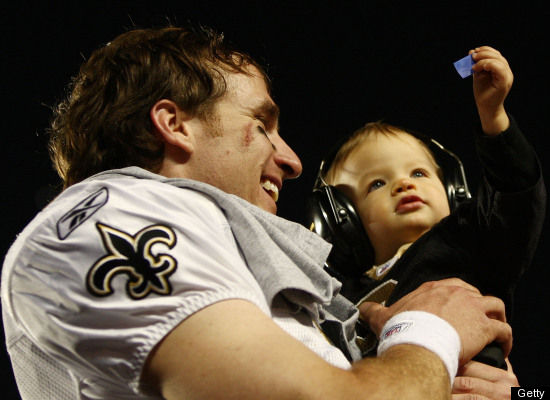
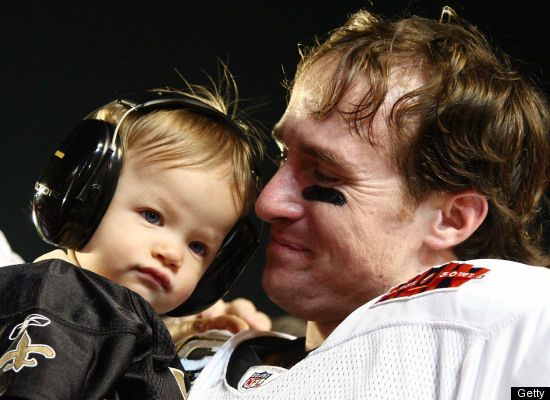
Drew Brees With His Son. Awwwwwwwww!
I don't care how manly you are, the pictures and videos of Drew Brees with his kid after the Saints won the Superbowl are just adorable

Obligatory SB Commercial Review
I think it's a constitutional amendment that everyone must share their opinion on the SB commercials. It's right there with Don't ask don't tell. So here is my abbreviated list of what I liked and what activated my gag relfex.
Like:
Gag reflex:
Like:
- Beaver playing the violin (monster.com)
- The Simpsons (coca-cola)
- Milkaholic babies (E-Trade)
Gag reflex:
- Mark Sanchez "You're important to me, especially if you watch football" (Female heart health, CBS)
- Tim Tebow with his mom (FocusOnTheFamily.com aka AbortionsAreEvil.com)
- Lebron and Dwight stupid, unrealistic dunk off (McDonalds)
Tom Izzo v. Bruce Weber FT Shooting Contest
Before the Illini upset #5 ranked Michigan St, Bruce Weber challenged Tom Izzo to a free throw shooting contest in an effort to raise money for Coaches vs Cancer. To quote Tom Izzo
Just as predicted, Izzo won the challenge 9 to 7, and both coaches pledged to donate $20k for cancer research. Kudos to them both. Maybe i'll put up a video of me draining it from the line one day. I'll challenge Izzo for his title any day
"It's something Bruce and I both believe in and this is a great way to let people know how much the cause matters to us."They believe in fighting cancer...as opposed to all those other Big 10 coaches who are totally against it. I love unorganized events like these that put athletes outside their comfort zone. Like the bowling match today prior to the Super Bowl between Chris Paul and LaMar Woodley(Chris Paul won). I pegged the contests as a 9 to 7(out of 10) victory for Tom Izzo, who is notorious for dominating the charity stripe. Luckily we have video evidence in HD
Just as predicted, Izzo won the challenge 9 to 7, and both coaches pledged to donate $20k for cancer research. Kudos to them both. Maybe i'll put up a video of me draining it from the line one day. I'll challenge Izzo for his title any day
Blame Jim Caldwell For The Loss
We can all agree that football is the one sport where the coach plays a significant role in deciding whether his team wins or loses. Scouting, scheming, and practicing are the main responsibilities of an NFL coach and often is the difference between winning and losing. Hence, if you are hiring a coach to run your franchise, it would be advantageous to hire someone with a history of winning games. I have been skeptical about Jim Caldwell's pedigree of running a winning franchise such as the Colts, btu have refrained from speaking up due to the great success the team displayed during the regular season. Oh, and his quarterback is Peyton freakin Manning. But looking back at all the late quarter comebacks, weak conference playoff opponents, and the poor performance in the super bowl, I have to speak the truth.
Here is Jim Caldwell's career coaching record in Wake Forest University. This was reported on SportsbyBrooks several months ago and is even more relevant today.
Wow, that's really bad. I know that Wake isnt exactly a football powerhouse, but since Caldwells departure, Jim Grobe has coached the Deamon Deacons to a 59-51 record. That's slightly better than Caldwell's .292 winning percentage as a coach. How does a guy with a .292 winning percentage get to coach Peyton Manning in the NFL? Not wanting to play the race card, but him and Dungy seen to have a bunch of melanin in common. Heck, Jim Grobe deserves to take over for Bill Belichick if he can double Caldwell's winning percentage at the same university in the exact same conference
Here is Jim Caldwell's career coaching record in Wake Forest University. This was reported on SportsbyBrooks several months ago and is even more relevant today.
Wow, that's really bad. I know that Wake isnt exactly a football powerhouse, but since Caldwells departure, Jim Grobe has coached the Deamon Deacons to a 59-51 record. That's slightly better than Caldwell's .292 winning percentage as a coach. How does a guy with a .292 winning percentage get to coach Peyton Manning in the NFL? Not wanting to play the race card, but him and Dungy seen to have a bunch of melanin in common. Heck, Jim Grobe deserves to take over for Bill Belichick if he can double Caldwell's winning percentage at the same university in the exact same conference
Trent Dilfer Sucks L.O.L.
Click To Enlarge

Trent Dilfer and Brad Johnson won Superbowls and were Superbowl MVPs. Further proof that you don't need a "franchise" or even good QB to get a ring. Sure it helps, but obviously not needed.
Also, Joe Namath is overrated. The man did a PHENOMINAL thing for football by helping to win Superbowl III to solidify the NFL for what it is today. But the dude threw more career INTs than TDs and was not that good of a player. Whatevs, maybe someday people will get it.

Trent Dilfer and Brad Johnson won Superbowls and were Superbowl MVPs. Further proof that you don't need a "franchise" or even good QB to get a ring. Sure it helps, but obviously not needed.
Also, Joe Namath is overrated. The man did a PHENOMINAL thing for football by helping to win Superbowl III to solidify the NFL for what it is today. But the dude threw more career INTs than TDs and was not that good of a player. Whatevs, maybe someday people will get it.
"Peterson Becoming A Liability"
These are the words that former Giants RB Tiki Barber uttered when talking about quote unquote, the best back in the game. It's been well documented that AD loved to cough up the ball and fumbles. A LOT. This year, Peterson led all running backs in fumbles. The same in 2008 and still coughed up the ball a fair amount is rookie year in 07 as well.
Fumbling was the major criticism I had of Peterson for what's preventing him from being considered the best running back in the game. In real life, as of now, I would take both Chris Johnson and Ray Rice ahead of AD and would have to think real hard about if I wanted MJD over AD. This should be a no-brainer; it should be Adrian Peterson hands down with his ability to make people miss and his break away speed. But because of his fumbling (and his lack of ability to catch the ball- but who really cares if you're as good of a runner as AD is), Peterson is still only top five.
There are obvious ways to addressing a fumbling problem. This isn't like baseball where you try to teach a player about how to walk more, this problem can be solved. Hell, Tiki had this problem early in his career (which I think makes this criticism much more valid). Last year, when Rashard Mendenhall has a fumbling problem in pre-season, his head coach Mike Tomlin forced Mendenhalll to walk around with a football at all times while his fellow teammates would try and knock the ball out of Mendenhall's hands. If a player did knock it out, Mendenhall would be punished.
But the easiest way for Peterson to stop fumbling is by changing the way he holds on to the ball. Right now, AD holds the ball away low and away from his body- making it significantly easier for defenders to strip the ball. Tiki suggests what is known as the "high-and-tight" style. Besides the obvious sexual innuendos I could make right now, this approach is pretty basic. You hold the ball up on your chest and close to your body. This makes it harder for defenders to strip the ball.
However, the best and the most constant way RBs hold on to the ball is that the hold on to the ball with your forearm. Hold on one end of the ball in your palm, place the other end against your bicep, and hold one side against your forearm. Doing this places pressure on multiple parts of your arm keeping the ball in place. Doing this allows allows flexibility in your movement because you can still swing your arms. Doing so also places enough pressure that makes it very difficult for defenders to knock the ball out of your hands, for even if they do hit and make contact with the ball, they will likely not knock the ball out of the ball carriers hands. (I swear I saw this on Sports Science I just can't find the clip where they do so. If you find it, please let me know)
There are clearly easy and doable solutions for Adrian Peterson to stop his fumbling problem and making him an even better back.
Fumbling was the major criticism I had of Peterson for what's preventing him from being considered the best running back in the game. In real life, as of now, I would take both Chris Johnson and Ray Rice ahead of AD and would have to think real hard about if I wanted MJD over AD. This should be a no-brainer; it should be Adrian Peterson hands down with his ability to make people miss and his break away speed. But because of his fumbling (and his lack of ability to catch the ball- but who really cares if you're as good of a runner as AD is), Peterson is still only top five.
There are obvious ways to addressing a fumbling problem. This isn't like baseball where you try to teach a player about how to walk more, this problem can be solved. Hell, Tiki had this problem early in his career (which I think makes this criticism much more valid). Last year, when Rashard Mendenhall has a fumbling problem in pre-season, his head coach Mike Tomlin forced Mendenhalll to walk around with a football at all times while his fellow teammates would try and knock the ball out of Mendenhall's hands. If a player did knock it out, Mendenhall would be punished.
But the easiest way for Peterson to stop fumbling is by changing the way he holds on to the ball. Right now, AD holds the ball away low and away from his body- making it significantly easier for defenders to strip the ball. Tiki suggests what is known as the "high-and-tight" style. Besides the obvious sexual innuendos I could make right now, this approach is pretty basic. You hold the ball up on your chest and close to your body. This makes it harder for defenders to strip the ball.
However, the best and the most constant way RBs hold on to the ball is that the hold on to the ball with your forearm. Hold on one end of the ball in your palm, place the other end against your bicep, and hold one side against your forearm. Doing this places pressure on multiple parts of your arm keeping the ball in place. Doing this allows allows flexibility in your movement because you can still swing your arms. Doing so also places enough pressure that makes it very difficult for defenders to knock the ball out of your hands, for even if they do hit and make contact with the ball, they will likely not knock the ball out of the ball carriers hands. (I swear I saw this on Sports Science I just can't find the clip where they do so. If you find it, please let me know)
There are clearly easy and doable solutions for Adrian Peterson to stop his fumbling problem and making him an even better back.
To Go For 19-0 or To Not Go For 19-0, That Is The Question
This was the big debate when both teams were 13-0. The Colts said (of course after they locked up home field advantage) that they would rest their players (which they did) in the games leading up to the playoffs. The Saints on the other hand, said they they were not going to rest their players and instead try and go 16-0 in the regular season.
Unfortunately for us, we will never knew which approach in better.
The Saints ended up losing to the Cowboys in a game they went all out for and didn't rest any players. After that loss, the Saints ended up resting their key players and the Colts acted like pussies and rested their stars and starters in the last one and a half games of the regular season.
It would have been nice if the Colts rested their players and the Saints didn't so this Superbowl can probably really decide once and for all which approach is better: resting or trying to go 19-0.
But of course, just another reason to hate the Colts.
Unfortunately for us, we will never knew which approach in better.
The Saints ended up losing to the Cowboys in a game they went all out for and didn't rest any players. After that loss, the Saints ended up resting their key players and the Colts acted like pussies and rested their stars and starters in the last one and a half games of the regular season.
It would have been nice if the Colts rested their players and the Saints didn't so this Superbowl can probably really decide once and for all which approach is better: resting or trying to go 19-0.
But of course, just another reason to hate the Colts.
Richard Dent Gets F@&^ed In The A$$
Richard Dent is one of the greatest DE ever. He was a part of the great 80's Bears teams, was the MVP of the '85 Superbowl, and was named to four Pro Bowls.
Oh, and he just happens to be sixth all time in sacks.
Each of at least the past three years, Dent is one of the finalist to be chosen to be a Hall of Famer, and yet each year, he seems to come up just short.
Mike Ditka told ESPNChicago recently that Dent belongs in the Hall of Fame. While Ditka was also Dent's head coach, I'm going to take those comments with a grain of salt. However, Ditka is absolutely right.
There is no good reason the voters keep leaving him out. Unfortunately, I feel this is going to be a Bert Blyleven scenario where he keeps getting so close, deserves to go, but won't go until he passes away when everyone will mourn him and remember him for his greatness
Oh, and he just happens to be sixth all time in sacks.
Each of at least the past three years, Dent is one of the finalist to be chosen to be a Hall of Famer, and yet each year, he seems to come up just short.
Mike Ditka told ESPNChicago recently that Dent belongs in the Hall of Fame. While Ditka was also Dent's head coach, I'm going to take those comments with a grain of salt. However, Ditka is absolutely right.
There is no good reason the voters keep leaving him out. Unfortunately, I feel this is going to be a Bert Blyleven scenario where he keeps getting so close, deserves to go, but won't go until he passes away when everyone will mourn him and remember him for his greatness
Devin Hester: DeSean Jackson or Joshua Cribbs?
TBO once said to me about Hester being a wide out and a kick returner (possibly on a podcast, but I don't think so): how many guys do you see that's both the teams #1 wide receiver and also their punt returner? You don't see Randy Moss or TO out there on special teams do you? Why do the Bears think Hester can do the same? (I might be paraphrasing a little, and by a little I mean a lot). This was before Cribbs and Jackson became prominent on their respected teams, and he brought up a good point.
But with the advent of the stellar season that DeSean Jackson had both in the special teams game and being the teams number one and best receiver (in fact Jackson was named to the Pro Bowl twice in 2010- for being a wide receiver and a kick returner), it is clear that there is nothing inherent preventing a player from being both a great kick returner and receiver.
But then we have an example of what mostly happens- Josh Cribbs. After a few years, when Hester's talent seemingly inevitably declined, Josh Cribbs took his place as the best return man in the game (fun fact: both Hester and Cribbs were named to the NFL's all decade team, Hester as a punt returner and Cribbs and a kick returner). And what the Bears did with Hester, the Browns did with Cribbs- made the man the teams number one receiver. And the same happened happened to both guys- they sucked in their respected offenses.
After years of the Bears promising us fans that Devin Hester would be the teams' number one receiver, and even after the team finally got a QB able of actually making completions to his receiver (and of course to the other teams as well...), I am declaring the Devin Hester experiment over. I think Devin has come to this conclusion as well. Last Thursday, ESPNChicago reported that Devin wants a bigger role in the return game and if it comes as a sacrifice to him being a wide out, so be it.
I said (Click on the "PODCAST" link on the top and listen to the one with me and Keith on 7.7.09, see 7:50 into it) before the 2009/10 season that after 8 games, if Hester is sucking as both a receiver and a returner- make him a full time returner. Of course, the Bears didn't listen to me and Hester was the teams #1 wide out and had limited work returning. As it turns out, Johnny Knox was the teams best kick returner (Danieal Manning was the teams best last year) and Devin Aromashodu was the teams best receiver (don't deny it, plus DA had one more TD in 7 less games).
Last year, Hester had 57 receptions for 757 yards and 3 TDs, 31 returns for 434 yards (both on punts and kick returns), and 6 rushing attempts for -1 yards.
DeSean Jackson had 63 receptions for 1167 yards (about 1055 if he had 57 receptions) and 9 TDs, 30 returns for 441 yards and 2 TDs, and 11 rushes for 137 yards and a TD.
Joshua Cribbs had 20 receptions for 135 yards and a TD (504 yards if he had 57 receptions) and a TD, 94 returns for 1994 yards and 4 TDs, and 55 rushes for 381 yards and a TD.
Plato talks about in The Republic, that in a perfect society, each person should do the job they were meant to do. You could be a great carpenter but if you were meant to be an ever better warrior, then you are doing a disservice to society by being a carpenter over a warrior. The same logic applies to Devin Hester. The man was on his way (maybe even there) to being the best return man of all time. Then the Bears made him a wide receiver and both his skills as a returner and a wide out diminished.
When the Bears made Hester a wide out, they really didn't have any other options. However, with a corps of DA, Johnny Knox, and Earl Bennett (all being a different type of receiver) and having Joaquin Iglesias and, uh, I don't know, Rashied Davis be the teams 4th and 5th receiver- there's not even a need to make Hester a receiver anymore.
Devin Hester is clearly MUCH more like Joshua Cribbs than DeSean Jackson and the Bears (and the Browns) should treat him as such. Let the man do what he do best- make him a full time punt returner, and stop putting him in the offense.
But with the advent of the stellar season that DeSean Jackson had both in the special teams game and being the teams number one and best receiver (in fact Jackson was named to the Pro Bowl twice in 2010- for being a wide receiver and a kick returner), it is clear that there is nothing inherent preventing a player from being both a great kick returner and receiver.
But then we have an example of what mostly happens- Josh Cribbs. After a few years, when Hester's talent seemingly inevitably declined, Josh Cribbs took his place as the best return man in the game (fun fact: both Hester and Cribbs were named to the NFL's all decade team, Hester as a punt returner and Cribbs and a kick returner). And what the Bears did with Hester, the Browns did with Cribbs- made the man the teams number one receiver. And the same happened happened to both guys- they sucked in their respected offenses.
After years of the Bears promising us fans that Devin Hester would be the teams' number one receiver, and even after the team finally got a QB able of actually making completions to his receiver (and of course to the other teams as well...), I am declaring the Devin Hester experiment over. I think Devin has come to this conclusion as well. Last Thursday, ESPNChicago reported that Devin wants a bigger role in the return game and if it comes as a sacrifice to him being a wide out, so be it.
I said (Click on the "PODCAST" link on the top and listen to the one with me and Keith on 7.7.09, see 7:50 into it) before the 2009/10 season that after 8 games, if Hester is sucking as both a receiver and a returner- make him a full time returner. Of course, the Bears didn't listen to me and Hester was the teams #1 wide out and had limited work returning. As it turns out, Johnny Knox was the teams best kick returner (Danieal Manning was the teams best last year) and Devin Aromashodu was the teams best receiver (don't deny it, plus DA had one more TD in 7 less games).
Last year, Hester had 57 receptions for 757 yards and 3 TDs, 31 returns for 434 yards (both on punts and kick returns), and 6 rushing attempts for -1 yards.
DeSean Jackson had 63 receptions for 1167 yards (about 1055 if he had 57 receptions) and 9 TDs, 30 returns for 441 yards and 2 TDs, and 11 rushes for 137 yards and a TD.
Joshua Cribbs had 20 receptions for 135 yards and a TD (504 yards if he had 57 receptions) and a TD, 94 returns for 1994 yards and 4 TDs, and 55 rushes for 381 yards and a TD.
Plato talks about in The Republic, that in a perfect society, each person should do the job they were meant to do. You could be a great carpenter but if you were meant to be an ever better warrior, then you are doing a disservice to society by being a carpenter over a warrior. The same logic applies to Devin Hester. The man was on his way (maybe even there) to being the best return man of all time. Then the Bears made him a wide receiver and both his skills as a returner and a wide out diminished.
When the Bears made Hester a wide out, they really didn't have any other options. However, with a corps of DA, Johnny Knox, and Earl Bennett (all being a different type of receiver) and having Joaquin Iglesias and, uh, I don't know, Rashied Davis be the teams 4th and 5th receiver- there's not even a need to make Hester a receiver anymore.
Devin Hester is clearly MUCH more like Joshua Cribbs than DeSean Jackson and the Bears (and the Browns) should treat him as such. Let the man do what he do best- make him a full time punt returner, and stop putting him in the offense.
The Unemployed Free Agency Team
Floating around in the netherworld of free agency are a plethora of valuable players, many who could be had at Wal-Mart-like prices. How good are these players? Let's build a 25-man roster of free agency players and use their CHONE-based projected 2010 WARs (for hitters, playing time weighted BRAR+FRAR+Positional+Replacement) to find out.
C-Rod Barajas (+1.9)
C-Yorvit Torrealba (+1.0)
1B-Carlos Delgado (+1.0)
2B-Adam Kennedy (+1.0)
SS-Felipe Lopez (+1.3 as SS/+2.2 as 2B)
3B-Russell Branyan (+3.3 as 3B/+2.4 as 1B)
MI-Rich Aurilia (-0.5)
CI-Joe Crede (+2.1)
LF-Jonny Gomes (+1.0)
CF-Johnny Damon (+3.1 as CF/+3.2 as RF/LF)
RF-Rocco Baldelli (+1.6)
OF-Garrett Anderson (+0.5)
DH-Jermaine Dye (+1.0)
TOTAL = +16.8 WAR
SP-Chien-Ming Wang (+2.5)
SP-Jarrod Washburn (+1.8)
SP-John Smoltz (+2.5)
SP-Erik Bedard (+2.4)
SP-Pedro Martinez (+1.5)
RP-Kiko Calero
RP-Russ Springer
RP-Joe Beimel
RP-Chad Bradford
RP-Chan Ho Park
RP-Will Ohman
CL-Mike MacDougal
24 hours ago, before Orlando Hudson (+2.2) signed, this team would have looked much better.
_____
Edit: Since writing this post, Yorvit Torrealba, Adam Kennedy and Erik Bedard have signed with teams.
C-Rod Barajas (+1.9)
C-Yorvit Torrealba (+1.0)
1B-Carlos Delgado (+1.0)
2B-Adam Kennedy (+1.0)
SS-Felipe Lopez (+1.3 as SS/+2.2 as 2B)
3B-Russell Branyan (+3.3 as 3B/+2.4 as 1B)
MI-Rich Aurilia (-0.5)
CI-Joe Crede (+2.1)
LF-Jonny Gomes (+1.0)
CF-Johnny Damon (+3.1 as CF/+3.2 as RF/LF)
RF-Rocco Baldelli (+1.6)
OF-Garrett Anderson (+0.5)
DH-Jermaine Dye (+1.0)
TOTAL = +16.8 WAR
SP-Chien-Ming Wang (+2.5)
SP-Jarrod Washburn (+1.8)
SP-John Smoltz (+2.5)
SP-Erik Bedard (+2.4)
SP-Pedro Martinez (+1.5)
RP-Kiko Calero
RP-Russ Springer
RP-Joe Beimel
RP-Chad Bradford
RP-Chan Ho Park
RP-Will Ohman
CL-Mike MacDougal
24 hours ago, before Orlando Hudson (+2.2) signed, this team would have looked much better.
_____
Edit: Since writing this post, Yorvit Torrealba, Adam Kennedy and Erik Bedard have signed with teams.
Russell Branyan & Structural Unemployment
Structural unemployment results from a mismatch of workers and jobs. Even if there are an equal number of job vacancies and unemployed workers, the unemployed may lack the necessary skills for the specifically available jobs or they may not be in the right geographic location to fill the open positions (ie, unemployed guy who fits a job vacancy in NY lives in TX). Structural unemployment is the result of a changing economy; demands and needs change with time and perception. The scarcity of resources causes employers to reallocate their resources to produce more efficient outcomes. The result is that some skills become obsolete and other positions just plain disappear.
This economic term is quite prevalent in modern baseball. In the post-Moneyball world, teams have become "smarter" (well, teams not run by Omar Minaya, Dayton Moore, Ed Wade and Brian Sabean generally have) even though payrolls have generall expanded. Teams (again, those not run by Omar Minaya, Dayton Moore, Ed Wade and Brian Sabean) look less superficial statistics like ERA and BA and more at actual production. Teams have shyed away from spending big on aging players in their twilight years and on free-market influenced free agency players and they have focused more on drafting, acquiring and developing prospects. In the process of transition, some players who are still productive have been left in the dust. Players like Kenny Lofton were forced into retirement, while the market has completely dropped out for the Jim Thome's of the world. True, it is unwise to spend equal or more money on older players, even if they are comparably productive to younger players. However, this does not necessarily make the older players "useless." While it is not a bad idea to fill team holes with young, cost-controlled players who will provide equivalent value to what can be had on the free market at a fraction of the price, there are some very important factors to consider when deciding whether to go internal or external. What is the marginal WAR value between the internal player and the free agency player? How much extra will the external player cost? What is your team's competitive position?
When teams with a chance to make the playoffs are in a highly competitive environment, the marginal value of a win likely exceeds the market cost. Additionally, filling a hole with an internal +1.5 WAR, $400,000 player rather than a +4 WAR, $8 million dollar player seems silly. It is also silly to fill the DH role with a player whose cumulative value comes from his defense just because they are cheaper.
 Acknowledging all of this -- the economics and the questions which must be asked in determining whether to go the internal or free agency route -- I turn to Russell Branyan and ask why the Mets have not signed him. The Mets are a team with a strong enough core of expensive superstars to legitimately compete for a wild card berth if the team can stay health in 2010. Without the services of a Jose Reyes and Carlos Delgado, with only half-season from Johan Santana and Carlos Beltran, and without a productive David Wright last season, the Mets were a 70-92 team. Pretty lousy, but there's a lot of reason to think they're a +.500 team as built. If we double Johan's production from last season and add the value provided by the career average rates of Reyes, Beltran, and Wright, the Mets in theory gain +13 WAR.
With Carlos Delgado seemingly out of the picture (injury prone, aging, seeking too much money), the Mets have a hole at first base. The team seems content using David Murphy and Fernando Tatis platoon at first. CHONE pegs Murphy as a -4 bat and +1 glove per 150 games and Tatis as a -2 bat and +1 glove per 150 games. In a platoon, let's take the cumulative average at -2 runs. Factor in a -12.5 positional adjustment and +20.0 replacement adjustment and you've got a +1 WAR player at best.
Russell Branyan, meanwhile, is sitting in free agency without a job. Yes, the Mets probably don't want to touch an injury risk player with a 10 foot poll after 2009, but Branyan might be worth it. In 505 PA last season, Branyan put up a respectable +2.8 WAR, 31 HR season despite posting a brutal .688 OPS in 268 PA while playing with a back injury.
Despite the injury and ridiculously poor second half, Branyan still posted a quality .251/.347/.520 (.867 OPS, .368 wOBA) triple slash line with a .307 BABIP and .313 xBABIP. This says a .850 OPS, .360 wOBA season is not entirely implausible. Branyan is also a league average glove. CHONE forecasts Branyan as a +16 run bat and +0 run glove per 150 games. Add in the -12.5 positional and +20.0 replacement adjustments and you get a +2.5 WAR player.
After setting his sights high and seeking a 3-year, $20-30 million deal at the beginning of the offseason, Branyan is now willing to settle for a deal in the one-year, $3 million dollar range. The Mets, in effect, would gain +1.5 WAR (over Tatis/Murphy) by signing Branyan to play first at the marginal cost of $3 million. That would be less than the market value of a single WAR.
No matter how you slice it, this would be a good signing for the Mets. Branyan would add value to the team at a good price and even if the Mets don't end up in a competitive position by mid-season, they could trade the cost-controlled asset to a team who is. This late in the season, open 1B/DH roles are few and far between. The Mets make the most sense for Branyan and Branyan makes the most sense for the Mets. I'm shocked Minaya has not inquired on Branyan's services yet. Probably because Branyan is white.
This economic term is quite prevalent in modern baseball. In the post-Moneyball world, teams have become "smarter" (well, teams not run by Omar Minaya, Dayton Moore, Ed Wade and Brian Sabean generally have) even though payrolls have generall expanded. Teams (again, those not run by Omar Minaya, Dayton Moore, Ed Wade and Brian Sabean) look less superficial statistics like ERA and BA and more at actual production. Teams have shyed away from spending big on aging players in their twilight years and on free-market influenced free agency players and they have focused more on drafting, acquiring and developing prospects. In the process of transition, some players who are still productive have been left in the dust. Players like Kenny Lofton were forced into retirement, while the market has completely dropped out for the Jim Thome's of the world. True, it is unwise to spend equal or more money on older players, even if they are comparably productive to younger players. However, this does not necessarily make the older players "useless." While it is not a bad idea to fill team holes with young, cost-controlled players who will provide equivalent value to what can be had on the free market at a fraction of the price, there are some very important factors to consider when deciding whether to go internal or external. What is the marginal WAR value between the internal player and the free agency player? How much extra will the external player cost? What is your team's competitive position?
When teams with a chance to make the playoffs are in a highly competitive environment, the marginal value of a win likely exceeds the market cost. Additionally, filling a hole with an internal +1.5 WAR, $400,000 player rather than a +4 WAR, $8 million dollar player seems silly. It is also silly to fill the DH role with a player whose cumulative value comes from his defense just because they are cheaper.
 Acknowledging all of this -- the economics and the questions which must be asked in determining whether to go the internal or free agency route -- I turn to Russell Branyan and ask why the Mets have not signed him. The Mets are a team with a strong enough core of expensive superstars to legitimately compete for a wild card berth if the team can stay health in 2010. Without the services of a Jose Reyes and Carlos Delgado, with only half-season from Johan Santana and Carlos Beltran, and without a productive David Wright last season, the Mets were a 70-92 team. Pretty lousy, but there's a lot of reason to think they're a +.500 team as built. If we double Johan's production from last season and add the value provided by the career average rates of Reyes, Beltran, and Wright, the Mets in theory gain +13 WAR.
With Carlos Delgado seemingly out of the picture (injury prone, aging, seeking too much money), the Mets have a hole at first base. The team seems content using David Murphy and Fernando Tatis platoon at first. CHONE pegs Murphy as a -4 bat and +1 glove per 150 games and Tatis as a -2 bat and +1 glove per 150 games. In a platoon, let's take the cumulative average at -2 runs. Factor in a -12.5 positional adjustment and +20.0 replacement adjustment and you've got a +1 WAR player at best.
Russell Branyan, meanwhile, is sitting in free agency without a job. Yes, the Mets probably don't want to touch an injury risk player with a 10 foot poll after 2009, but Branyan might be worth it. In 505 PA last season, Branyan put up a respectable +2.8 WAR, 31 HR season despite posting a brutal .688 OPS in 268 PA while playing with a back injury.
Despite the injury and ridiculously poor second half, Branyan still posted a quality .251/.347/.520 (.867 OPS, .368 wOBA) triple slash line with a .307 BABIP and .313 xBABIP. This says a .850 OPS, .360 wOBA season is not entirely implausible. Branyan is also a league average glove. CHONE forecasts Branyan as a +16 run bat and +0 run glove per 150 games. Add in the -12.5 positional and +20.0 replacement adjustments and you get a +2.5 WAR player.
After setting his sights high and seeking a 3-year, $20-30 million deal at the beginning of the offseason, Branyan is now willing to settle for a deal in the one-year, $3 million dollar range. The Mets, in effect, would gain +1.5 WAR (over Tatis/Murphy) by signing Branyan to play first at the marginal cost of $3 million. That would be less than the market value of a single WAR.
No matter how you slice it, this would be a good signing for the Mets. Branyan would add value to the team at a good price and even if the Mets don't end up in a competitive position by mid-season, they could trade the cost-controlled asset to a team who is. This late in the season, open 1B/DH roles are few and far between. The Mets make the most sense for Branyan and Branyan makes the most sense for the Mets. I'm shocked Minaya has not inquired on Branyan's services yet. Probably because Branyan is white.
Verlander or King Felix?
According to AP (through ESPN), the Tigers and Justin Verlander have come to an agreement on a five-year, $80 million deal. This comes on the heels of King Felix's five-year, $78 million dollar deal. In terms of value, both pitchers are quite comparable. Since 2006, Verlander has been worth +3.1, +4.1, +3.4, and +8.2 WAR; cumulatively +18.8 WAR. King Felix, on the other hand, has posted +3.8, +4.1, +3.9, and +6.9 WAR seasons in that same time frame (he also posted a +2.6 WAR half-season in 2005); cumulatively, +18.6 WAR. On the surface, the two pitchers seem equally worthy of the deals they signed. The current market value of 1 WAR is approximately $3.5 million. If we pessimistically assess both pitchers as +4.5 WAR players each of the next five years, then each would provide their respective team with +22.5 WAR, or $78.5 million in free agency value. It would seem like both the Tigers and Mariners are simply locking each pitcher up "at market value," but its important to note that 1) premium arms tend to come at a premium price and 2) each team is in such a position to compete for a playoff position that the marginal value of a win may be worth more than market value. This assessment of "market value" also assumes that both Verlander and King Felix average "only" +4.5 WAR per season through their prime years.
Though I see both contracts as quality signings for their respective teams, it is an important question to ask whether or not Verlander deserves more money than King Felix. Verlander has a negligibly higher cumulative WAR since 2006 and 7 more wins in 6 less starts than Felix Hernandez, but King Felix bests Verlander in terms of career numbers in the following categories:
Taking all of this data as a whole, I would say that Felix Hernandez is the one who deserves the higher paid contract. Verlander had the better breakout year, but in both fantasy and real life terms, King Felix will be the more valuable (and younger player). Felix already has better peripherals and -- based on age, defense and park dimensions -- seemingly more superficial upside come years four and five of the contract.
In the short term, however, both players should provide comparable value. CHONE pegs Justin Verlander as being worth +49 runs prevented compared to the average pitcher (RPAA) over 194 IP, while Felix Hernandez is projected as a +50 RPAA pitcher per 200 IP.
Though I see both contracts as quality signings for their respective teams, it is an important question to ask whether or not Verlander deserves more money than King Felix. Verlander has a negligibly higher cumulative WAR since 2006 and 7 more wins in 6 less starts than Felix Hernandez, but King Felix bests Verlander in terms of career numbers in the following categories:
- ERA (3.45 v. 3.92)
- FIP (3.54 v. 3.78)
- xFIP (3.43 v. 4.14)
- BB/9 (2.68 v. 3.02)
- K/9 (8.18 v. 7.99)
- GB% (53.4% v 39.7%)
- Age (born in 1986 v. 1983)
Taking all of this data as a whole, I would say that Felix Hernandez is the one who deserves the higher paid contract. Verlander had the better breakout year, but in both fantasy and real life terms, King Felix will be the more valuable (and younger player). Felix already has better peripherals and -- based on age, defense and park dimensions -- seemingly more superficial upside come years four and five of the contract.
In the short term, however, both players should provide comparable value. CHONE pegs Justin Verlander as being worth +49 runs prevented compared to the average pitcher (RPAA) over 194 IP, while Felix Hernandez is projected as a +50 RPAA pitcher per 200 IP.
The Worst General Manager In Baseball Competition (round 1)
Bad trades, bad signings, bad drafting. Terrible GM's run amok in the world of baseball. Jim Beattie, Woody Woodward, Dave Littlefield, Randy Smith, Steve Phillips. Yes, Baseball has had some terrible GMs running major franchises, often into the ground (though Matt Millen is perhaps the worst sports GM of all time). But of those persisting at the beginning of 2009, who can we say is the worst? Enter this competition. There are 30 current GMs across 6 divisions. Some are too new to evaluate, so we'll use their predecessors.
This is round 1 of voting. In round 1, cast your vote for the two worst GMs of each division. The two GMs with the most votes for "worst GM" will move on to round two. Voting for round 1 will be open until February 12. You can cast your vote by clicking the giant blue link atop the page or by clicking HERE (sorry, voting for round 1 has closed).
This is round 1 of voting. In round 1, cast your vote for the two worst GMs of each division. The two GMs with the most votes for "worst GM" will move on to round two. Voting for round 1 will be open until February 12. You can cast your vote by clicking the giant blue link atop the page or by clicking HERE (sorry, voting for round 1 has closed).

Jay Mariotti Is Officially The Worst Sports Announcer In The World
Ladies and gentlemen, the competition is over. 32 men walked into the ring, only one man is left standing. That man (if you can call him one) is Jay Mariotti. It was a close vote, but someone had to win. Though Joe Morgan and Joe Buck will always be the worst sports announcers in my mind, Mariotti takes the honors tonight. His daily mumbo jumbo on Around The Horn is terrible; his sports columns are terrible; his personality is terrible. When it comes to sucking, there are few worse than ex-Sun Times writer (if you can call what he does writing) Jay Mariotti. Ozzie Guillen would surely approve of this award.
As Keith Olbermann would say, "he's the worst sports announcer, in the woooooorld."
Congratulations Jay Mariotti. You make our ears bleed harder than anyone else.
Vote results below (click to enlarge). Thank you to EVERYONE for voting!

As Keith Olbermann would say, "he's the worst sports announcer, in the woooooorld."
Congratulations Jay Mariotti. You make our ears bleed harder than anyone else.
Vote results below (click to enlarge). Thank you to EVERYONE for voting!

Dusty Baker Update: Yonder Alonso
We at Game Of Inches have done our share of Dusty Baker hating. Some may say we are picking on him, but he's really just picking on himself. When he's not to busy devising ways to break pitchers and telling his players to stop walking, he's deviously plotting other ways to play baseball backwards. Such ways include playing a guy with a DH's body and surgically repaired right hand, who has never played catcher ever in his life, at catcher. No really. I'm actually not kidding. Here is what Baker said at a press conference yesterday:
And so is born the tag to monitor Dusty Baker's persistent gallimaufry.
"We've entertained a few things, even the possibility of putting Alonso behind the plate. He's built more like a catcher than he is anything. Imagine a left-handed, power-hitting catcher. A lot of that depends on our Minor League development people that spend time with the kids and the time training them."A lot of it also depends on whether or not that player has ever played catcher, a physically demanding position, before. Alonso has not. It's not like they moved Mike Piazza BEHIND the plate...
And so is born the tag to monitor Dusty Baker's persistent gallimaufry.